High wind and rain in the night. Still more strong and gusty but remarkably warm southwest wind during the day.
P. M. – To Fair Haven Hill by boat with W. E. C.
We rowed against a very powerful wind, sometimes scarcely making any headway. It was with difficulty often that we moved our paddles through the air for a new stroke. As C. said, it seemed to blow out of a hole. We had to turn our oars edgewise to it. But we worked our way slowly upward, nevertheless, for we came to feel and hear it blow and see the waves run.
There was quite a sea running on the lee shore, – broad black waves with white crests, which made our boat toss very pleasantly. They wet the piers of the railroad bridge for eighteen inches up. I should guess that the whole height from the valley between to the top of a wave was nearer fifteen inches.
The muskrats have added a new story to their houses since the last flood which covered them; I mean that of October 31st and thereabouts.
They are uncommonly high, methinks, full four feet by five or more in diameter, a heaping ox-cart load. There are at least eight such within half a mile from Clamshell Hill to Hubbard's Wood. It is remarkable how little effect the waves have on them, while a heap of manure or a haycock would be washed away or undermined at once.
I opened one. It was composed of coarse grass, pontederia stems, etc., etc., not altogether in mouthfuls. This was three feet and a half above water, others quite four.
After taking off a foot I came to the chamber. It was a regularly formed oval or elliptical chamber, about eighteen inches the longest way and seven or eight inches deep, shaped like a pebble, with smooth walls of the weeds, and bottomed or bedded with a very little drier grass, a mere coating of it. It would hold four or five, closely packed.
The entrance, eight or nine inches wide, led directly from this to the water at an angle of 45°, and in the water there I saw some green and white stub ends of pontederia (?) stems, I think, looking like flagroot.
That thick wall, a foot quite or more above and eighteen inches or two feet around, being of these damp material, soon freezes and makes a tight and warm house. The walls are of such [thickness at] the bottom that the water in the gallery probably never freezes. If the height of these houses is any sign of high or low water, this winter it will be uncommonly high.
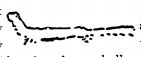
Soon after, we saw a mink swimming in the agitated water close to the shore, east side, above Nut Meadow Brook. It showed the whole top of the back and part of the tail, unlike the muskrat, and did not dive. Stopped a moment when we headed toward it, and held up its head at the end of its long neck toward us, reminding me of pictures of the otter, then turned and swam and ran the other way; dark-brown.
We see no birds, unless one crow; the wind is too strong for them.
I must know what that tall, coarse grass is which stands withered so abundantly amid the button-bushes all along the shore. It escapes the mower by its position. The water milkweed stands withered amid the button-bushes, the pods still erect, though open and empty.
Landed and walked over Conant's Indian rye-field, and I picked up two good arrowheads.
The river with its waves has a very wild look southward, and I see the white caps of the waves in Fair Haven Bay.
Went into the woods by Holden Swamp and sat down to hear the wind roar amid the tree-tops. What an incessant straining of the trees! It is a music that wears better than the opera, methinks. This reminds me how the telegraph-wire hummed coarsely in the tempest as we passed under it.
Hitherto it had only rained a little from time to time, but now it began suddenly in earnest. We hastily rowed across to the firm ground of Fair Haven Hill-side, drew up our boat and turned it over in a twinkling on to a clump of alders covered with cat-briars which kept up the lee side, and crawled under it.
There we lay half an hour on the damp ground and cat-briars, hardly able to see out to the storm which we heard on our roof, through the thick alder stems, much pleased with the tightness of our roof, which we frequently remarked upon. We took immense satisfaction in the thoroughness of the protection against the rain which it afforded.
Remembered that such was the origin of the Numidian architecture and, as some think, of the nave (ship) in Gothic architecture, and if we had had a dry bed beneath us, and an ugly gap under the windward side of the boat through [which] the wind drew had been stopped, we should have lain there longer.
At length, as it threatened to be an all-night storm, we crawled out again and set sail homeward. It now began to rain harder than ever, and the wind was so strong and gusty, and blew so nearly at right angles with the river, that we found it impossible to keep the stream long at a time with our sail set, sitting on one side till the water came in plentifully, that the side might act as a keel, but were repeatedly driven ashore amid the button-bushes, and then had to work our way to the other side slowly and start again.
What with water in the boat and in our clothes, we were now indifferent to wet. At length it began to rain so much harder than before, the great drops seeming to flat down the waves and suppress the wind, and feeling like hail on our hands and faces, that, as we remembered, it had only sprinkled before.
By this time of course we were wet quite through and through, and C. began to inquire and jest about the condition of our money – a singular prudence methought – and buried his wallet in his pocket-handkerchief and returned it to his pocket again. He thought that bank-bills would be spoiled. It had never occurred to me if a man got completely wet through how it might affect the bank-bills in his wallet, it is so rare a thing for me to have any there.
At length we both took to rowing vigorously to keep ourselves warm, and so got home just after candlelight.
H. D. Thoreau, Journal, November 9, 1853


