Monday, June 9, 2014

The yellow-throated vireo I hear now.

June 9.

June 9, 2017

I should like to know the birds of the woods better, what birds inhabit our woods? I hear their various notes ringing through them. What musicians compose our woodland quire? They must be forever strange and interesting to me. 

How prominent a place the vireos hold! It is probably the yellow-throated vireo I hear now, — a more interrupted red-eye with its prelia — prelioit or tully-ho, — invisible in the tops of the trees.

7 p. m. — Up Assabet.  Chimney and bank swallows are still hovering over the river, and cherry-birds fly past. The veery rings, and the tree- toad. 

The air is now full of shad-flies, and there is an incessant sound made by the fishes leaping for their evening meal, dimpling the river like large drops as far as I can see, sometimes making a loud plashing.

Meanwhile the kingfishers are on the lookout for the fishes as they rise.  I see one dive in the twilight and go off uttering his cr-r-ack, cr-r-rack

The mosquitoes encircle my head and torment me, and I see a great moth go fluttering over the tree-tops and the water, black against the sky, like a bat. The fishes continue to leap by moonlight. A full moon.

H. D. Thoreau, Journal, June 9, 1854

 It is probably the yellow-throated vireo I hear now, —  . . . with its prelia — prelioit or tully-ho, — invisible in the tops of the trees. See May 27, 1854 ("I see and hear the yellow-throated vireo. It is somewhat similar (its strain) to that of the red-eye, prelia pre-li-ay, with longer intervals and occasionally a whistle like tlea tlow, or chowy chow, or tully ho on a higher key. It flits about in the tops of the trees."); See also A Book of the Seasons, by Henry Thoreau, The Yellow-throated Vireo

The air is now full of shad-flies, and there is an incessant sound made by the fishes leaping for their evening meal. 
See June 9, 1856 ("Again, about seven, the ephemera came out, in numbers as many as last night, ...; and the fishes leap as before. . . "); June 8, 1856 (“my boat being by chance at the same place where it was in ’54, I noticed a great flight of ephemera”)

June 9. See A Book of the Seasons, by Henry Thoreau, June 9

I should know the birds –
they must be forever strange 
and interesting

the yellow-throated
vireo invisible
in the tops of trees

"A book, each page written in its own season,
out-of-doors, in its own locality.”
~edited, assembled and rewritten by zphx © 2009-2024
tinyurl.com/hdt-540609

.


*** 

P . M . – To Well Meadow .

The summer aspect of the river begins perhaps when the Utricularia vulgaris is first seen on the surface, as yesterday.
As I go along the railroad causeway, I see in the cultivated grounds, a lark flashing his white tail, and showing his handsome yellow breast, with its black crescent like an Indian locket. For a day or two I have heard the fine seringo note of the cherry - birds, and seen them flying past, the only ( ? ) birds, methinks, that I see in small flocks now, except swallows.         
 The willow down and seeds are blowing over the causeway.         
 Veronica scutellata, apparently several days.         
 A strawberry half turned on the sand of the causeway side, — the first fruit or berry of the year that I have tasted.         
 Ladies’-slippers are going to seed. I see some white oak pincushions, nearly two inches through.         
Is that galium, out apparently some days in the woods by Deep Cut, near Linnæa, triflorum or Aparine ?. Compare that at Lee ' s. 

I should like to know the birds of the woods better, what birds in habit our woods?
 
I hear their various notes ringing through them.         
What musicians compose our wood land quire ? They must be forever strange and interesting to me.         
How prominent a place the vireos hold ! It is probably the yellow - throated vireo I hear now, — a more interrupted red- eye with its prelia - prelioit or tully - ho, — invisible in the tops of the trees.      
   
 I see the thick, flower - like huckleberry apples.           
Haynes (?), Goodwin ' s comrade, tells me that he used to catch mud turtles in the ponds behind Provincetown with a toad on a mackerel hook thrown into the pond and the line tied to a stump or stake on shore.         
Invariably the turtle when hooked crawled up, following the line to the stake, and was there found waiting — Goodwin baits minks with muskrats.


Find the great fringed orchis out apparently two or three days.

Two are almost fully out, two or three only budded.
 A large spike of peculiarly delicate pale-purple flowers growing in the luxuriant and shady swamp is remarkable that this, one of the fairest of all our flowers, should also be one of the rarest, — for the most part not seen at all. 
I think that no other but myself in Concord annually finds it. 
That so queenly a flower should annually bloom so rarely and in such : withdrawn and secret places as to be rarely seen by man ! The village belle never sees this more delicate belle of the swamp. 
How little relation between our life and its ! Most of us never see it or hear of it. 
The seasons go by to us as if it were not. 
A beauty reared in the shade of a convent, who has never strayed beyond the convent bell.
  Only the skunk or owl or other inhabitant of the swamp beholds it. 
In the damp twilight of the swamp, where it is wet to the feet. 
 How little anxious to display its attractions ! It does not pine because man does not admire it. 
 How independent on our race ! It lifts its delicate spike amid the hellebore and ferns in the deep shade of the swamp. 
 I am inclined to think of it as a relic of the past as much as the arrowhead, or the tomahawk I found on the 7th.       
Ferns are four or five feet high there.         


7 P. M. — Up Assabet.
         
The tupelo stamens are loose and will perhaps shed pollen to- morrow or next day.
 
 It is twilight, and the river is covered with that dusty lint, as was the water next the shore at Walden this afternoon.
  Chimney and bank swallows are still hovering over the river, and cherry-birds fly past.
 The veery rings, and the tree toad. 

The air is now pretty full of shad-flies, and there is an incessant sound made by the fishes leaping for such as are struggling on the surface ; it sounds like the lapsing of a swift stream, sucking amid rocks.
 The fishes make a business of thus getting their evening meal, dimpling the river like large drops as far as I can see, sometimes making a loud plashing. 
Meanwhile the kingfishers are on the lookout for the fishes as they rise, and I saw one dive in the twilight and go off utter ing his cr-r-ack, cr-r-rack. 
The mosquitoes encircle my head and torment me, and I see a great moth go fluttering over the tree-tops and the water, black against the sky, like a bat. 
The fishes continue to leap by moonlight.
 A full moon.


 Covered with disgrace, this State has sat down coolly to try for their lives the men who attempted to do its duty for it.
         And this is called justice! They who have shown that they can behave particularly well, — they alone are put under bonds “for their good behavior !” Such a judge and court are an impertinence. 
           Only they are guiltless who commit the crime of contempt of such a court.
            It behooves every man to see that his influence is on the side of justice, and let the courts make their own characters.
            What is any political organization worth, when it is in the service of the devil ? I see that the authorities — the Governor, Mayor, Commissioner, Marshal, etc.     — are either weak or unprincipled men, - i. e.         , well disposed but not equal to the occasion, — or else of dull moral perception, with the unprincipled and servile in their pay.
            All sound moral sentiment is opposed to them.
            I had thought that the Governor, was in some sense the executive officer of the State ; that it was his business to see that the laws of the State were executed ; but, when there is any special use for him, he is useless, permits the laws to go unexecuted, and is not heard from.
            But the worst I shall say of the Governor is that he was no better than the majority of his constituents - he was not equal to the occasion.
            While the whole military force of the State, if need be, is at the service of a slaveholder, to enable him to carry back a slave, not a soldier is offered to save a citizen of Massachusetts from being kidnapped.
           Is this what all these arms, all this “training,” has been for these seventy-eight years past  

What is wanted is men of principle, who recognize a higher law than the decision of the majority.


            The marines and the militia whose bodies were used lately were not men of sense nor of principle; in a high moral sense they were not men at all.

            Justice is sweet and musical to hear; but injustice is harsh and discordant.
            The judge still sits grinding at his organ, but it yields no music, and we hear only the sound of the handle. He believes that all the music resides in the handle, and the crowd toss him their coppers just the same as before.


Saturday, June 7, 2014

Seeds on my shoes, a step from flowers to fruit.


June 7. 


River reduced to summer width.
Weeds begin to fill the stream.
Muggy evening: fireflies!
(The first I have seen.)

June 7, 2012

A thick fog this morning, through which at last rain falls -- the first after a considerable and first dry spell. As yet nothing has suffered from dryness; the grass is very green and rank, owing to the cold spring, the June-grass converting hillside pastures into mowing-land, and the seeds (or chaff?) of many grasses begin to fall on my shoes.

P. M. - To Dugan Desert via Linnæa Hills.

Curled dock. Linnæa abundantly out some days; say 3d or 4th. 

It has not rained since morning, but continues cloudy and is warm and muggy, the sun almost coming out. The birds sing now more than ever, as in the morning, and mosquitoes are very troublesome in the woods. The locusts so full of pendulous white racemes five inches long, filling the air with their sweetness and resounding with the hum of humble and honey bees. These racemes are strewn along the path by children.  

I am surprised at the size of green berries, -- shad-bush, low blueberries, choke-cherries, etc., etc. It is but a step from flowers to fruit. 

Yesterday I saw the painted and the wood tortoise out. Now I see a snapping turtle, its shell about a foot long, out here on the damp sand, with its head out, disturbed by me. It had just been excavating, and its shell — especially the fore part and sides — and especially its snout, were deeply covered with earth. It appears to use its shell as a kind of spade whose handle is within, tilting it now this way, now that, and perhaps using its head and claws as a pick. It was in a little cloud of mosquitoes, which were continually settling on its head and flippers, but which it did not mind.

Now the river is reduced to summer width. It is in the spring that we observe those dark-blue lakes on our meadows. Now weeds are beginning to fill the stream. 

This muggy evening I see fireflies, the first I have seen or heard of at least.

H. D. Thoreau, Journal, June 7, 1854

Linnæa abundantly out some days; say 3d or 4th. See June 1, 1855 ("I find the Linnaea borealis growing near the end of the ridge in this lot toward the meadow, near a large white pine stump recently cut."); June 4, 1855 ("The Linnaea borealis has grown an inch."); June 10, 1856 ("I find some linnaea well out, after all, within a rod of the top of the hill, apparently two or three days. If it flowered more abundantly, probably it would be earlier.");  and  note to June 9, 1851 ("Gathered the Linnæa borealis.")
 
These racemes are strewn along the path by children. See June 5, 1854 ("Children have been to the Cliffs and woven wreaths or chaplets of oak leaves, which they have left, for they were unconsciously attracted by the beauty of the leaves now.")

A snapping turtle . . .  had just been excavating. See September 16, 1854 ("I find the mud turtle’s eggs at the Desert all hatched.”)

I am surprised at the size of green berries. It is but a step from flowers to fruit. See  May 19, 1854 ("The amelanchiers have bloomed, and already both kinds have shed their blossoms and show minute green fruit. There is not an instant's pause!"); May 30, 1854 ("I see now green high blueberries, and gooseberries in Hubbard's Close, as well as shad-bush berries and strawberries."); June 6, 1852 ("The earliest blueberries are now forming as greenberries.”); June 19, 1859 ("Notice green berries, — blueberries and huckleberries"); see also June 17, 1854 (“The season of hope and promise is past; already the season of small fruits has arrived. We are a little saddened, because we begin to see the interval between our hopes and their fulfillment”);  August 18, 1853 (“The season of flowers or of promise may be said to be over, and now is the season of fruits; but where is our fruit ?”)

The seeds many grasses begin to fall on my shoes. . . The birds sing now more than ever. Compare June 7, 2014 (Carry some boards out to the boardwalk then loop up around by the rope trail and up to the view, just before sunset. The orange spots of light in the woods are later matched by phosphorescent moonlight on way home past the pond in the dark. I thought she had painted rocks until i see the glow all through the woods. Spring flowers are past – now to see one old violet or one columbine left is remarkable. The grasses are in seed and birds subdued, but we still hear thrush sounds and bursts from the ovenbird)

This muggy evening I see fireflies, the first I have seen or heard See also A Book of the Seasons,  by Henry Thoreau, Fireflies, winged sparks of fire!

June 7. See A Book of the Seasons,  by Henry Thoreau, June 7

It is but a step
from flowers to fruit – the size
of these green berries!

A Book of the Seasons, by Henry Thoreau
"A book, each page written in its own season,
out-of-doors, in its own locality.”
~edited, assembled and rewritten by zphx © 2009-2024
tinyurl.com/hdt-540607

Thursday, June 5, 2014

I have come to this hill to see the sun go down.

6 p. m. — To Cliffs. 

Now, just before sundown, a nighthawk is circling, imp-like, with undulating, irregular flight over the sprout-land on the Cliff Hill, with an occasional squeak and showing the spots on his wings. He does not circle away from this place, and I associate him with two gray eggs somewhere on the ground beneath and a mate there sitting. 

This squeak and occasional booming is heard in the evening air, while the stillness on the side of the village makes more distinct the increased hum of insects. I see at a distance a kingbird or blackbird pursuing a crow lower down the hill, like a satellite revolving about a black planet. 


I have come to this hill to see the sun go down, to recover sanity and put myself again in relation with Nature. I would fain drink a draft of Nature's serenity. Let deep answer to deep. 

Already I see reddening clouds reflected in the smooth mirror of the river, a delicate tint, unlike anything in the sky as yet. The evergreens now look even black by contrast with the sea of fresh and light-green foliage which surrounds them. Children have been to the Cliffs and woven wreaths or chaplets of oak leaves, which they have left, for they were unconsciously attracted by the beauty of the leaves now. 

The sun goes down red and shorn of his beams, a sign of hot weather, as if the western horizon or the lower stratum of the air were filled with the hot dust of the day. 

I love to sit here and look off into the broad deep vale in which the shades of night are beginning to prevail. When the sun has set, the river becomes more white and distinct in the landscape. 

I return by moonlight.

H. D. Thoreau, Journal, June 5, 1854

I associate him with two gray eggs. See June 1, 1853 and June 7, 1853.

I have come to this hill to see the sun go down, to recover sanity and put myself again in relation with Nature. See July 14, 1854 (Health is a sound relation to nature); December 29, 1856 ("We must go out and re-ally ourselves to Nature every day. . . .I am aware that I recover some sanity which I had lost almost the instant that I come abroad."). See also August 14, 1854 ("I have come forth to this hill at sunset to see the forms of the mountains in the horizon, — to behold and commune with something grander than man.”)

. . .to recover sanity: A reference to HDT's agitation over the rendition of Anthony Burns.??? Probably not.  See May 29, 1854 , June 9, 1854June 16, 1854 and ""Slavery in Massachusetts,"("The remembrance of my country spoils my walk . . . I walk toward one of our ponds; but what signifies the beauty of nature when men are base?  We walk to lakes to see our serenity reflected in them; when we are not serene, we go not to them. Who can be serene in a country where both the rulers and the ruled are without principle? ") ~ Zphx

June 5. See A Book of the Seasons, by Henry Thoreau, June 5

I would drink a draft
of Nature's serenity –
let deep answer deep.

A Book of the Seasons,  by Henry Thoreau
"A book, each page written in its own season,
out-of-doors, in its own locality."
~edited, assembled and rewritten by zphx © 2009-2024
tinyurl.com/hdt-540605

Wednesday, June 4, 2014

Now is the time to observe the leaves

June 4.

Now is the time to observe the leaves, so fair in color and so perfect in form. I stand over a sprig of choke-cherry, with fair and perfect glossy green obovate and serrate leaves, in the woods this p.m., as if it were a rare flower.  Now various forms of oak leaves in sprout-lands, wet-glossy, as if newly painted green and varnished, attract me. 
June 4 2022

In the washing breeze the lighter undersides begin to show, and a new light is flashed upon the year, lighting up and enlivening the landscape.

The surface of the still water nowadays looking like dust at a little distance. Is it the down of the leaves blown off? I distinguish the different surfaces, — here broken into waves and sparkling with light, there, where covered with this linty dust or film, merely undulating without breaking, and there quite smooth and stagnant. I see in one place a sharp and distinct line, as if there were a cobweb on the water, between the clear and ruffled water and the stagnant filmy part, as if it were a slightly raised seam. 

These warm and dry days, which put spring far behind, the sound of the cricket at noon has a new value and significance, so serene and cool. It is the iced-cream of song. It is modulated shade.

I now notice froth on the pitch and white pines.

H. D. Thoreau, Journal, June 4, 1854


Now is the time to observe the leaves, so fair in color and so perfect in form. See June 4, 1855 (“and now the crimson velvety leafets of the black oak, showing also a crimson edge on the downy under sides, are beautiful as a flower”); May 17, 1852 ("These young leaves have the beauty of flowers. “);May 17, 1853 (" Now is the time to admire the very young and tender leaves. ") See also June 4, 1860 ("You may say that now, the leafy season has fairly commenced.")

Now various forms of oak leaves in sprout-lands, wet-glossy, as if newly painted green and varnished, attract me. See June 4, 1855 ("And now the crimson velvety leafets of the black oak, showing also a crimson edge on the downy under sides, are beautiful as a flower, and the more salmon white oak. ")

The surface of the still water nowadays looking like dust at a little distance. Is it the down of the leaves blown off? See June 4, 1855 ("Lint comes off on to clothes from the tender leaves, but it is clean dirt and all gone when you get home "); June 4, 1857 ("Each under side of a leaf you strike leaves the mark of its lint on your clothes, but it is clean dirt and soon wears off."); June 6, 1855 (“You see . . . a dust-like tint on river, apparently from the young leaves and bud-scales, covering the waters, which begin to be smooth, and imparting a sense of depth.”. See also note to June 4, 1857 (“It is an agreeable phenomenon to me, as connected with the season and suggesting warm weather. I suppose it to be the down from the new leaves which so rapidly become smooth. . . . where the water slowly circles round in that great eddy, has the appearance of having been dusted over.”)

The sound of the cricket at noon has a new value and significance, so serene and cool. See June 4, 1857 ("One thing that chiefly distinguishes this season from three weeks ago is that fine serene undertone or earth-song . . . the creak of crickets, which affects our thoughts so favorably, imparting its own serenity.") See also A Book of the Seasons, by Henry Thoreau, The Cricket in Spring

June 4. See A Book of the Seasons, by Henry Thoreau, June 4

Now is the time to
observe the leaves so perfect
in color and form. 

In the washing breeze
the undersides of leaves flash
new light on the year.

A Book of the Seasons, by Henry Thoreau
"A book, each page written in its own season,
out-of-doors, in its own locality.”
~edited, assembled and rewritten by zphx © 2009-2024
https://tinyurl.com/hdt-540604

Tuesday, June 3, 2014

Reflections in a bubble.


June 3, 2016
(avesong)
June 3.

To Fair Haven with Blake and Brown. 

A very warm day, without a breeze. 


A kingbird's nest in a fork of a black willow. 

Going up Fair Haven Hill, the blossoms of the huckleberries and blueberries impart a sweet scent to the whole hillside.

On the pond we make bubbles with our paddles on the smooth surface, in which little hemispherical cases we see ourselves and boat, small, black and distinct, with a fainter reflection on the opposite side of the bubble (head to head). These last sometimes a minute before they burst.  

Cross to Baker Farm and Mt. Misery. To-day, having to seek a shady and the most airy place, at length we are glad when the east wind rises, ruffles the water and cools the air, and wafts us homeward. 

How many times have  other similar bubbles, now burst, reflected here the Indian, his canoe and paddle with the same faithfulness that they now image me and my boat.

H. D. Thoreau, Journal, June 3, 1854

A kingbird's nest in a fork of a black willow. June 2, 1854 ("Are these not kingbird days, when, in clearer first June days full of light, this aerial, twittering bird flutters from willow to willow and swings on the twigs, showing his white-edged tail?"); June 6, 1857 (" A kingbird's nest, with two of its large handsome eggs, very loosely set over the fork of a horizontal willow by river, with dried everlasting of last year, as usual, just below Garfield's boat. Another in black willow south of long cove (east side, north of Hubbard's Grove) and another north of said cove. "); June 8, 1858 (" A kingbird's nest with three eggs, lined with some hair, in a fork — or against upright part — of a willow, just above near stone bridge") See also A Book of the Seasons, by Henry Thoreau, the Eastern Kingbird

The blossoms of the huckleberries and blueberries impart a sweet scent to the whole hillside. See "The Whortleberry Family," December 30, 1860 ("The flowers have an agreeable sweet and berry-promising fragrance . . . In May and June all our hills and fields are adorned with a profusion of the pretty little more or less bell-shaped flowers of this family, commonly turned toward the earth and more or less tinged with red or pink and resounding with the hum of insects, each one the fore runner of a berry the most natural, wholesome, palatable that the soil can produce.")

Image in bubbles. See March 19, 1852 ("Standing with Channing on the brink of the rill . . .I observe our images three quarters of an inch long and black as imps appearing to lean toward each other on account of the convexity of the bubbles."); January 6, 1853 ("When I lie down on it [the ice] and examine it closely, I find that the greater part of the bubbles which I had thought were within its own substance are against its under surface . . .— perfect spheres, apparently, and very beautiful and clear, in which I see my face through this thin ice.") See aslo September 14, 1854("Now our oars leave a broad wake of large bubbles, which are slow to burst.”); June 7, 1857 (“Now I notice many bubbles left on the water in my wake, as if it were more sluggish or had more viscidity than earlier. Far behind me they rest without bursting.”)

How can that depth be 
fathomed where a man may see 
himself reflected?

June 3. See A Book of the Seasons, by Henry Thoreau, June 3

Day without a breeze. 
A kingbird's nest in a fork 
of a black willow. 

A Book of the Seasons, by Henry Thoreau
"A book, each page written in its own season,
out-of-doors, in its own locality.”
~edited, assembled and rewritten by zphx © 2009-2024

tinyurl.com/hdt-540603

Monday, June 2, 2014

The birth of shadow

June 2

I look now from the yard to the waving and slightly glaucous-tinged June meadows, edged by the cool shade of shrubs and trees, — a waving shore of shady bays and promontories, — yet different from the August shades. The air has now begun to be filled with a bluish haze. 
June 2, 2018
These virgin shades of the year, when everything is tender, fresh and green, — how full of promise!  I would fain be present at the birth of shadow. It takes place with the first expansion of the leaves.

Are these not kingbird days, when, in clearer first June days full of light, this aerial, twittering bird flutters from willow to willow and swings on the twigs, showing his white-edged tail?

When we returned to our boat at 7 p. m., I noticed first, to my surprise, that the river was all alive with leaping fish, their heads seen continually darted above water, and they were large fish, too. Looking up I found that the whole atmosphere over the river was full of shad-flies. 

It was a great flight of ephemera

It was not so when I landed an hour and a half before. They extended as high as I could see. It was like a dense snow-storm, and all (with very few exceptions) flying as with one consent up the stream. Many coupled in the air, and many more with the bodies curved. They reached a mile or more from the stone-heaps to the mouth of the Assabet, but were densest where there were woods on both sides, whether they came out of them, or they made the air more still for them. Those I examined had three very long streamers behind, the two outside about an inch and a quarter. 

H. D. Thoreau, Journal, June 2, 1854

I would fain be present at the birth of shadow. See  May 17, 1852 ("The birch leaves are so small that you see the landscape through the tree, and they are like silvery and green spangles in the sun, fluttering about the tree.”); May 21, 1860 ("Noticed the shadows of apple trees yesterday”); May 24, 1860 (“I notice the first shadows of hickories, - not dense and dark shade, but open-latticed, a network of sun and shadow on the north sides of the trees.”); June 4, 1860  (" a grateful but thin shade, like a coarse sieve, so open that we see the fluttering of each leaf in its shadow.”); June 11, 1856 (“I observe and appreciate the shade, as it were the shadow of each particular leaf on the ground.”)

Are these not kingbird days, when, in clearer first June days full of light, this aerial, twittering bird flutters from willow to willow. See August 5, 1858 ("
[Willows] resound still with the sprightly twitter of the kingbird, that aerial and spirited bird hovering over them, swallow-like, which loves best, methinks, to fly where the sky is reflected beneath him. ") See also A Book of the Seasons, by Henry Thoreau, the Eastern Kingbird

When we returned to our boat at 7 p. m . . .It was a great flight of ephemera. See June 8, 1856 (“my boat being by chance at the same place where it was in ’54, I noticed a great flight of ephemera”); June 9, 1854 ("7 p. m. — Up Assabet. . . .[T]here is an incessant sound made by the fishes leaping for their evening meal, dimpling the river like large drops as far as I can see . ..”); June 9, 1856 ("Again, about seven, the ephemera came out, in numbers as many as last night, ...; and the fishes leap as before. . . . “); June 15,1850(“I observe to-night, June 15th, the air over the river by the Leaning Hemlocks filled with myriads of newly fledged insects drifting and falling as it were like snow-flakes from the maples, only not so white. Now they drift up the stream, now down, while the river below is dimpled with the fishes rising to swallow the innumerable insects which have fallen [into] it and are struggling with it.”)  See also 
A Book of the Seasons by Henry Thoreau, Insect Hatches in Spring (millers, perla, shad-flies or ephemera)

June 2. See A Book of the Seasons, by Henry Thoreau, June 2

These virgin shades of
the year when everything is
tender fresh and green . . .

How full of promise!
I would fain be present at
the birth of shadow.

A Book of the Seasons,  by Henry Thoreau
"A book, each page written in its own season,
out-of-doors, in its own locality.”
~edited, assembled and rewritten by zphx © 2009-2025

https://tinyurl.com/hdt-540602

Sunday, June 1, 2014

Leaves now flutter and rustle in the breeze.

June 1.

It was so cold last night and still that I surely expected a frost and covered all our melons. But either the wind changed or clouds came over in the night, and there was no frost here. 

Here is another cool day. I sit with window shut and walk with a thick coat, as yesterday. Do we not always have these changes about the first of June?

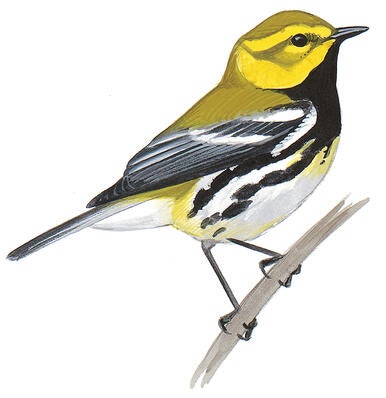
Black-throated green warbler
Setophaga virens
Hear my evergreen-forest note, sounding rather raspingly as usual, where there are large oaks and pines mingled. er-er te, te ter twee, or er te, te ter .

It is very difficult to discover now that the leaves are grown, as it frequents the tops of the trees. But I get a glimpse of its black throat and, I think, yellow head. 

This and the red-eye and wood pewee are singing now at midday.

Within little more than a fortnight the woods, from bare twigs, have become a sea of verdure, and young shoots have contended with one another in the race. The leaves have unfurled all over the country like a parasol. Shade is produced, and the birds are concealed and their economies go forward uninterruptedly, and a covert is afforded to the animals generally. But thousands of worms and insects are preying on the leaves while they are young and tender. Myriads of little parasols are suddenly spread all the country over, to shield the earth and the roots of the trees from parching heat, and they begin to flutter and rustle in the breeze.

H. D. Thoreau, Journal, June 1, 1854

Hear my evergreen-forest note. See May 11, 1854 ("Hear the evergreen-forest note"); May 12, 1854 ("Heard again the evergreen-forest note. It is a slender bird , about size of white-eyed vireo, with a black throat and I think some yellow above, with dark and light beneath, in the tops of pines and oaks."); May 26, 1854 ("Evergreen-forest note still, the first syllable three times repeated, er-er-er, etc. , — flitting amid the tops of the pines."); June 12, 1854 ("Hear the evergreen-forest note, and see the bird on the top of a white pine, somewhat creeper-like, along the bough , and golden head except a black streak from eye, black throat, slate-colored back, forked tail, white beneath, er te , ter ter te"); See aslo May 6, 1855 (“the er er twe, ter ter twe, evergreen-forest note”); May 30, 1855("In the thick of the wood between railroad and Turnpike, hear the evergreen forest note, and see probably the bird ");May 7, 1856 ("I hear the evergreen-forest note close by;") and A Book of the Seasons, by Henry Thoreau, The Black-throated Green Warbler

Popular Posts Last 30 Days.

The week ahead in Henry’s journal

The week ahead in Henry’s journal
A journal, a book that shall contain a record of all your joy.
"A stone fruit. Each one yields me a thought." ~ H. D. Thoreau, March 28, 1859


I sit on this rock
wrestling with the melody
that possesses me.