Monday, October 8, 2018

Black willows lose leaves and the shore begins to look quite Novemberish.

October 8
October 8, 2018
Fine pasture grass seen in the sun, begins to.look faded and bleached like the corn.  

Strong northwest wind. The button-bushes and black willows are rapidly losing leaves, and the shore begins to look Novemberish. 

Mulberry leaves of ash are apparently dulled.

H. D. Thoreau, Journal, October 8, 1858

Strong northwest wind.  
 See October 2, 1858 ("Sailed to Baker Farm with a strong northwest wind."); October 20, 1857 ("There is a very strong northwest wind, Novemberish and cool, raising waves on the river and admonishing to prepare for winter."); October 20, 1859 ("I see a large and very straggling flock of crows . . . contending with the strong and cold northwest wind. This is the annual phenomenon."); October 25, 1853 ("Sail down river to the pitch pine hill behind Abner Buttrick's, with a strong northwest wind, and cold. "); October 27, 1851 ("The strong northwest wind blows the damp snow along almost horizontally. The birds fly about as if seeking shelter. The cold numbs my fingers.")

The button-bushes and black willows are rapidly losing leaves, and the shore begins to look Novemberish. See October 4, 1857 ("The button-bushes are generally greenish-yellow now; only the highest and most exposed points brown and crisp in some places. The black willow, rising above them, is crisped yellowish-brown, so that the general aspect of the river's brim now is a modest or sober ripe yellowish-brown"); October 4, 1858 ("Many white and red maple, bass, elm, and black willow leaves are strewn over the surface of the water, light, crisp colored skiffs."); October 9, 1853 ("The birch is yellow; the black willow brown; the elms sere, brown, and thin; the bass bare."); October 10, 1858 ("November has already come to the river with the fall of the black willow and the button-bush, . . . letting in the autumn light to the water"); October 12, 1858 ("Most exposed button-bushes and black willows are two thirds bare, and the leaves which remain on the former are for the most part brown and shrivelled."); October 15, 1856 (“Banks begin to wear almost a Novemberish aspect. The black willow almost completely bare”); October 16, 1859 ("The button-bushes are just bare, and the black willows partly so"); October 22, 1857 (“The black willows along the river are about as bare as in November.”); October 25, 1855 ("The willows along the river now begin to look faded and somewhat bare and wintry. The dead wool-grass, etc., characterizes the shore. The meadows look sere and straw-colored.”)

October 8. See A Book of the Seasons, by Henry Thoreau, October 8


A Book of the Seasons, by Henry Thoreau,   the shore begins to look quite Novemberish.
A Book of the Seasons, by Henry Thoreau
"A book, each page written in its own season,
out-of-doors, in its own locality.”

https://tinyurl.com/HDT581008

Saturday, October 6, 2018

Bleached and faded corn stands quite white in the twilight.

October 6. 

October 6, 2018

P. M. — To Saw Mill Brook and Flint’s Pond. 

Now, methinks, the autumnal tints are brightest in our streets and in the woods generally. 

In the streets, the young sugar maples make the most show. The street is never more splendid. As I look up the street from the Mill-Dam, they look like painted screens standing before the houses to celebrate a gala-day. One half of each tree glows with a delicate scarlet. 

But only one of the large maples on the Common is yet on fire. The butternuts on the street are with, or a little later than, the walnuts. The three-thorned acacias have turned (one half) a peculiarly clear bright and delicate yellow, peculiar also for the smallness of the leaf. 

Asparagus-beds are a soft mass of yellow and green. Buttonwoods have no bright colors, but are a brownish and yellowish green, some what curled and crisp and looking the worse for the wear. 

Stand where half a dozen large elms droop over a house. It is as if you stood within a ripe pumpkin rind, and you feel as mellow as if you were the pulp.

In Saw Mill Brook Path, and in most wood-paths, the Aster undulatus is now very fair and interesting. Generally a tall and slender plant with a very long panicle of middle-sized lilac or paler purple flowers, bent over to one side the path. 

The Rhus Toxicodendron leaves are completely changed and of very various colors, pale yellow to deep scarlet and delicate. The leaf-stalks are commonly drooping, being bent short downward near the base in a peculiar manner. 

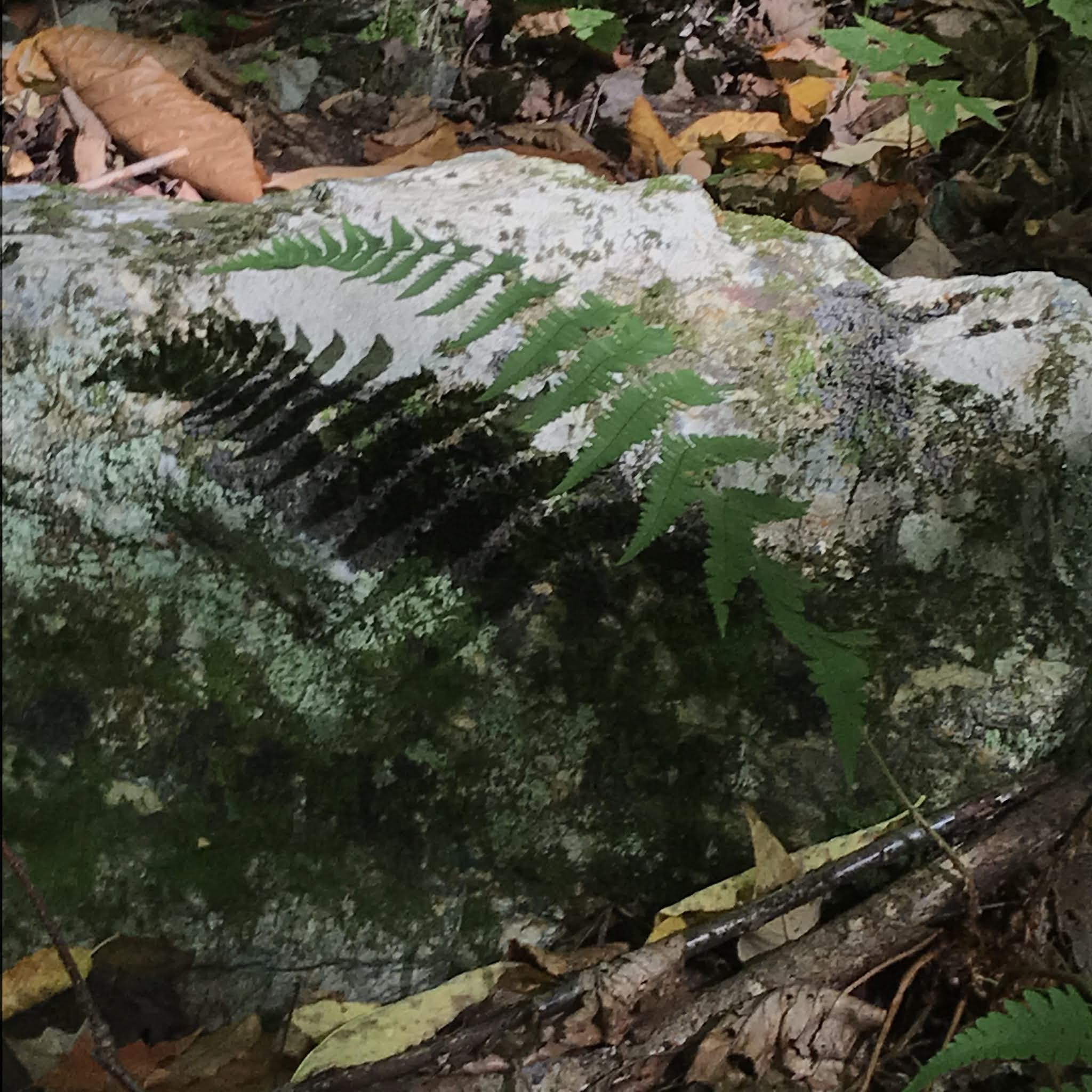
Several species of ferns are faded quite white in the swamp, — dicksonia and another, and some brakes, — for in moist woods and swamps they are preserved longer than in dry places. 

Solidago latifolia in bloom still, but always sparingly. 

Cinnamon ferns are generally crisped, but in the swamp I saw some handsomely spotted green and yellowish, and one clump, the handsomest I ever saw, perfect in outline, falling over each way from the centre, of a very neat drab color, quaker-like, fit to adorn an Oriental drawing-room. 

The evergreens seem positively greener, owing to the browning of other leaves. 

I should not suspect that the white birches had changed so much and lost so many leaves, if I did not see them against the unchanged pitch pines on the hillside. 

I notice Hieracium paniculatum and scabrum in dark, low wood-paths, turned a hoary white. 

The medeola leaves are a pale straw-color with a crimson centre; perhaps getting stale now. 

The tupelo at Wharf Rock is completely scarlet, with blue berries amid its leaves. 

Leaves now have fairly begun to rustle under foot in wood-paths, especially in chestnut woods, scaring the ducks as you approach the ponds. And what is that common scent there so much like fragrant everlasting? 

The smooth sumachs, which are in their prime, or perhaps a little past, are, methinks, the most uniform and intense scarlet of any shrub or tree. They stand perfectly distinct amid the pines, with slender spreading arms, their leafets drooping and somewhat curled though fresh. Yet, high-colored as they are, from their attitude and drooping, like scarfs, on rather bare and dark stems, they have a funereal effect, as if you were walking in the cemetery of a people who mourned in scarlet. 

Most S. nemoralis, and most other goldenrods, now look hoary, killed by frost. 

The corn stands bleached and faded — quite white in the twilight — in the fields. No greenness there has the frost and sun left. Seen against the dark earth. 

My phosphorescent wood still glows a little, though it has lain on my stove all day, and, being wet, it is much improved still.

H. D. Thoreau, Journal, October 6, 1858


Autumnal tints are brightest in our streets and in the woods generally. See October 6, 1857 (“We are not prepared to believe that the earth is now so parti-colored, and would present to a bird's eye such distinct masses of bright color. A great painter is at work.”); October 23, 1857 ("I can find no bright leaves now in the woods.")

The Aster undulatus is now very fair and interesting. See September 20, 1852 ("Aster undulatus, or variable aster, with a large head of middle-sized blue flowers."); October 2, 1859 ("The A. undulatus looks fairer than ever, now that flowers are more scarce."); October 4, 1853 ("Bumblebees are on the Aster undulatus"); October 25, 1858 ("The Aster undulatus is now a dark purple (its leaves), with brighter purple or crimson under sides."); November 3, 1858 ("Aster undulatus is still freshly in bloom");November 7, 1858 ("Aster undulatus and several goldenrods, at least, may be found yet.") 
 
Most S. nemoralis, and most other goldenrods, now look hoary, killed by frost. See October 3, 1857 ("Asters, and still more goldenrods, look quite rare now.") Compare  October 3, 1852 ("The Aster undulates is common and fresh, also the Solidago nemoralis of Gray.”)

Cinnamon ferns are generally crisped, but in the swamp I saw some handsomely spotted green and yellowish. See  October 2, 1859 ("I perceive in various places, in low ground, this afternoon, the sour scent of cinnamon ferns decaying. It is an agreeable phenomenon, reminding me of the season and of past years.") See also A Book of the Seasons, by Henry Thoreau, The Cinnamon Fern

Where half a dozen large elms droop over a houseit is as if you stood within a ripe pumpkin rind. See October 9, 1857 ("As I look down our street, which is lined with them, now clothed in their very rich brownish-yellow dress, they remind me of yellowing sheaves of grain, as if the harvest had come to the village itself”)

The medeola leaves are a pale straw-color with a crimson centre; perhaps getting stale now.. See May 25, 1852 ("Medeola or cucumber-root in bud, with its two-storied whorl of leaves. "); July 24, 1853 ("The medeola is still in flower, though with large green berries"); August 27, 1851 ("The Medeola Virginica, cucumber-root, the whorl-leaved plant, is now in green fruit"); September 2, 1853 ("The medeola berries are now dull glossy and almost blue-black; about three, on slender threads one inch long, arising in the midst of the cup formed by the purple bases of the whorl of three upper leaves.");October 14, 1859 (" Medeola probably fallen several weeks.")See also A Book of the Seasons, by Henry Thoreau, Cucumber Root (medeola)

The tupelo at Wharf Rock is completely scarlet, with blue berries amid its leaves.
See August 31, 1857 ("At Flint's Pond I wade along the edge eight or ten rods to the wharf rock, carrying my shoes and stockings"); September 11, 1859 ("I see tall tupelos, all dotted with the now ripe (apparently in prime) small oval purple berries, two or three together on the end of slender peduncles, amid the reddening leaves. This fruit is very acid and has a large stone, but I see several robins on the trees, which appear to have been attracted by it."); September 30, 1854 ("I find a fine tupelo near Sam Barrett’s now all turned scarlet. I find that it has borne much fruit — small oval bluish berries,"); October 19, 1859 ("The tupelo berries have all fallen") [Nyssa sylvatica, commonly known as the Black Tupelo, is a medium-sized deciduous tree native to eastern North America, from New England and southern Ontario south to central Florida and eastern Texas. ~ iNaturalist]
Leaves now have fairly begun to rustle under foot in wood-paths, scaring the ducks as you approach the ponds. See October 10, 1851 ("You make a great noise now walking in the woods.”); October 22, 1857 (“As I go through the woods now, so many oak and other leaves have fallen the rustling noise somewhat disturbs my musing. However, Nature in this may have intended some kindness to the ducks, which are now loitering hereabouts on their migration south ward, mostly young and inexperienced birds, for, as they are feeding [in] Goose Pond, for instance, the rustling of the leaves betrays the approach of the sports man and his dog, or other foe; so perhaps the leaves on the ground protect them more than when on the trees. ”); and note to October 22, 1854 ("Now they rustle as you walk through them in the woods.”)

I notice Hieracium paniculatum and scabrum in dark, low wood-paths, turned a hoary white. See August 6, 1856 ("Hieracium scabrous.”) See July 21, 1851 ("The rough hawkweed, too, resembling in its flower the autumnal dandelion.”); August21, 1851 ("Hieracium paniculatum, a very delicate and slender hawkweed. I have now found all the hawkweeds. Singular these genera of plants, plants manifestly related yet distinct. They suggest a history to nature, a natural history in a new sense.”)

The corn stands bleached and faded — quite white in the twilight . . . seen against the dark earth. See October 1, 1851 ("I go through Wheeler's corn-field in the twilight, where the stalks are bleached almost white, and his tops are still stacked along the edge of the field. The moon is not far up above the southwestern horizon. Looking west at this hour, the earth is an unvaried, undistinguishable black in contrast with the twilight sky. It is as if you were walking in night up to your chin.") See also September 17, 1852 ("The corn-stalks are stacked like muskets along the fields."); October 8, 1858 ("Fine pasture grass seen in the sun, begins to.look faded and bleached like the corn."); October 10, 1857 ("See the heaps of apples in the fields and at the cider mill, of pumpkins in the fields, and the stacks of cornstalks and the standing corn."); October 12, 1858 ("The coarse grass of the riverside . . . is bleached as white as corn."); October 28, 1853 ("Just saw in the garden, in the drizzling rain, little sparrow-sized birds flitting about amid the dry corn stalks and the weeds.")

My phosphorescent wood.  See October 4, 1858 ("I saw on the sidewalk something bright like fire.");
October 5, 1858 ("My phosphorescent wood of last night still glows somewhat, but I improve it much by putting it in water. The little chips which remain in the water or sink to the bottom are like so many stars in the sky.")

October 6. See  A Book of the Seasons by Henry Thoreau, October 6

Medeola leaves 
 are a pale straw-color with 
a crimson centre;

Bleached and faded corn
stands quite white in the twilight
against the dark earth.
 A Book of the Seasons by Henry Thoreau, 

A Book of the Seasons, by Henry Thoreau
"A book, each page written in its own season,
out-of-doors, in its own locality.”
~edited, assembled and rewritten by zphx © 2009-2024

https://tinyurl.com/hdt-581006 

Friday, October 5, 2018

The comet makes a great show these nights.

October 5

Donati's Comet, Oxford, 7:30 p.m., 5 Oct. 1858

I still see large flocks, apparently of chip birds, on the weeds and ground in the yard; without very distinct chestnut crowns, and they are divided by a light line. They are eating seeds of the Amaranthus hybridus, etc. 

8 A. M. — I go to Hubbard’s Close to see when the fringed gentians open. They begin to open in the sun about 8.30 A. M., or say 9. 

Chewink note still. Grackles in flocks. Phebe note of Chickadee often these days. 

Much green is indispensable for maples, hickories, birches, etc., to contrast with, as of pines, oaks, alders, etc. The former are fairest when seen against these. The maples, being in their prime, say yesterday, before the pines, are conspicuously parti-colored. 

P. M. — To Easterbrooks Country. 

White pines in low ground and swamps are the first to change. Some of these have lost many needles. Some on dry ground have so far changed as to be quite handsome, but most only so far as to make the misty glaucous (green) leaves more soft and indefinite. 

The fever-bush is in the height of its change and is a showy clear lemon yellow, contrasting with its scarlet berries. The yellow birch is apparently at the height of its change, clear yellow like the black. I think I saw a white ash which was all turned clear yellowish, and no mulberry, in the Botrychium Swamp. 

Looking on the Great Meadows from beyond Nathan Barrett’s, the wool-grass, where uncut, is very rich brown, contrasting with the clear green of the portions which are mown; all rectangular. The staghorn sumach apparently in the prime of its change. 

In the evening I am glad to find that my phosphorescent wood of last night still glows somewhat, but I improve it much by putting it in water. The little chips which remain in the water or sink to the bottom are like so many stars in the sky. 

The comet makes a great show these nights. Its tail is at least as long as the whole of the Great Dipper, to whose handle, till within a night or two, it reached, in a great curve, and we plainly see stars through it. [It finally reaches between one fourth and one third from the horizon to the zenith.]

Huckleberry bushes generally red, but dull Indian red, not scarlet. 

The red maples are generally past their prime (of color). They are duller or faded. Their first fires, like those of genius, are brightest. In some places on the edges of swamps many of their tops are bare and smoky. 
October 5, 2019

The dicksonia fern is for the most part quite crisp and brown along the walls.

H. D. Thoreau, Journal, October 5, 1858

The comet makes a great show these nights. See September 23 , 1858 (Saw the comet very bright in the northwest. "); November 1, 1858 ("Here are all the friends I ever had or shall have . . .They see the comet from the northwest coast just as plainly as we do, and the same stars through its tail. ") see also Comet Donali (first observed it on June 2, 1858. After the Great Comet of 1811, it was the most brilliant comet that appeared in the 19th century. It was also the first comet to be photographed.)

I still see large flocks, apparently of chip birds, on the weeds and ground in the yard; without very distinct chestnut crowns.  See August 25, 1859 ("quite a flock of (apparently) Fringilla socialis in the garden"); September 1, 1854 ("Now I notice a few faint-chipping sparrows, busily picking the seeds of weeds in the garden"); September 16, 1854 (“I see little flocks of chip-birds along the roadside and on the apple trees, showing their light under sides when they rise.”); September 27, 1858 ("What are those little birds in flocks in the garden and on the peach trees these mornings, about size of chip-birds, without distinct chestnut crowns?”); October 7, 1860 (“Now and for a week the chip-birds in flocks; the withered grass and weeds, etc., alive with them.”) See also A Book of the Seasons, by Henry Thoreau, the Chipping Sparrow


8 A. M. — I go to Hubbard’s Close to see when the fringed gentians open. See September 12, 1854 (" I cannot find a trace of the fringed gentian."); September 14, 1855 ("To Hubbard's Close. I see no fringed gentian yet.");  September 14, 1856 (" To Hubbard's Close. Fringed gentian well out (and some withered or frost-bitten ?), say a week, though there was none to be seen here August 27th.");  September 28, 1853 ("The fringed gentian was out before Sunday; was (some of it) withered then, says Edith Emerson."); October 1, 1858 ("The fringed gentians are now in prime. . . .They who see them closed, or in the afternoon only, do not suspect their beauty.”); October 2, 1857 ("The fringed gentian at Hubbard's Close has been out some time, and most of it already withered"); .October 2, 1853 ("The gentian in Hubbard's Close is frost-bitten extensively"); October 18, 1857 ("The fringed gentian closes every night and opens every morning in my pitcher.");  October 19, 1852 ("It is too remarkable a flower not to be sought out and admired each year, however rare. It is one of the errands of the walker, as well as of the bees, for it yields him a more celestial nectar still. It is a very singular and agreeable surprise to come upon this conspicuous and handsome and withal blue flower at this season, when flowers have passed out of our minds and memories; the latest of all to begin to bloom"); November 4, 1853 (“To Hubbard's Close. I find no traces of the fringed gentian here, so that in low meadows I suspect it does not last very late”) See also A Book of the Seasons, by Henry Thoreau: The Fringed Gentian
 

Phebe note of Chickadee often these days. See  October 4, 1859 (" I hear. . . the sweet phe-be of the chickadee"); October 6, 1856 ("The common notes of the chickadee, so rarely heard for a long time, and also one phebe strain from it, amid the Leaning Hemlocks, remind me of pleasant winter days, when they are more commonly seen.”);  October 10, 1856 ("The phebe note of the chickadee is now often heard ");  October 20, 1856  ("The chickadees are more numerous and lively and familiar and utter their phebe note.") See also A Book of the Seasons,  by Henry Thoreau, the Chickadee in Winter

The fever-bush is in the height of its change and is a showy clear lemon yellow, contrasting with its scarlet berries. See September 24, 1859 ("Fever-bush berries are scarlet now, and also green. They have a more spicy taste than any of our berries, carrying us in thought to the spice islands. Taste like lemon-peel."); October 4, 1857 (“Fever-bush has begun to yellow.”); October 15, 1859 ("The fever-bush is for the most part bare, and I see no berries.")

The dicksonia fern is for the most part quite crisp and brown along the walls. See October 4, 1859 ("How interesting now, by wall-sides and on open springy hillsides, the large, straggling tufts of the dicksonia fern . . .. Long, handsome lanceolate green fronds, pointing in every direction, recurved and full of fruit, intermixed with yellowish and sere brown and shrivelled ones. . . .Their lingering greenness so much the more noticeable now that the leaves (generally) have changed. They affect us as if they were evergreen, such persistent life and greenness in the midst of their own decay") See also September 30, 1859 (" The evergreen ferns have been growing more and more distinct amid the fading and decaying and withering ones,")

https://tinyurl.com/HDT581005

Thursday, October 4, 2018

Witch-hazel in prime – Yellow leaves by their color conceal the flowers.

October 4

October 4, 2018
 

P. M.  Paddled up the Assabet. Strong north wind, bringing down leaves. 

Many white and red maple, bass, elm, and black willow leaves are strewn over the surface of the water, light, crisp colored skiffs. The bass is in the prime of its change, a mass of yellow. 

See B a-fishing notwithstanding the wind. A man runs down, fails, loses self-respect, and goes a-fishing, though he were never seen on the river before. Yet methinks his “misfortune” is good for him, and he is the more mellow and humane. Perhaps he begins to perceive more clearly that the object of life is something else than acquiring property, and he really stands in a truer relation to his fellow-men than when he commanded a false respect of them. There he stands at length, per chance better employed than ever, holding communion with nature and himself and coming to understand his real position and relation to men in this world. It is better than a poor debtors’ prison, better than most successful money-getting. 

I see some rich-weed in the shade of the Hemlocks, for some time a clear, almost ivory, white, and the boehmeria is also whitish. 

Rhus Toxicodendron in the shade is a pure yellow; in the sun, more scarlet or reddish. 

Grape leaves apparently as yellow as ever.

Witch-hazel apparently at height of change, yellow below, green above, the yellow leaves by their color concealing the flowers. The flowers, too, are apparently in prime. The leaves are often richly spotted reddish and greenish brown. 

The white maples that changed first are about bare. 

The brownish-yellow clethra leaves thickly paint the bank. 

Salix lucida leaves are one third clear yellow. 

The Osmunda regalis is yellowed and partly crisp and withered, but a little later than the cinnamon, etc. 

Scare up two ducks, which go off with a sharp creaking ar-r-week, ar-r-week, ar-r-week. Is not this the note of the wood duck? 

Hornets are still at work in their nests. 

Ascend the hill. 

The cranberry meadows are a dull red. 

See crickets eating the election-cake toadstools.

The Great Meadows, where not mown, have long been brown with wool-grass. 

The hickories on the northwest side of this hill are in the prime of their color, of a rich orange; some intimately mixed with green, handsomer than those that are wholly changed. The outmost parts and edges of the foliage are orange, the recesses green, as if the outmost parts, being turned toward the sunny fire, were first baked by it.


Going by Dr. Barrett’s, just at the edge of evening, I saw on the sidewalk something bright like fire, as if molten lead were scattered along, and then I wondered if a drunkard’s spittle were luminous, and proceeded to poke it on to a leaf with a stick. It was rotten wood. I found that it came from the bottom of some old fence-posts which had just been dug up near by and there glowed for a foot or two, being quite rotten and soft, and it suggested that a lamp-post might be more luminous at bottom than at top. 

I cut out a handful and carried it about. It was quite soft and spongy and a very pale brown — some almost white — in the light, quite soft and flaky; and as I withdrew it gradually from the light, it began to glow with a distinctly blue fire in its recesses, becoming more universal and whiter as the darkness increased. Carried toward a candle, it is quite a blue light. 

One man whom I met in the street was able to tell the time by his watch, holding it over what was in my hand. 

The posts were oak, probably white. 

Mr. Melvin, the mason, told me that he heard his dog barking the other night, and, going out, found that it was at the bottom of an old post he had dug up during the day, which was all aglow.


H. D. Thoreau, Journal, October 4, 1858

Rhus Toxicodendron in the shade is a pure yellow; in the sun, more scarlet or reddish.
See September 30, 1857 (“Rhus Toxicodendron turned yellow and red, handsomely dotted with brown.”); October 3, 1857 ("The Rhus radicans also turns yellow and red or scarlet, like the Toxicodendron."); October 11, 1857 ("I see some fine clear yellows from the Rhus Toxicodendron on the bank by the hemlocks and beyond.")

Witch-hazel apparently at height of change, yellow below, green above, the yellow leaves by their color concealing the flowers. The flowers, too, are apparently in prime.  See September 24, 1853 ("Witch-hazel well out."); September 27, 1857 ("Witch-hazel two thirds yellowed. "); September 29, 1853 ("The witch-hazel . . .has but begun to blossom . . . Its leaves are yellowed."); October 9, 1851 ("The sunlight from over the top of the hill lights up its top-most sprays and yellow blossoms. Its spray, so jointed and angular, is not to be mistaken for any other. I lie on my back with joy under its bough. While its leaves fall, its blossoms spring.") See also A Book of the Seasons,  by Henry Thoreau, The Witch-Hazel

Osmunda regalis is yellowed and partly crisp and withered, but a little later than the cinnamon. See  October 1, 1858 ("The cinnamon ferns are crisp and sour in open grounds"); October 11, 1857 ("The osmunda ferns are generally withered and brown except where very much protected from frost. The O. regalis is the least generally withered of them"); October 12, 1858 ("The Osmunda regalis . . . in and about the swamps, are generally brown and withered, though with green ones intermixed. They are still, however, interesting, with their pale brown or cinnamon-color and decaying scent.")

Hornets are still at work in their nests. See October 24, 1858 ("That large hornets’ nest which I saw on the 4th is now deserted, and I bring it home. But in the evening, warmed by my fire, two or three come forth and crawl over it, and I make haste to throw it out the window.")

See crickets eating the election-cake toadstools. See October 2, 1859 ("Nowadays I see most of the election-cake fungi, with crickets and slugs eating them. ") See also note to See note to September 21, 1859 ("And now at last I see a few toadstools, — the election-cake (the yellowish, glazed over)"

Holding communion with nature and himself and coming to understand his real position and relation to men in this world. See June 26, 1853 ("They might go there a thousand times, perchance, before the sediment of fishing would sink to the bottom and leave their purpose pure, — before they began to angle for the pond itself."); December 2, 1856 ("There they sit, ever and anon scanning their reels to see if any have fallen, and, if not catching many fish, still getting what they went for, though they may not be aware of it, i. e. a wilder experience than the town affords.") 

See crickets eating the election-cake toadstools. See note to October 20, 1856 (“I notice, as elsewhere of late, a great many brownish-yellow (and some pink) election-cake fungi, eaten by crickets; about three inches in diameter.")

The hickories on the northwest side of this hill are in the prime of their color, of a rich orange; some intimately mixed with green, handsomer than those that are wholly changed. See October 8, 1856 ("The hickory leaves are among the handsomest now, varying from green through yellow, more or less broadly green-striped on the principal veins, to pure yellow, at first almost lemon-yellow, at last browner and crisped. This mingling of yellow and green on the same leaf, the green next the veins where the life is most persistent, is very pleasing."); October 15, 1858 ("Small hickories are the clearest and most delicate yellow in the shade of the woods. ");  October 22, 1858 ("The leaves of the hickory are a very rich yellow, though they may be quite withered and fallen, but they become brown.");  October 24, 1853 ("Some hickories bare, some with rich golden-brown leaves. "); October 24, 1858 ("Hickories are two thirds fallen, at least."); November 13, 1858 ("One hickory at least (on the hill) has not lost its leaves yet, i. e., has a good many left. So they are a month falling.") See also AA Book of the Seasons,, by Henry Thoreau. The Hickory

I saw on the sidewalk something bright like fire.  See October 5, 1858 ("My phosphorescent wood of last night still glows somewhat, but I improve it much by putting it in water. The little chips which remain in the water or sink to the bottom are like so many stars in the sky."); October 6, 1858 ("My phosphorescent wood still glows a little, though it has lain on my stove all day, and, being wet, it is much improved still.") See also July 24, 1857 and The Maine Woods ("Getting up some time after midnight to collect the scattered brands together, while my companions were sound asleep, I observed, partly in the fire, which had ceased to blaze, a perfectly regular elliptical ring of light . . . phosphorescent wood, which I had so often heard of, but never chanced to see . . . I did not regret my not having seen this before, since I now saw it under circumstances so favorable. I was in just the frame of mind to see something wonderful, and this was a phenomenon adequate to my circumstances and expectation, and it put me on the alert to see more like it.")

October 4. See A Book of the Seasons,, by Henry Thoreau, October 4

Witch-hazel in prime –
Yellow leaves by their color
conceal the flowers.
A Book of the Seasons by Henry Thoreau
"A book, each page written in its own season,
out-of-doors, in its own locality.”
~edited, assembled and rewritten by zphx © 2009-2024

https://tinyurl.com/hdt-581004 


Wednesday, October 3, 2018

The maples about Walden are quite handsome now.

October 3

One brings me this morning a Carolina rail alive, this year’s bird evidently from its marks. He saved it from a cat in the road near'the Battle-Ground. On being taken up, it peeked a little at first, but was soon quiet. It staggers about as if weak on my window sill and pecks at the glass, or stands with its eyes shut, half asleep, and its back feathers hunched up. Possibly it is wounded. I suspect it may have been hatched here. Its feet are large and spreading, qualifying it to run on mud or pads. Its crown is black, but chin white, and its back feathers are distinctly edged with white in streaks. 

I compare my hazelnuts gathered some time ago. The beaked are pointed nuts, while the common are blunt; and the former are a much paler brown, also have a yellower and much sweeter meat. 

A fringed gentian, plucked day before yesterday, at length, this forenoon, untwists and turns its petals partially, in my chamber.

Have noticed a very brilliant scarlet blackberry patch within a week. 

The red maples which changed first, along the river, are now faded and partly fallen. They look more pink. But others are lit, and so there is more color than before. Some particular maple among a hundred will be of a peculiarly bright and pure scarlet, and, by its difference of tint and intenser color, attract our eyes even at a distance in the midst of the crowd. Looking all around Fair Haven Pond yesterday, where the maples were glowing amid the evergreens, my eyes invariably rested on a particular small maple of the purest and intensest scarlet. 

P. M. — Paddle about Walden. 

As I go through the Cut, I discover a new locality for the crotalaria, being attracted by the pretty blue-black pods, now ripe and dangling in profusion from these low plants, on the bare sandy and gravelly slope of the Cut. The vines or plants are but half a dozen times longer (or higher) than the pods. It was the contrast of these black pods with the yellowish sand which betrayed them.

How many men have a fatal excess of manner! There was one came to our house the other evening, and behaved very simply and well till the moment he was passing out the door. He then suddenly put on the airs of a well-bred man, and consciously described some are of beauty or other with his head or hand. It was but a slight flourish, but it has put me on the alert. 

It is interesting to consider how that crotalaria spreads itself, sure to find out the suitable soil. One year I find it on the Great Fields and think it rare; the next I find it in a new and unexpected place. It flits about like a flock of sparrows, from field to field. 

The maples about Walden are quite handsome now. Standing on the railroad, I look across the pond to Pine Hill, where the outside trees and the shrubs scattered generally through the wood glow through the green, yellow, and scarlet, like fires just kindled at the base of the trees, — a general conflagration just fairly under way, soon to envelop every tree. The hillside forest is all aglow along its edge and in all its cracks and fissures, and soon the flames will leap upward to the tops of the tallest trees. About the pond I see maples of all their tints, and black birches (on the southwest side) clear pale yellow; and on the peak young chestnut clumps and walnuts are considerably yellowed. 

I hear, out toward the middle, or a dozen rods from me, the plashing made apparently by the shiners, — for they look and shine like them, — leaping in schools on the surface. Many lift themselves quite out for a foot or two, but most rise only part way out, — twenty black points at once. There are several schools indulging in this sport from time to time as they swim slowly along. This I ascertain by paddling out to them. Perhaps they leap and dance in the water just as gnats dance in the air at present. I have seen it before in the fall. Is it peculiar to this season? 

Hear a hylodes peeping on shore. 

A general reddening now of young and scrub oaks. Some chinquapin bright-red. 

White pines fairly begin to change. 

The large leaves of some black oak sprouts are dark-purple, almost blackish, above, but greenish beneath. 

See locust leaves all crisped by frost in Laurel Glen Hollow, but only part way up the bank, as on the shore of a lake.

H. D. Thoreau, Journal, October 3, 1858

A Carolina rail alive. Its crown is black, but chin white, and its back feathers are distinctly edged with white in streaks. Compare September 18, 1858 ("In R. Virginianus. . . the crown and whole upper parts are black, streaked with brown; the throat, breast, and belly, orange-brown; sides and vent, black tipped with white; legs and feet, dark red-brown; none of which is true of the R. Carolinus.")

The beaked are pointed nuts, while the common are blunt. See September 9, 1858 ("I find an abundance of beaked hazelnuts at Blackberry Steep, one to three burs together, but, gathering them, I get my fingers full of fine shining bristles, while the common hazel burs are either smooth or covered with a softer glandular down; i. e., its horns are brazen tipped.")

A fringed gentian, plucked day before yesterday, at length, this forenoon, untwists and turns its petals partially, in my chamber.See October 1, 1858 ("The fringed gentians are now in prime. . . .They who see them closed, or in the afternoon only, do not suspect their beauty.")

Have noticed a very brilliant scarlet blackberry patch within a week. See September 23, 1854 ("Low blackberry vines generally red. "); September 25, 1854 ("I am detained by the very bright red blackberry leaves strewn along the sod")

Some particular maple among a hundred will be of a peculiarly bright and pure scarlet, and, by its difference of tint and intenser color, attract our eyes even at a distance in the midst of the crowd. See September 25, 1857 (“A single tree becomes the crowning beauty of some meadowy vale and attracts the attention of the traveller from afar.”); September 26, 1854 ("Some single red maples are very splendid now, the whole tree bright-scarlet against the cold green pines; now, when very few trees are changed, a most remarkable object in the landscape; seen a mile off. "); September 27, 1855 ("Some single red maples now fairly make a show along the meadow. I see a blaze of red reflected from the troubled water.");  September 27, 1857 (“At last, its labors for the year being consummated and every leaf ripened to its full, it flashes out conspicuous to the eye of the most casual observer, with all the virtue and beauty of a maple, – Acer rubrum.”); October 8, 1852 (“Nothing can exceed the brilliancy of some of the maples which stand by the shore and extend their red banners over the water.”);)

I discover a new locality for the crotalaria, being attracted by the pretty blue-black pods, now ripe and dangling in profusion from these low plants, on the bare sandy and gravelly slope of the Cut. See October 3, 1856 ("I detect the crotalaria behind the Wyman site, by hearing the now rattling seeds in its pods as I go through the grass, like the trinkets about an Indian's leggins, or a rattlesnake.")

Hear a hylodes peeping on shore. See October 3, 1852 ("I hear a hylodes (?) from time to time.")

 White pines fairly begin to change. See October 3, 1852 ("The pine fall, i.e. change, is commenced, and the trees are mottled green and yellowish."); October 3, 1856 ("The white pines are now getting to be pretty generally parti-colored, the lower yellowing needles ready to fall.") See also November 9, 1850 (" I expect to find that it is only for a few weeks in the fall after the new leaves have done growing that there are any yellow and falling, — that there is a season when we may say the old pine leaves are now yellow, and again, they are fallen."); See also A Book of the Seasons, by Henry Thoreau, The October Pine Fall


Tuesday, October 2, 2018

A dark and windy night .


October 2

A dark and windy night the last. It is a new value when darkness amounts to something positive. Each morning now, after rain and wind, is fresher and cooler, and leaves still green reflect a brighter sheen. 

Minott told me yesterday that he had never seen the seashore but once, and that was Noddle’s Island in the War of 1812. 

The garden is alive with migrating sparrows these mornings. The cat comes in from an early walk amid the weeds. She is full of sparrows and wants no more breakfast this morning, unless it be a saucer of milk, the dear creature. I saw her studying ornithology between the corn-rows.

As I approached Perch Pool the other day, half a dozen frogs leaped into it and buried themselves in the mass of callitriche at the bottom. I stood looking for perch a minute or two, when one after another up came the frogs from out the callitriche, just as a piece of cork would rise by mere buoyancy to the surface; and then, by a distinct effort, they let go all, drop anchor, elevate or let float up their heels, and lie spread out on the surface. They were probably Rana fontinalis.  

Sailed to Baker Farm with a strong northwest wind.

Got a peck of the small long-bunched grapes now turned purple under Lee’s Cliff. One or two vines bear very plentifully. The bunches are about six inches long by one and a half, and quite dense and cylindrical commonly. They are now apparently just in their prime, to judge from color. Considerably later than the Vitis Labrusca, but are not good. [Mother [made] a nice jelly of them afterward.] 

A large chocolate-colored puffball “smokes. ”

H. D. Thoreau, Journal, October 2, 1858

Each morning now, after rain and wind, is fresher and cooler, and leaves still green reflect a brighter sheen. See September 20, 1853 (It rained very hard while we were aboard the steamer."); September 20, 1854 ("Windy rain-storm last night"); September 20, 1856 ("Rain in afternoon. Rain again in the night, hard."); ; September 20, 1857 ("This is our first fall rain, and makes a dividing line between the summer and fall."); September 20, 1860 ("Rainy in forenoon.")


Minott told me yesterday that he had never seen the seashore but once in the War of 1812. . See March 23, 1854("Minott confesses to me to-day that he has not been to Boston since the last war, or 1815. Aunt said that he had not been ten miles from home since”)  January 8, 1857 ("Minott says he has lived where he now does as much as sixty years. He has not been up in town for three years, on account of his rheumatism ");  and note to October 4, 1851 ("Minott is, perhaps, the most poetical farmer — who most realizes to me the poetry of the farmer's life — that I know . . . He loves to walk in a swamp in windy weather and hear the wind groan through the pines.");

The garden is alive with migrating sparrows these mornings. See October 4, 1859 (“Birds are now seen more numerously than before, as if called out by the fine weather, probably many migrating birds from the north.”); October 8, 1855 ("Flocks of tree sparrows by river, slightly warbling. Hear a song sparrow sing. See apparently white-throated sparrows . . .”); October 8, 1856 (“The trees and weeds by the Turnpike are all alive this pleasant afternoon with twittering sparrows .”)

Monday, October 1, 2018

The fringed gentians are now in prime.


October 1. 

P. M. — To Hubbard’s Close. 

Clintonia Maple Swamp is very fair now, especially a quarter of a mile off, where you get the effect of the light colors without detecting the imperfections of the leaves. Look now at such a swamp, of maples mixed with the evergreen pines, at the base of a pine-clad hill, and see their yellow and scarlet and crimson fires of all tints, mingled and contrasted with the green. Some maples are yet green, only yellow-tipped on the edges of their flakes, as the edges of a hazelnut bur. Some are wholly brilliant scarlet, raying out regularly and finely every way. Others, of more regular form, seem to rest heavily, flake on flake, like yellow or scarlet snow-drifts. 

The cinnamon ferns are crisp and sour in open grounds. 

The fringed gentians are now in prime. These are closed in the afternoon [No. Vide forward.], but I saw them open at 12 M. a day or two ago, and they were exceedingly beautiful, especially when there was a single one on a stem. They who see them closed, or in the afternoon only, do not suspect their beauty. 

Viola lanceolata again. 

See larks in small flocks. 

Was overtaken by a sudden gust and rain from the west. It broke off some limbs and brought down many leaves. Took refuge in Minott’s house at last. 

He told me his last duck-shooting exploit for the fifth or sixth time.

Says that Jake Potter, who died over eighty some dozen years since, told him that when he was a boy and used to drive his father Ephraim’s cows to pasture in the meadows near Fair Haven, after they were mown in the fall, returning with them at evening, he used to hear the wildcats yell in the Fair Haven woods. 

Minott tells of a great rise of the river once in August, when a great many “marsh-birds,” as peeps, killdees, yellow-legs, etc., came inland, and he saw a flock of them reaching from Flint’s Bridge a mile down-stream over the meadows, and making a great noise. 

Says the “killdees” used to be common here, and the yellow legs, called “humilities,” used commonly to breed here on the tussocks in the meadows. He has often found their nests. 

Let a full-grown but young cock stand near you. How full of life he is, from the tip of his bill through his trembling wattles and comb and his bright eye to the extremity of his clean toes! How alert and restless, listening to every sound and watching every motion! How various his notes, from the finest and shrillest alarum as a hawk sails over, surpassing the most accomplished violinist on the short strings, to a hoarse and terrene voice or cluck! He has a word for every occasion; for the dog that rushes past, and partlet cackling in the barn. And then how, elevating himself and flapping his wings, he gathers ear-piercing strain! not a vulgar note of defiance, but the mere effervescence of life, like the bursting of a bubble in a wine-cup. Is any gem so bright as his eye? 

The elms are now great brownish-yellow masses hanging over the street. Their leaves are perfectly ripe. I wonder if there is any answering ripeness in the lives of those who live beneath them. The harvest of elm leaves is come, or at hand. 

The cat sleeps on her head! What does this portend? It is more alarming than a dozen comets. 

How long prejudice survives! The big-bodied fisherman asks me doubtingly about the comet seen these nights in the northwest, — if there is any danger to be apprehended from that side! I would fain suggest that only he is dangerous to himself.

H. D. Thoreau, Journal, October 1, 1858

Maples mixed with the evergreen pines, at the base of a pine-clad hill, and see their yellow and scarlet and crimson fires of all tints, mingled and contrasted with the green. See October 1, 1854 ("The young black birches about Walden, next the south shore, are now commonly clear pale yellow, very distinct at distance, like bright-yellow white birches, so slender amid the dense growth of oaks and evergreens on the steep shores.")

The fringed gentians are now in prime. See October 2, 1853 ("The gentian in Hubbard's Close is frost-bitten extensively.”); ;October 2, 1857 ("The fringed gentian at Hubbard's Close has been out some time, and most of it already withered. “); October 12, 1857 ("To Annursnack. . . .The fringed gentian by the brook opposite is in its prime, and also along the north edge of the Painted-Cup Meadows”); October 18, 1857 (“The fringed gentian closes every night and opens every morning in my pitcher.”)
See larks in small flocks. See October 13, 1855 ("Larks in flocks in the meadows, showing the white in their tails as they fly, sing sweetly as in spring."); November 1, 1853 ("I see and hear a flock of larks in Wheeler's meadow on left of the Corner road, singing exactly as in spring and twittering also, but rather faintly ...")

I wonder if there is any answering ripeness in the lives of those who live beneath them. See October 9, 1857 ("The elms are now at the height of their change. As I look down our street, which is lined with them, now clothed in their very rich brownish-yellow dress, they remind me of yellowing sheaves of grain, as if the harvest had come to the village itself, and we might expect to find some maturity and flavor in the thoughts of the villagers at last.")

The comet seen these nights in the northwest. See September 23 , 1858 (Saw the comet very bright in the northwest. "); October 5, 1858 ("The comet makes a great show these nights.");  November 1, 1858 ("Here are all the friends I ever had or shall have . . .They see the comet from the northwest coast just as plainly as we do, and the same stars through its tail. ")

Popular Posts Last 30 Days.

The week ahead in Henry’s journal

The week ahead in Henry’s journal
A journal, a book that shall contain a record of all your joy.
"A stone fruit. Each one yields me a thought." ~ H. D. Thoreau, March 28, 1859


I sit on this rock
wrestling with the melody
that possesses me.