Friday, June 7, 2019

An Indian soapstone pot.

June 7. 

June 7, 2012

Surveying for Sam. Pierce. Found piece of an Indian soapstone pot.

H. D. Thoreau, Journal, June 7, 1852

See March 20, 1858 (“I had noticed from the Cliff by Lee's road an elevated sandy point above Pole Brook which I said must be Indian ground, and, walking there, I found a piece of a soapstone pot.”); March 28, 1859 (“[I]f the knolls in the meadows are washed by a freshet where they have been plowed the previous fall, the soil will be taken away lower down and the stones left, — the arrow heads, etc., and soapstone pottery amid them”);  See also March 28, 1859 (“I have not decided whether I had better publish my experience in searching for arrowheads in three volumes, with plates and an index, or try to compress it into one. ”);  August 22, 1860 ("I never find a remarkable Indian relic but I have first divined its existence, and planned the discovery of it. Frequently I have told myself distinctly what it was to be before I found it. “); and Tahatowan’s Scarab

June 7. See A Book of the Seasons,  by Henry Thoreau, June 7
A Book of the Seasons,  by Henry Thoreau
"A book, each page written in its own season,
out-of-doors, in its own locality.”
~edited, assembled and rewritten by zphx © 2009-2021

Thursday, June 6, 2019

A kingfisher's nest, six or seven feet deep in the bank.

June 6.

June 6, 2019

P. M. — To Well Meadow. 

Yellow wood-sorrel out. Umbelled thesium, how long? 

Red avens, how long? 

Stellaria longifolia, at Well Meadow Head, how long? 

Cardamine rhomboidea has green seed.

Hear of a kingfisher's nest, just found in a sand bank behind Abner Buttrick's, with six fresh eggs, of which I have one. The boy said it was six or seven feet deep in the bank.

H. D. Thoreau, Journal, June 6, 1859

Stellaria longifolia, at Well Meadow Head, how long? See June 6, 1854 ("The Stellaria longifolia has been out, apparently, a day or two."); See also June 8, 1856 ("Stellaria longrfolia opposite Barbarea Shore not yet out")

Hear of a kingfisher's nest, just found in a sand bank. See June 16, 1859  ("Examined a kingfisher's nest, — though there is a slight doubt if I found the spot. . . .Could feel nothing in it, but it may have been removed. Have an egg from this.”). See also  April 10, 1859 ("See a kingfisher flying very low, in the ricochet manner, across the water. "); April 11, 1856 ("Saw a kingfisher on a tree over the water. Does not its arrival mark some new movement in its finny prey? He is the bright buoy that betrays it!"); April 15, 1855 ("See and hear a kingfisher—do they not come with the smooth waters of April? — hurrying over the meadow as if on urgent business.”); April 17, 1858 ("See several kingfishers"); April 22, 1855 ("The bluish band on the breast of the kingfisher leaves the pure white beneath in the form of a heart"); April 23, 1854 (“A kingfisher with his crack, — cr-r-r-rack.”); April 24, 1854 ("The kingfisher flies with a crack cr-r-r-ack and a limping or flitting flight from tree to tree before us ”); May 10, 1854 ("Above the railroad bridge I see a kingfisher twice sustain himself in one place, about forty feet above the meadow, by a rapid motion of his wings, somewhat like a devil's-needle, not progressing an inch, apparently over a fish.”); June 9, 1854 ("The air is now full of shad-flies, and there is an incessant sound made by the fishes leaping for their evening meal, . . .Meanwhile the kingfishers are on the lookout for the fishes as they rise. I see one dive in the twilight and go off uttering his cr-r-ack, cr-r-rack. "); June 12, 1854 ("Scare a kingfisher on a bough over Walden. As he flies off, he hovers two or three times thirty or forty feet above the pond, and at last dives and apparently catches a fish, with which he flies off low over the water to a tree."); June 25, 1854 ("I observe many kingfishers at Walden and on the Assabet, very few on the dark and muddy South Branch.”); July 28, 1858 ("Heard a kingfisher, which had been hovering over the river, plunge forty rods off. "); August 6, 1858 ("The kingfisher is seen hovering steadily over one spot, or hurrying away with a small fish in his mouth, sounding his alarum nevertheless. ") See also A Book of the Seasons, by Henry Thoreau. The Kingfisher


Wednesday, June 5, 2019

A yellowbird's nest; four eggs, developed

June 5. 

Sunday. P. M. — To Ball's Hill. 

Cat-briar in flower, how long? 

Allium not out. 

See several ducks, I think both summer and black. 

A yellowbird's nest; four eggs, developed. 

Pigeon woodpecker's nest in a hollow black willow over river; six eggs, almost hatched. 

The new white maple leaves look reddish, and at a distance brown, as if they had not put out yet.

H. D. Thoreau, Journal, June 5, 1859

Allium not out. See June 7, 1857 ("Garlic . . . not yet out"); June 14, 1853 ("The Allium Canadense in Tarbell's meadow. Wild meadow garlic, with its head of bulbs and a few flower- buds, not yet").

Several ducks, both summer and black. See June 4, 1856 (“Found, on a hummock in the open swamp, in the midst of bushes, at the foot of a pitch pine, a nest about ten inches over, made of dry sedge and moss. I think it must have been a duck’s nest.”)

A yellowbird's nest; four eggs, developed. See  June 7, 1855 ("A yellowbird’s nest on a willow bough against a twig, ten feet high, four eggs."); June 9, 1855 ("A yellowbird’s nest eight feet from ground in crotch of a very slender maple"); June 9, 1856 ("A yellowbird’s nest in a poplar on Hubbard’s Bridge; four fresh eggs; ten feet high, three rods beyond fence.")

Pigeon woodpecker's nest in a hollow black willow over river; six eggs, almost hatched. See June 10, 1856 ("In a hollow apple tree, hole eighteen inches deep, young pigeon woodpeckers, large and well feathered.");  June 13, 1855 ("C. finds a pigeon woodpecker’s nest in an apple tree, five of those pearly eggs, about six feet from the ground."); June 13, 1858 ("In the great apple tree front of the Miles house I hear young pigeon woodpeckers")  See also A Book of the Seasons, by Henry Thoreau, The Pigeon Woodpecker (flicker).


. 


Tuesday, June 4, 2019

Alternate leaf dogwood.

June 4. 

P. M. — To Flint's Pond. 

Cornus alternifolia well out, apparently three or four days. 

Yellow-eyed grass, how long? 


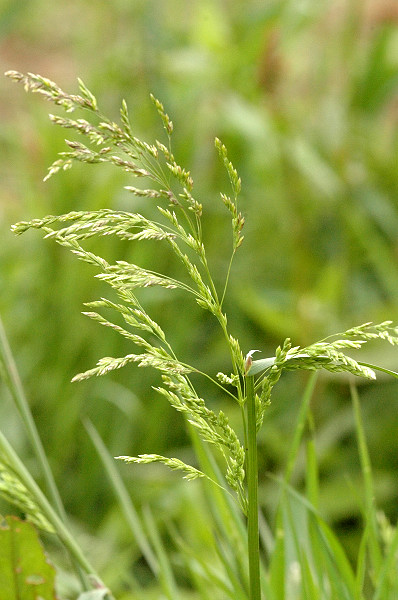
Canada Bluegrass

Poa compressa not quite out.

H. D. Thoreau, Journal, June 4, 1859

Cornus alternifolia well out. See June 10, 1856 ("Cornus alternifolia a day or two, up railroad; maybe longer elsewhere.")

Poa compressa .  The Canada bluegrass or flattened meadow-grass, is a perennial flattened meadow grass, similar to common meadow-grass,  native to Europe  found nearly worldwide as an introduced species. ~ Wikipedia . Specimen in Thoreau herbarium collected on June 14, 1859 at the railroad  causeway. Two other specimens collected at Britton’s Shanty and Great Road on June 2 and 4, 1859, which are in neighboring Lincoln, Massachusetts . The only Journal reference with a specific Concord locale is on June 23, 1860, the railroad at Walden Pond, likely the same locale as his June 14, 1859 collection. ~ Vascular Flora of Concord, Massachusetts. See June 23, 1860 ("Poa compressa may fairly begin on the railroad at Walden").

Monday, June 3, 2019

A large yellow butterfly

June 3

Friday. P. M. — Up Assabet. 


(Papilio glaucus ) (Wikipedia)

A large yellow butterfly (somewhat Harris Papilio Asterias like but not black-winged) three and a half to four inches in expanse. Pale-yellow, the front wings crossed by three or four black bars; rear, or outer edge, of all wings widely bordered with black, and some yellow behind it; a short black tail to each hind one, with two blue spots in front of two red-brown ones on the tail. (P. Turnus?)

Arenaria lateriflora well out, how long? 

Common rum cherry out yesterday, how long? 

Carex crinita out a good while. Carex lanuginosa, Smith's shore, green fruit. Carex pallescens, Smith's shore (higher up bank), green fruit. 

Nighthawk, two eggs, fresh. 

Quail heard.

H. D. Thoreau, Journal, June 3, 1859

A large yellow butterfly . . . (P. Turnus?).See May 28, 1855 ("Large yellow and black butterfly."); June 11, 1856 ("Saw yesterday a great yellow butterfly with black marks."); June 14, 1860 ("I see near at hand two of those large yellow (and black) butterflies which I have probably seen nearly a month . They rest on the mud near a brook. Two and three quarters to three inches in alar extent; yellow with a broad black border, outside of which a row of small yellow spots; three or four black marks transversely to the fore wings, and two fine lines parallel with the body on the hinder (?) wings; a small and slender swallow tail with reddish brown and blue at the tail; body black above and yellow along the sides. (C. says it is the Papilio Turnus of Say.)"). See also Lewis Hyde,  What Thoreau knew about butterflies :
"What he’s seen is the Eastern Tiger Swallowtail whose scientific name at the time was Papilio turnus. He seems unsure of that, however, and guesses that it’s Papilio asterias, the name properly belonging to the Black Swallowtail. The parenthetical question mark suggests that he knows he’s not sure and the name Harris indicates that he knows where to turn for help: Thaddeus William Harris . . .  In the entry for June 14, 1860 . . . Thoreau gives the correct scientific name of the Eastern Tiger Swallowtail. After a clear description (“a small and slender swallow tail with reddish brown and blue at the tail,” etc.) he adds a note: “C[hanning] says itis the Papilio Turnus of Say”. Thomas Say was another nineteenth-century entomologist whose three-volume master work, American Entomology, was originally published in the 1820s. In the Journal, however, Say does not appear until this entry in 1860, plausibly because in 1859 another entomologist, John Lawrence LeConte, had published a two-volume version of Say’s 1820 edition. LeConte’s edition has a fine color plate of the Tiger Swallowtail; William Ellery Channing must have seen it, whereupon, one year later, Thoreau is sure of the name."


Tiger swallowtails, hand-colored engraving by Cornelis Tiebout 
after drawings by Titian R. Peale, 
called Papilio turnus by Thomas Say, 
in his American Entomology, vol. 3, 1824-28

According to Harris "The caterpillar of the Turnus butterfly  lives upon the leaves of apple and wild-cherry trees. It is of a green color above  with little blue dots in rows, a yellow eye-spot with a black centre on each side of the third segment, a yellow and black band across the fourth segment , and the head, belly, and legs are pink. It suspends itself and becomes a chrysalis about the first of August, and is not changed to a butterfly till the month of June in the following summer."  See July 15, 1851 ("Slow- moving green worms, with rings spotted black and yellow, like an East Indian production.")

Arenaria lateriflora well out, how long? See June 6, 1852 ("The side-flowering sandwort, an inconspicuous white flower like a chickweed."); June 5, 1855 ("Side-flowering sandwort apparently three days out in Clamshell flat meadow."); June 10, 1856 ("Side-flowering sandwort abundantly out this side of Dugan Spring."); June 13, 1858 ("Arenaria lateriflora, how long?")

Nighthawk, two eggs, fresh. 
See May 30, 1860 ("On the wall, at the brook behind Cyrus Hosmer’s barn, I start a nighthawk within a rod or two. It alights again on his barn-yard board fence, sitting diagonally. I see the white spot on the edge of its wings as it sits. It flies thence and alights on the ground in his corn-field, sitting flat, but there was no nest under it. This was unusual. Had it not a nest nearby?") June 1, 1853 ("Walking up this side-hill, I disturb a nighthawk eight or ten feet from me . .Without moving, I look about and see its two eggs on the bare ground, on a slight shelf of the hill, on the dead pine-needles and sand, without any cavity or nest whatever."); June 7, 1853 ("Visit my nighthawk on her nest. . . . The sight of this creature sitting on its eggs impresses me with the venerableness of the globe"); June 5, 1854 ("Now, just be fore sundown, a nighthawk is circling, imp-like, with undulating, irregular flight over the sprout-land on the Cliff Hill, with an occasional squeak and showing the spots on his wings. He does not circle away from this place, and I associate him with two gray eggs somewhere on the ground beneath and a mate there sitting. ")  See also  A Book of Seasons,  by Henry Thoreau,, the Nighthawk

Saturday, June 1, 2019

The barberry flower is now in prime.

June 1. 

Farmer has heard the quail a fortnight. Channing yesterday. 

The barberry flower is now in prime, and it is very handsome with its wreaths of flowers. 

Many low blackberry flowers at Lee's Cliff. 

June-grass there well out. 

Krigia, how long? 

Breams' nests begun at Hubbard's Grove shore. They have carefully cleaned the bottom, removing the conferva, small weeds, etc., leaving the naked stems of some coarse ones, as the bayonet rush, bare and red. 

Young Stewart tells me that when he visited again that gray squirrel's nest which I described about one month ago up the Assabet, the squirrels were gone, and he thought that the old ones had moved them, for he saw the old about another nest. He found another, similar nest with three dead blind gray squirrels in it, the old one probably having been killed. 

This makes three gray squirrels' nests that I have seen and heard of (seen two of them) this year, made thus of leaves and sticks open in the trees, and I hear of some more similar ones found in former years, so that I think this mode of nesting their young may be the rule with them here. 

Add to this one red squirrel's nest of the same kind.

H. D. Thoreau, Journal, June 1, 1860


The barberry flower is now in prime, and it is very handsome with its wreaths of flowers. See May 29,  1852 ("Barberry in bloom. “); May 29, 1857 ("I perceive the buttery-like scent of barberry bloom from over the rock,”)

Many low blackberry flowers at Lee's Cliff.  See May 25, 1857 (“Also low blackberry on the rocks a day or two.”); May 28, 1859 (“Low blackberry in bloom on railroad bank.”); June 2, 1852 (“ Low blackberry in bloom. ”); June 5, 1855 (“Low blackberry out in low ground”); June 16, 1858 (“How agreeable and wholesome the fragrance of the low blackberry blossom,”)

Breams' nests begun. See June 6, 1855 (“I notice . . . two or three cleared or light-colored places, apparently bream-nests commenced.”); June 8, 1858 ("I see many breams’ nests”); June 11, 1856 (“See a bream’s nest two and a quarter feet diameter, laboriously scooped out, and the surrounding bottom for a diameter of eight feet (! !) comparatively white and clean”); June 26, 1857 (“Stand over a bream's nest close to the shore ”); July 1, 1852 (“From the bridge I see a bream's nest in soft sand on the edge of deeper water”); July 10, 1853 ("The bream poised over its sandy nest on waving fin”)


Three gray squirrels' nests that I have seen and heard of (seen two of them) this year, made thus of leaves and sticks open in the trees. See April 25, 1860 (“Mr. Stewart tells me that he has found a gray squirrel's nest up the Assabet, in a maple tree. I resolve that I too will find it.”);  May 29, 1860 (“In another white pine near by, some thirty feet up it, I found a gray squirrel's nest, with young”); . See also  January 24, 1856 (“That Wheeler swamp is a great place for squirrels. I observe many of their tracks along the riverside there. The nests are of leaves, and apparently of the gray species.”); March 6, 1856 (“ [A](probably) gray squirrel’s nest high in a pitch pine, and acorn shells about on it. ”); October 23, 1857 (“I see a squirrel's nest in a white pine, recently made, on the hillside near the witch-hazels.”); November 13, 1857 (“ I see, on a white oak on Egg Rock, where the squirrels have lately made a nest for the winter of the dry oak leaves . . . I suspect it is a gray squirrel's nest.”); May 31, 1858 (“go to see a gray squirrel's nest in the oak at the Island point. It is about fifteen feet from the ground,”); November 5, 1860 ([T]here are the nests of several gray squirrels in the trees.”)

Add to this one red squirrel's nest of the same kind. See May 29, 1860 ("Some eighteen feet high in a white pine in a swamp in the oak meadow lot, I climbed to a red squirrel’s nest. . . . This was a mass of rubbish covered with sticks, such as I commonly see (against the main stem), but not so large as a gray squirrel’s . . . I have thus found three squirrels’ nests this year, two gray and one red, in these masses of twigs and leaves and bark exposed in the tree-tops and not in a hollow tree, and methinks this is the rule and not the exception.")

Friday, May 31, 2019

Millers over river with long feelers

May 31. 

Tuesday. 

May 31, 2019

Small black flies or millers over river, with long feelers, flying low in swarms now.

H. D. Thoreau, Journal, May 31, 1859

See June 6, 1855 (“There are now those large swarms of black-winged millers a half-inch long, with two long streamers ahead, fluttering three to six inches over the water”). See also A Book of the Seasons, by Henry Thoreau, Insect Hatches in Spring (millers, perla, shad-flies or ephemera)


May 31. See A Book of the Seasons,  by Henry Thoreau, May 31

A Book of the Seasons,  by Henry Thoreau
"A book, each page written in its own season,
out-of-doors, in its own locality.”


~edited, assembled and rewritten by zphx © 2009-2021

Popular Posts Last 30 Days.

The week ahead in Henry’s journal

The week ahead in Henry’s journal
A journal, a book that shall contain a record of all your joy.
"A stone fruit. Each one yields me a thought." ~ H. D. Thoreau, March 28, 1859


I sit on this rock
wrestling with the melody
that possesses me.