Showing posts sorted by relevance for query tanager. Sort by date Show all posts

Wednesday, May 13, 2026

A Book of the Seasons: The Scarlet Tanager in May


I would make a chart of our life,
know why just this circle of creatures completes the world.
Observe all kinds of coincidences,
as what kinds of birds come with what flowers.
Henry Thoreau, April 18, 1852


Surprising red bird – 
a tanager against the 
darkening green leaves.

It appears as if 
he loved to contrast himself 
with the green forest. 

May 13.  Methinks I hear and see the tanager now. May 13, 1853

May 14.  C. sees the chestnut-sided warbler and the tanager to-day, and heard a whip-poor-will last night.  May 14, 1860

May 15.  As I sat by the Riordan crossing, thought it was the tanager I heard? . . . it must have been a tanager, which I hear frequently the 19th.   May 15, 1856

May 16.  Hear a tanager to-day, and one was seen yesterday.  May 16, 1859 

May 18. The scarlet tanagers are come. May 18, 1851

May 19. The tanager is now heard plainly and frequently. May 19, 1856

May 20.  Saw a tanager in Sleepy Hollow. It most takes the eye of any bird. You here have the red-wing reversed, – the deepest scarlet of the red-wing spread over the whole body, not on the wing-coverts merely, while the wings are black. It flies through the green foliage as if it would ignite the leaves. May 20, 1853

May 20.  See tanagers, male and female, in the top of a pine, one red, other yellow, from below. We have got to these high colors among birds. May 20, 1858

May 21.  A tanager, – the surprising red bird, – against the darkening green leaves. May 21, 1854

May 22.  Hear the hoarse note of the tanager and the sweet pe-a-wai. May 22, 1853

May 23. At Loring's Wood I hear and see a tanager. How he enhances the wildness and wealth of the woods! That contrast of a red bird with the green pines and the blue sky! Even when I have heard his note and look for him and find the fellow sitting on a dead twig of a pine, I am always startled. (They seem to love the darkest and thickest pines.) That incredible red, with the green and blue. I am transported; these are not the woods I ordinarily walk in. May 23, 1853

May 24As I sit just above the northwest end of the Cliff, I see a tanager perched on one of the topmost twigs of a hickory, evidently come to spy after me, peeping behind a leafet. He is between me and the sun, and his plumage is incredibly brilliant, all aglow. It a deep scarlet (with a yellower reflection when the sun strikes him), in the midst of which his pure-black wings look high-colored also. You can hardly believe that a living creature can wear such colors. A hickory, too, is the fittest perch for him. May 24, 1860

May 28.  I see a tanager, the most brilliant and tropical-looking bird we have, bright-scarlet with black wings, the scarlet appearing on the rump again between wing-tips. He brings heat, or heat him. A remarkable contrast with the green pines. At this distance he has the aspect and manners of a parrot, with a fullness about the head and throat and beak, indolently inspecting the limbs and twigs —leaning over to it — and sitting still a long time. The female, too, is a neat and handsome bird, with the same indolent ways, but very differently colored from the male; all yellow below with merely dusky wings, and a sort of clay(?)-color on back. May 28, 1855

May 29. At A. Hosmer's hill on the Union Turnpike I see the tanager hoarsely warbling in the shade; the surprising red bird, a small morsel of Brazil, advanced picket of that Brazilian army. But no more shall we see; it is only an affair of out-posts.  It appears as if he loved to contrast himself with the green of the forest. May 29, 1853


A Book of the Seasons,  by Henry Thoreau
"A book, each page written in its own season,
out-of-doors, in its own locality."
 ~edited, assembled and rewritten by zphx ©  2009-2026

https://tinyurl.com/hdt-tanager


Thursday, May 16, 2019

Hear a tanager to-day, and one was seen yesterday.

May 16 

Monday. 

Surveying Damon's farm and factory lot. 

Our corydalis was out the 13th. 

Hear a tanager to-day, and one was seen yesterday. 

Sand cherry out. 

Ranunculus abortivus well out (when?), southwest angle of Damon's farm. 

Hear a bobolink and kingbird, and find sparrows' nests on the ground. 

At eve the first spark of a nighthawk.

H. D. Thoreau, Journal, May 16, 1859

Our corydalis was out the 13th. See May 3, 1857 ("Corydalis glauca is five inches high. "); May 20, 1857 ("I find that the corydalis sprig which I brought home five days ago keeps fresh and blossoms remarkably well in water, — its delicate bright flesh-colored or pink flowers and glaucous leaves!");; July 11, 1857 ("There is an abundance of corydalis on the top of the Cliffs, but most of it is generally out of bloom"); May 29, 1858 ("Cannot find any large corydalis plants where it has been very plenty.")

Hear a tanager to-day, and one was seen yesterday.  See May 13, 1853 (“Methinks I hear and see the tanager now.”); May 15, 1856 ("As I sat by the Riordan crossing, thought it was the tanager I heard?"); May 18, 1851("The scarlet tanagers are come.”). May 19, 1856 (“The tanager is now heard plainly and frequently.”) See also A Book of Seasons,  by Henry Thoreau, the Scarlet Tanager

Sand cherry out. See May 4, 1855 ("Sand cherry yesterday leafs"); May 23, 1857 ("Sand cherry at Lupine Bank, possibly a day. “)

Hear a bobolink and kingbird.  See May 16, 1854 ("The earth is all fragrant as one flower. And bobolinks tinkle in the air.”) See also  May 10, 1853 ("New days, then, have come. . . now made perfect by the twittering of the kingbird and the whistle of the oriole amid the elms,, - if not already the bobolink.")

At eve the first spark of a nighthawk. See May 17, 1853 ("I hear the first unquestionable nighthawk squeak and see him circling far off high above the earth. It is now about 5 o'clock p. m");; May 23, 1857 ("and at evening I hear the spark of a nighthawk.");  May 25, 1852 ("First nighthawks squeak and boom.");   See also A Book of Seasons,  by Henry Thoreau,the Nighthawk

Sunday, May 15, 2016

Peach, strawberry and cherry

May 15. 

A fog this morning. Our peach out. 

P. M. — To beeches. 

As I sat by the Riordan crossing, thought it was the tanager I heard? I think now, only because it is so early, that it may have been the yellow-throat vireo.  [No; it must have been a tanager, which I hear frequently the 19th.]

J J. Audubon's blue yellow-backed warbler, now Northern Parula warbler (Setophaga americana ).

l see also, for a moment, in dry woods, a warbler with blue-slate head and apparently all yellow beneath for a minute, nothing else conspicuous; note slightly like tseep, tseep, tseep, tseep, tsit sitter ra-re-ra, the last fast, on maples, etc. Maybe I heard the same yesterday. [No doubt the Sylvia Americana, blue yellow-back or parti-colored warbler; heard before.]

Northern wild red cherry out, out by railroad; maybe day or two elsewhere. 

At Heywood Spring I see a clumsy woodchuck, now, at 4 P. M., out feeding, gray or grizzly above, brown beneath. It runs, or waddles, to its hole two or three rods off, and as usual pauses, listening, at its entrance till I start again, then dives in. 

Viola cucullata abundant now. 

Just on the brink of this Heywood Spring, I find what may be the Stellaria borealis (if it is not the longifolia, but it is not in cymes like that; only a single flower to each axil, now at  least), though Bigelow makes its calyx-divisions nerve-less. These are three-nerved, and one flower, at least, has five styles. It has been out perhaps several days. Some of the flowers are without petals, others with those very deeply cleft or divided white petals. The others may have pollen.

Strawberry well out; how long? 

On Amelanchier Botryapium, many narrow dark bronze-colored beetles (say three fourths inch long) coupled and at same time eating the flowers, calyx and all. 

Night-warbler. 

Hickory leafets not so large as beech. Beech leaves two inches long. Say it has leafed a day or two. 

White birch pollen. Beech not out yet. 

Checker-berries very abundant on south side of Pine Hill, by pitch pine wood. Now is probably best time to gather them. 

Cleared out the Beech Spring, which is a copious one. So I have done some service, though it was a wet and muddy job. Cleared out a spring while you have been to the wars. Now that warmer days make the traveller thirsty, this becomes an important work. 

This spring was filled and covered with a great mass of beech leaves, amid and beneath which, damp and wet as they were, were myriads of snow-fleas and also their white exuviae; the latter often whitening a whole leaf, mixed with live ones. It looks as if for coolness and moisture — which the snow had afforded — they were compelled to take refuge here. 

Cerasus pumila, south side Pine Hill, not yet by Cut Woods. 

Perceive some of that delicious meadow fragrance coming over the railroad causeway. 

Measured a chestnut stump cut last winter on Pine Hill; twenty five inches in diameter and fifty-six rings.

H. D. Thoreau, Journal, May 15, 1856

The tanager I heard? See May 13, 1853 (“Methinks I hear and see the tanager now.”); May 16, 1859 ("Hear a tanager to-day, and one was seen yesterday."); May 18, 1851("The scarlet tanagers are come.”). May 19, 1856 (“The tanager is now heard plainly and frequently.”)See also May 20, 1858 (“See tanagers, male and female, in the top of a pine, one red, other yellow, from below. We have got to these high colors among birds”); May 23, 1853 (“At Loring's Wood heard and saw a tanager. That contrast of a red bird with the green pines and the blue sky! Even when I have heard his note and look for him and find the bloody fellow, sitting on a dead twig of a pine, I am always startled. . ..That incredible red, with the green and blue, .. . .I am transported; these are not the woods I ordinarily walk in. . . .How he enhances the wildness and wealth of the woods!”)May 24, 1860 ("You can hardly believe that a living creature can wear such colors.”); May 28, 1855 (" I see a tanager, the most brilliant and tropical-looking bird we have, bright-scarlet with black wings, the scarlet appearing on the rump again between wing-tips. He brings heat, or heat him. A remarkable contrast with the green pines.”) See also A Book of the Seasons,  by Henry Thoreau, The Scarlet Tanager in May

A warbler with blue-slate head and apparently all yellow beneath See May 13, 1856 ("At the swamp, hear . . . the tweezer-bird or Sylvia Americana . . . At the Kalmia Swamp, the parti-colored warbler, and was that switter switter switter switter swit also by it?" ");  May 27, 1855 ("The blue yellow-back or parti-colored warbler still, with the chestnut crescent on breast, near my Kalmia Swamp nest.") See also A Book of the Seasons,  by Henry Thoreau, the parti-colored warbler (Sylvia Americana)

Northern wild red cherry out, out by railroad [pin cherry (Prunus pensylvaticus] See  May 5, 1855 ("The trees and shrubs which I observe to make a show now with their green . . .in the order of their intensity and generalness — . . . Choke-cherry shoots . . .  young black cherry, . . . probably wild red cherry in some places,. . . cultivated cherry") May 10, 1858 ("The northern wild red cherry by Everett's, apparently to-morrow."); July 13, 1852 ("The northern wild red cherry of the woods is ripe, handsome, bright red, but scarcely edible; also, sooner than I expected, ")

 [A woodchuck] runs, or waddles, to its hole two or three rods off, and as usual pauses, listening, at its entrance. See April 29, 1855 ("I see a woodchuck . . . He runs to within three feet of his hole; then stops, with his head up.")

Viola cucullata abundant now. See May 3, 1856 (" Viola cucullata, how long?"); May 16, 1852 (“I observe some very pale blue Viola cuculata in the meadows.”); May 19, 1858 (“There appears to be quite a variety in the colors of the Viola cucullata. Some dark-blue, if not lilac (?), some with a very dark blue centre and whitish circumference, others dark-blue within and dark without, others all very pale blue.”);  May 31, 1858 (“To-day a white V. cucullata. ”) See also A Book of the Seasons, by Henry Thoreau, the Violets

I find what may be the Stellaria borealis [boreal starwort/stitchwort](if it is not the longifolia [long-leaved stitchwort], but it is not in cymes like that; only a single flower to each axil, now at  
least) 
See May 21, 1856 ("At the trough near Turnpike, near Hosmer’s Spring, the (perhaps) Stellaria borealis of the 15th. I am still in doubt whether it is a stellaria or cerastium. This is quite smooth, four to five inches high, spreading and forking,with a single flower each fork, on a long peduncle. . . Can it be Stellaria longipes?"); May 23, 1856 ("
The stellaria at Heywood Spring must be the same with that near the E. Hosmer Spring, though the former has commonly fewer styles and rather slenderer leaves.  It appears to be the S. borealis, though the leaves are narrowly lanceolate; has three to seven styles; a few petals (cleft almost to the bottom) or none; pods, some larger than the calyx  and apparently ten-ribbed; petals, now about the length of the sepals.");  June 8, 1856 ("Stellaria longrfolia opposite Barbarea Shore not yet out. It is obviously different from what I call S. borealis.")See also June 6, 1854 ("The Stellaria longifolia has been out, apparently, a day or two.");  May 19, 1858  ("Stellaria borealis well out, apparently several days."); June 6, 1859 ("Stellaria longifolia, at Well Meadow Head, how long?"); May 29, 1860 ("Saw, in a shaded swamp beyond, the Stellaria borealis, still out, — large, broadish leaves.")

On Amelanchier Botryapium, many narrow dark bronze-colored beetles . .. eating the flowers, calyx and all.  See May 15, 1858 ("The shad-bush in bloom is now conspicuous, its white flags on all sides. Is it not the most massy and conspicuous of any wild plant now in bloom? ") See also
May 17, 1853 ("The petals have already fallen from the Amelanchier Botryapium, and young berries are plainly forming."); May 19, 1854 ("With what unobserved secure dispatch nature advances! The amelanchiers have bloomed, and already both kinds have shed their blossoms and show minute green fruit. There is not an instant's pause!")
Hickory leafets not . . . two inches long. See  May 8, 1853 ("Some hickory buds are nearly two inches long.");  May 14, 1855 ("Some hickories, just opening their leaves, make quite a show with the red inner sides of the bud-scales turned back."); May 17, 1853 ("How red are the scales of some hickory buds, now turned back!"); May 18, 1851 ("The hickory buds are almost leaves."); May 24, 1860 ("I notice the first shadows of hickories, - not dense and dark shade, but open-latticed, a network of sun and shadow on the north sides of the trees . . ., I see a tanager  holding by the tender leafets , now five inches long "); May 26, 1857 ("The very sudden expansion of the great hickory buds, umbrella-wise."); May 29, 1857 (“ Suddenly the buds burst, and those large pinnate leaves stretched forth in various directions.”)

Beech leaves two inches long. See May 4, 1855 ("The beech leaf-buds are . . .  nearly an inch and a half long and very slender . . . will open, apparently, in three or four days. The blossom-buds are still larger; may bloom in eight days.")

White birch pollen.  May 13, 1855 ("One white birch sheds pollen. The white birches on the side of Ponkawtasset are beginning to show faint streaks of yellowish green here and there. ")

Checker-berries very abundant . . .best time to gather them. See May 21, 1857 ("I find checkerberries still fresh and abundant. Last year was a remarkable one for them. They lurk under the low leaves, scarcely to be detected . . . dark-scarlet berries, some of them half an inch in diameter, broad pear-shaped, of a pale or hoary pink color beneath.") Note: “checkerberry" is another name for American wintergreen (Gaultheria procumbens). See Checkerberry cum Wintergreen. and GoBotany.  What HDT calls  “wintergreen” is Chimaphila umbellata, a/k/a pipsissewa,

Cerasus pumila, south side Pine Hill, not yet by Cut Woods. See  May 16, 1859 ("Sand cherry out."); May 22, 1855 ("Cerasus pumila in full bloom."); see also July 28, 1856 ("Sand cherry ripe. The fruit droops in umble-like clusters, two to four peduncles together, on each side the axil of a branchlet or a leaf.") ; August 10, 1860 ("Sand cherry is well ripe — some of it — and tolerable, better than the red cherry or choke-cherry.")

Perceive some of that delicious meadow fragrance coming over the railroad causeway. See  May 6, 1855 ("that unaccountable fugacious fragrance, as of all flowers,”); May 27, 1855 ("The meadow fragrance to-day”); May 27, 1856 ("perceived the meadow fragrance”); May 27, 1857 ("I perceived that rare meadow fragrance on the 25th.”); June 3, 1860 ("I perceive the meadow fragrance.”)

May 15. See A Book of the Seasons,  by Henry Thoreau,  May 15 

See for a moment
warbler with blue-slate head 
all yellow beneath.

A Book of the Seasons,  by Henry Thoreau
"A book, each page written in its own season,
out-of-doors, in its own locality."
 ~edited, assembled and rewritten by zphx ©  2009-2026

https://tinyurl.com/hdt-560515

Saturday, June 23, 2018

With some boys to Flint's Pond, to see the nests


June 23. 

June 23, 2018

P. M. – With some boys to Flint's Pond, to see the nests mentioned on [June 19]. 

The hermit(?) thrush's nest referred to on last page is a rather shallow nest of loose construction, though sufficiently thick-bottomed, about five inches in diameter and hardly one deep within, externally of rather coarse and loosely arranged stubble, chiefly everlasting stems with the flowers yet emitting some fragrance, some whorled loosestrife with the seed-vessels, etc., etc.; within, finer grass and pine-needles. Yet the grass is as often bent angularly as curved regularly to form the nest. 

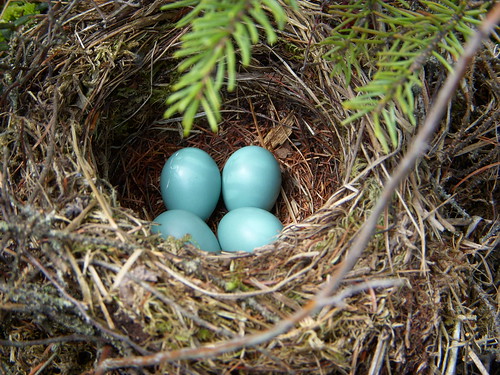
The tanager's nest of the 19th is four and a half to five inches wide and an inch or more deep, considerably open to look through; the outside, of many very slender twigs, apparently of hemlock, some umbelled pyrola with seed-vessels, everlasting, etc.; within, quite round and regular, of very slender or fine stems, apparently pinweed or the like, and pine needles; hardly any grass stubble about it. 

The egg is a regular oval nine tenths of an inch long by twenty seven fortieths, pale-blue, sprinkled with purplish brown spots, thickest on the larger end. To-day there are three rather fresh eggs in this nest. Neither going nor returning do we see anything of the tanager, and conclude it to be deserted, but perhaps she stays away from it long. 

That rather low wood along the path which runs parallel with the shore of Flint's Pond, behind the rock, is evidently a favorite place for veery-nests. I have seen three there. 

One lately emptied I got to day, amid the dry leaves by some withered ferns. It is composed externally of a mass of much withered oak leaves, thick and pretty well stuck together, plastered or stuck down over the rim, is five to six inches in diameter and four high, two and a half wide within, and very deep, more than two inches. Next to the leaves come bark-shreds, apparently maple bark, and the lining is of a little fine grass, pine-needles, apparently a little hypnum root-fibre. A very deep well-shaped and rounded cavity.


Saw another with two eggs in it, one a much lighter blue than the other. This was by the path leading toward the rock, amid some sprouts at the base of a sapling oak, elevated about six inches above the general level (the veery's). It was a deep, firm nest three quarters of an inch thick, outwardly oak and chestnut leaves, then rather coarse bark-shreds, maple or oak, lined with the same and a few dark root-fibers. 

What that empty nest partly of mud, with conspicuous saliva, on a middle-sized maple, against main stem, near wood thrush’s? 

In the case of the hermit (?) thrush, wood thrush, and tanager's, each about fourteen feet high in slender saplings, you had to climb an adjacent tree in order to reach them. 

A male redstart seen, and often heard. What a little fellow! 

Lysimachia quadrifolia, how long? and veiny-leaved hawkweed, how long? 

Get an egg out of a deserted bank swallow's nest, in a bank only about four feet high dug in the spring for a bank wall near Everett's. The nest is flattish and lined abundantly with the small, somewhat downy, naturally curved feathers of poultry. Egg pure white, long, oval, twenty-seven fortieths by eighteen fortieths of an inch. 

Take two eggs out of the oviduct of an E. insculpta, just run over in the road. They have lately cooked a snapping turtle at Mrs. Wetherbee's, eggs and all, and she thinks there were just forty-two of them!

H. D. Thoreau, Journal, June 23, 1858


Veery nests. See June 2, 1852 (“Nest of Wilson's thrush with bluish-green eggs.”); June 18, 1858 ("A little boy brings me an egg of Wilson's thrush, which he found in a nest in a low bush about a foot from the ground.”); June 19, 1853 ("In the middle of the path to Wharf Rock at Flint's Pond, the nest of a Wilson's thrush, five or six inches high, between the green stems of three or four golden rods, made of dried grass or fibres of bark, with dry oak leaves attached loosely, making the whole nine or ten inches wide, to deceive the eye. Two blue eggs. Like an accidental heap. Who taught it to do thus?"); June 19, 1858 (“boys have found this forenoon at Flint’s Pond one or more veery-nests on the ground. ”)

WILSON'S THRUSH or VEERY, Turdus Wilson,The song of this species, although resembling that of the Wood Thrush in a great degree, is less powerful, and is composed of continued trills repeated with different variations, enunciated with great delicacy and mellowness, so as to be extremely pleasing to one listening to them in the dark solitudes where the sylvan songster resides. It now and then tunes its throat in the calm of evening, and is heard sometimes until after the day has closed. J.J. Audubon

The tanager's nest of the 19th ... To-day there are three rather fresh eggs. See June 19, 1858 ("Two fresh eggs in small white oak sapling, some fourteen feet from ground. They saw a tanager near. (I have one egg.) ")See also A Book of the Seasons, by Henry Thoreau, the Scarlet Tanager

You had to climb an adjacent tree in order to reach them. See June 11, 1855("In order to get the deserted tanager’s nest at the top [of] a pitch pine which was too weak to climb, we carried a rope in our pockets and took three rails a quarter of a mile into the woods, and there rigged a derrick, by which I climbed to a level with the nest, . . . Tied the three tops together and spread the bottoms. “)

Veiny-leaved hawkweed, how long? See June 23, 1859 ("Veiny-leaved hawkweed freshly out."); See also August 21, 1851 (" I have now found all the hawkweeds. Singular these genera of plants, plants manifestly related yet distinct. They suggest a history to nature, a natural history in a new sense.”). See also A Book of the Seasons,  by Henry Thoreau, The Hawkweeds (hieracium)

A male redstart seen, and often heard. What a little fellow! See June 23, 1855 ("Probably a redstart’s nest on a white oak sapling, twelve feet up, on forks against stem. Have it. See young redstarts about.”); May 29, 1855 ("females of the redstart, described by Wilson, — very different from the full-plumaged black males. ")  See also A Book of the Seasons,  by Henry Thoreau, The American Redstart

Get an egg out of a deserted bank swallow's nest. See November 20, 1857 ("Some bank swallows’ nests are exposed by the caving of the bank at Clamshell. The very smallest hole is about two and a half inches wide horizontally, by barely one high. All are much wider than high (vertically). . . .The nest is a regular but shallow one made simply of stubble, about five inches in diameter, and three quarters of an inch deep. ")

Thursday, May 19, 2016

As he looked at my sail, I listened to his singing.

May 19


Thick fog in the morning, which lasted late in the forenoon and left behind it rainy clouds for the afternoon. 

P. M. — To Cedar Swamp. 

Landed at Island Neck, and saw a small striped snake in the act of swallowing a Rana palustris, within three feet of the water. The snake, being frightened, released his hold, and the frog hopped off to the water. 

Hear and see a yellow-throated vireo, which methinks I have heard before. Going and coming, he is in the top of the same swamp white oak and singing indolently, ullia — eelya, and sometimes varied to eelyee

The tanager is now heard plainly and frequently. 


Aquatic Wood-wagtail
(Audubon)
I see running along the water’s edge on the Island Neck, amid the twigs, a new bird, slender and somewhat warbler-like, but plainly a Turdus, with a deep, dark chocolate-brown back (apparently uniformly) , apparently cream-colored beneath, handsomely and abundantly spotted with dark brown, vent white, light flesh-colored legs, yellowish or cream-colored line over eyes. Me thinks it teetered or wagged its tail. Flew soon and was quite shy. I think it must have been the Turdus aquaticus from its dark chocolate-brown back and running along the water’s edge. Feel pretty sure, yet that is said to have white (?) over eye. I lost it before I had examined fully. Quite a discovery. Vide golden-crowned thrush carefully. 

Apple in bloom; some, no doubt, earlier. Night hawk’s squeak. Red-Wing’s nest made, and a robin's without mud, on black willow four feet above water. 

As I sail up the reach of the Assabet above Dove Rock with a fair wind, a traveller riding along the highway is watching my sail while he hums a tune. How inspiring and elysian it is to hear when the traveller or the laborer from a call to his horse or the murmur of ordinary conversation rises into song! It paints the landscape suddenly as no agriculture, no flowery crop that can be raised. It is at once another land, the abode of poetry. I am always thus affected when I hear in the fields any singing or instrumental music at the end of the day. It implies a different life and pursuits than the ordinary. As he looked at my sail, I listened to his singing. Perchance they were equally poetic, and we repaid each other. Why will not men oftener advertise me of musical thoughts? The singer is in the attitude of one inviting the muse, — aspiring. 

The Maryland yellow-throat amid the alders sings now, whit-we-chee whit-we-chee whit-we-chee whit-whit, the last two fast, or whit alone, or none.  

Woolly aphides on alder. 

The Smilacina trifolia will apparently bloom to-morrow or next day.

Returning, stopped at Barrett's sawmill while it rained a little. Was also attracted by the music of his saw. He was sawing a white oak log; was about to saw a very ugly and knotty white oak log into drag plank, making an angle. Said that about as many logs were brought to his mill as ten years ago, — he did not perceive the difference, — but they were not so large, and perhaps they went further for them. There were white oak, pine, maple, and walnut logs waiting to be sawed.

I observed that he was not grinding. No, he said, it was the first day he had not had a grist, though he had plenty of water; probably because the farmers were busy planting.  

A bullfrog, sluggish, by my boat’s place. 

On the 13th I saw washed up to the edge of the meadow, this side of Clamshell, portions of one or two large bluish-white eggs, apparently a size larger than hens’ eggs, which may have been laid last year by some wild fowl in the meadow. 

May 19, 2016

If my friend would take a quarter part the pains to show me himself that he does to show me a piece of roast beef, I should feel myself irresistibly invited. He says, — 

“ Come and see
Roast beef and me.”

I find the beef fat and well done, but him rare.

H. D. Thoreau, Journal, May 19, 1856


Saw a small striped snake in the act of swallowing a Rana palustris . . . The snake, being frightened, released his hold, and the frog hopped off to the water. See  August 23, 1851 ("
I saw a snake by the roadside and touched him with my foot . . . He had a toad in his jaws, which he was preparing to swallow with his jaws distended to three times his width, but he relinquished his prey in haste and fled"); July 23, 1856 ("A small bullfrog in the act of swallowing a young but pretty sizable apparently Rana palustris . . . I sprang to make him disgorge, but it was too late to save him.");

Hear and see a yellow-throated vireo, which methinks I have heard before. See 
 May 18, 1856 ("I think I hear a yellow-throated vireo. "); May 27, 1854 ("I see and hear the yellow-throated vireo. It is somewhat similar (its strain) to that of the red-eye, prelia pre-li-ay, with longer intervals and occasionally a whistle like tlea tlow, or chowy chow, or tully ho on a higher key.”) See also A Book of the Seasons,  by Henry Thoreau, The Yellow-throated Vireo

The tanager is now heard plainly and frequently.  See     May 15, 1856 ("As I sat by the Riordan crossing, thought it was the tanager I heard? . . . it must have been a tanager, which I hear frequently the 19th. ");   May 22, 1853 ("Hear the hoarse note of the tanager and the sweet pe-a-wai."); May 23, 1853 ("I hear and see a tanager. How he enhances the wildness and wealth of the woods! ") See also A Book of the Seasons, by Henry Thoreau, The Scarlet Tanager in May

I see running along the water’s edge on the Island Neck, amid the twigs, a new bird, slender and somewhat warbler-like, but plainly a Turdus. See May 23, 1860 ("[I see]running along the shore close to the water, at different times, three or four water-thrushes (water wagtails, Turdus Noveboracensis ) . . . It is considerably like the golden-crowned thrush, but it has a distinct buffish-white line over the eye and the breast and sides distinctly striped with dark. All above uniform olive-brown. It may be distinguished at a distance from a sparrow by its wagging motion, teetering on its perch. It persistently runs along the shore, peetweet- and song-sparrow-like, running like a rail around the tussocks and other obstacles and appearing again at the water's edge. It was not very shy.") Note. In 1856, the warbler known today as the northern waterthrush (Parkesia noveboracensis) was most commonly referred to as
  • Aquatic Wood-Wagtail, or
  • New York Thrush or Water Thrush (Turdus noveboracensis or  Turdus aquaticus). 
Apple in bloom. See The blooming of the apple trees is becoming general.  See May 18, 1851 ("The blooming of the apple trees is becoming general. ") See also A Book of the Seasons,  by Henry Thoreau, Apple Blossom Time
 
A traveller riding along the highway is watching my sail while he hums a tune. See March 26, 1855 ('"Sail down to the Great Meadows. A strong wind with snow driving from the west and thickening the air. The farmers pause to see me scud before it."); April 18, 1856 ("The farmer neglects his team to watch my sail."); September 27, 1858 ("The farmers digging potatoes on shore pause a moment to watch my sail and bending mast.")

I am always thus affected when I hear in the fields any singing or instrumental music at the end of the day. See  April 19, 1856 ("Was awakened in the night to a strain of music dying away, — passing travellers singing."); June 14, 1851 ("How sweet and encouraging it is to hear the sound of some artificial music from the midst of woods or from the top of a hill at night, borne on the breeze from some distant farmhouse, — the human voice or a flute!"); June 16, 1852 ("A flute from some villager. How rare among men so fit a thing as the sound of a flute at evening!"); June 18, 1852 ("I hear a man playing a clarionet far off."); June 25, 1852 ("Now his day's work is done, the laborer plays his flute, — only possible at this hour."); July 12, 1851 ("I hear a human voice, — some laborer singing after his day's toil");   July 20, 1853 ("You are pretty sure also to hear some human music, vocal or instrumental, far or near.")  August 15, 1851 ("I hear now from Bear Garden Hill — I rarely walk by moonlight without hearing — the sound of a flute, or a horn, or a human voice.")

The Maryland yellow-throat amid the alders sings now. See May 10, 1858 ("As I paddle along, hear the Maryland yellow-throat, the bobolink, the oven-bird, and the yellow-throated vireo. . . . It is remarkable how many new birds have come all at once to-day.");  May 11, 1854 ("Now, some time after sunset, the robins scold and sing, the Maryland yellow-throat is heard amid the alders and willows by the waterside, and the peetweet and black birds, and sometimes a kingbird, and the tree-toad.")

The Smilacina trifolia will apparently bloom to-morrow or next day. See  May 4, 1856 ("Smilacina trifolia recently up; will apparently open in ten or twelve days. "); See also A Book of the Seasons,  by Henry Thoreau, Three-leaved  false Solomon's-seal
 
Returning, stopped at Barrett's sawmill while it rained a little. Was also attracted by the music of his saw. See March 15, 1854 ("The sound of Barrett's sawmill in the still morning comes over the water very loud."); April 15, 1856 ("I hear very distinctly Barrett’s sawmill at my landing."); May 8, 1857 ("I hear the sound of Barrett's sawmill with singular distinctness."); August 17, 1858 ("Being overtaken by a shower, we took refuge in the basement of Sam Barrett’s sawmill, where we spent an hour.")

Wood pewee. See  May 17, 1853 ("I hear the wood pewee, — pe-a-wai. The heat of yesterday has brought him on."); May 17, 1854 ("Hear the wood pewee, the warm weather sound.");  May 22, 1854 ("I hear also pe-a-wee pe-a-wee, and then occasionally pee-yu, the first syllable in a different and higher key emphasized, — all very sweet and naive and innocent"); See also A Book of the Seasons,  by Henry Thoreau, The Arrival of the Eastern Wood Pewee

May 19.  See A Book of the Seasons, by Henry Thoreau, May 19

He looked at my sail – 
I listened to his singing
inviting the muse.

A Book of the Seasonsby Henry Thoreau
"A book, each page written in its own season,
out-of-doors, in its own locality.”
~edited, assembled and rewritten by zphx © 2009-2026

https://tinyurl.com/hdt-560519

Popular Posts Last 30 Days.

The week ahead in Henry’s journal

The week ahead in Henry’s journal
A journal, a book that shall contain a record of all your joy.
"A stone fruit. Each one yields me a thought." ~ H. D. Thoreau, March 28, 1859


I sit on this rock
wrestling with the melody
that possesses me.