Sunday, August 7, 2016

The new steam-whistle

August 7

Hemp, perhaps a week. 

Heard this forenoon what I thought at first to be children playing on pumpkin stems in the next yard, but it turned out to be the new steam-whistle music, what they call the Calliope (!) in the next town. It sounded still more like the pumpkin stem near at hand, only a good deal louder. Again I mistook it for an instrument in the house or at the door, when it was a quarter of a mile off, from habit locating it by its loudness. At Acton, six miles off, it sounded like some new seraphim in the next house with the blinds closed. All the milkmen and their horses stood still to hear it. The horses stood it remarkably well. It was not so musical as the ordinary whistle. 

P. M. — With a berry party, ride to Conantum. 

At Blackberry Steep, apparently an early broad- leafed variety of Desmodium paniculatum, two or three days. This and similar plants are common there and may almost name the place. The D. rotundifolium is there abundant; also, beside, Lespedeza hirta and capitata, the elliptic-oblong L. violacea and the angustata, as also at Heywood Peak. All these plants seem to love a dry open hillside, a steep one. Are rarely upright, but spreading, wand-like. 

Aster patens, a day or more. Inula, some time. Mulgedium, perhaps a fortnight. Eupatorium sessilifolium, apparently about August 5th. 

I suspect that I see but one species of smooth-stemmed grape as yet. 

I must contrast the Galium circoezans and pilosum (?) more carefully. Vide if the first ever has purple flowers. The only difference, perhaps, that I yet notice is that the leaves of the latter are scarcely three-nerved and are more rounded or obovate, and it is a later plant. 

I see that common gall on goldenrods now on an S. coesia. 

The river has been raised by the rain, and water stands still in low grass ground. 

The leaves in low land, as of the mulgedium, are white with mildew, owing  the continued dampness of dog-days. One mulgedium at Corner Spring is at least ten feet high and hollow all the way. 

Those who have weak eyes complain of the darkness of the late dog-days.

H. D. Thoreau, Journal, August 7, 1856

Hemp, perhaps a week. See February 9, 1853 ("Dr. Harris thinks the Indians had no real hemp but their apocynum.");  August 4, 1854 ("Cannabis sativa."); August 11, 1852 ("Cannabis sativa, apparently out."); August 16, 1851 ("Hemp (Cannabis sativa), said by Gray to have been introduced; not named by Bigelow. Is it not a native?"); August 28, 1852 ("Hemp still in blossom.”) ;  September 2, 1856 ("Some years ago I sought for Indian hemp (Apocynum cannabinum) hereabouts in vain, and concluded that it did not grow here. A month or two ago  . . .  my eyes fell on it, aye, in three different places, and different varieties of it.") See also A Book of the Seasons, by Henry Thoreau, Dogsbane and Indian hemp

I see that common gall on goldenrods now. See July 30, 1853 ("I 
See some green galls on a goldenrod three quarters of an inch in diameter, shaped like a fruit or an Eastern temple, with two or three little worms inside, completely changing the destiny of the plant . . . It suggests that Nature is a kind of gall, that the Creator stung her and man is the grub she is destined to house and feed.”)

August 7. See A Book of the Seasons, by Henry Thoreau, August 7

All the milkmen and
their horses stand still to hear 
the Calliope.


A Book of the Seasons, by Henry Thoreau
"A book, each page written in its own season,
out-of-doors, in its own locality.”

~edited, assembled and rewritten by zphx © 2009-2026

https://tinyurl.com/hdt-560807

Saturday, August 6, 2016

Artificial, denaturalized persons cannot handle nature without being poisoned.

August 6

Copious and continuous rain in the night, deluging, soaking rain, with thunder and lightning, beating down the crops; and this morning it is cooler and clearer and windier. 

P. M. — To Walden. 

The wind, or motion of the air, makes it much cooler on the railroad causeway or hills, but in the woods it is as close and melting as before. 

Solidago altissima, a small specimen, a day or two. Apios tuberosa, some days. Rubus hispidus ripe. Middle umbels of the bristly aralia ripe. 

Desmodium nudiflorum, some time out at Peak. It is sometimes three feet high! Holly berries ripe. Clethra, how long? Some anychia shows green seed. Desmodium rotundifolium, some days at least.

Cynoglossum Morisoni mostly gone to seed, roadside, at grape-vine just beyond my bean-field. Some is five feet high. 

Aster macrophyllus, apparently two or three days, at hillside, under beaked hazel.

Eupatorium purpureum at Stow's Pool, apparently several days, but more common there the tall hollow one, whorled to top, also out. 

Hear a nuthatch. 

Hieracium scabrous. 

Artificial, denaturalized persons cannot handle nature without being poisoned. If city-bred girls visit their country cousins, — go a-berrying with them, — they are sure to return covered with blueberry bumps at least. They exhaust all the lotions of the country apothecary for a week after. Unnamable poisons infect the air, as if they were pursued by imps. I have known those who forbade their children going into the woods at all.

H. D. Thoreau,  Journal, August 6, 1856

The wind, or motion of the air, makes it much cooler on the railroad causeway or hills, but in the woods it is as close and melting as before. See August 6, 1854 ("The sun is quite hot to-day, but the wind is cool . . .Methinks that after this date there is commonly a vein of coolness in the wind.”)

Hieracium scabrous. See July 21, 1851 ("The rough hawkweed, too, resembling in its flower the autumnal dandelion.”); August 21, 1851 (" I have now found all the hawkweeds. Singular these genera of plants, plants manifestly related yet distinct. They suggest a history to nature, a natural history in a new sense.”) See also A Book of the Seasons,  by Henry Thoreau, The Hawkweeds (hieracium)

If city-bred girls visit their country cousins, — go a-berrying with them, — they are sure to return covered with blueberry bumps at least. August 6, 1851 ("We in the country make no report of the seals and sharks in our neighborhood to those in the city. We send them only our huckleberries, not free wild thoughts.”)

August 6. See A Book of the Seasons, by Henry Thoreau, August 6


A Book of the Seasons,  by Henry Thoreau
"A book, each page written in its own season,
out-of-doors, in its own locality.” 
~edited, assembled and rewritten by zphx © 2009-2021

Friday, August 5, 2016

Botanizing the Assabet near House-leek Rock

August 5

August 5, 2016

A. M. — On river. 

Mikania a day or two. Polygonum amphibium in water, slightly hairy, well out. Polygonum orientate, how long? 

P. M. — To house-leek via Assabet Bath. 

Trichostema, maybe several days in some places. Nightshade berries, how long? 

When I crossed the new stone bridge a great water adder lay on it, full five feet long and nearly as big round as my arm. It turned and ran along, with a coarse grating rustle, to the end of the railing, and then dropped deliberately head foremost from the last abutment, full nine feet, to the gravelly ground, amid the osiers, making a loud sound when he struck; at once took to the water, and showed his head amid the pads. I also saw another similar one at House-leek Rock. 

Centaurea well out, how long? 

Aster dumosus, apparently a day or two, with its large conspicuous flower-buds at the end of the branchlets and linear-spatulate involucral scales. 

At haunted house site, as at Bittern Cliff grain-field, I see much apparent Euphorbia maculata semi-erect in the grass. Eupatorium pubescens, by Pear Path. 

I now find an abundance of the clustered rubus ripe. It is not large and has a clammy, subacid taste, but some are very sweet. Clusters generally drooping.

Hypericum mutilum, dwart john’s-wort,
August 2, 2019
Now, at 4 p. m. this dog-day, cloudy weather, the Hypericum mutilum is abundantly open in the Solidago lanceolata path, sometimes fifteen inches high, while the Canadense and angulatum are shut.

S. lanceolata, some days. S. nemoralis, two or three days. 

Choke-cherries near House-leek Rock begin to be ripe, though still red. They are scarcely edible, but their beauty atones for it. See those handsome racemes of ten or twelve cherries each, dark glossy red, semi- transparent. You love them not the less because they are not quite palatable. Along fences or hedgerows. 


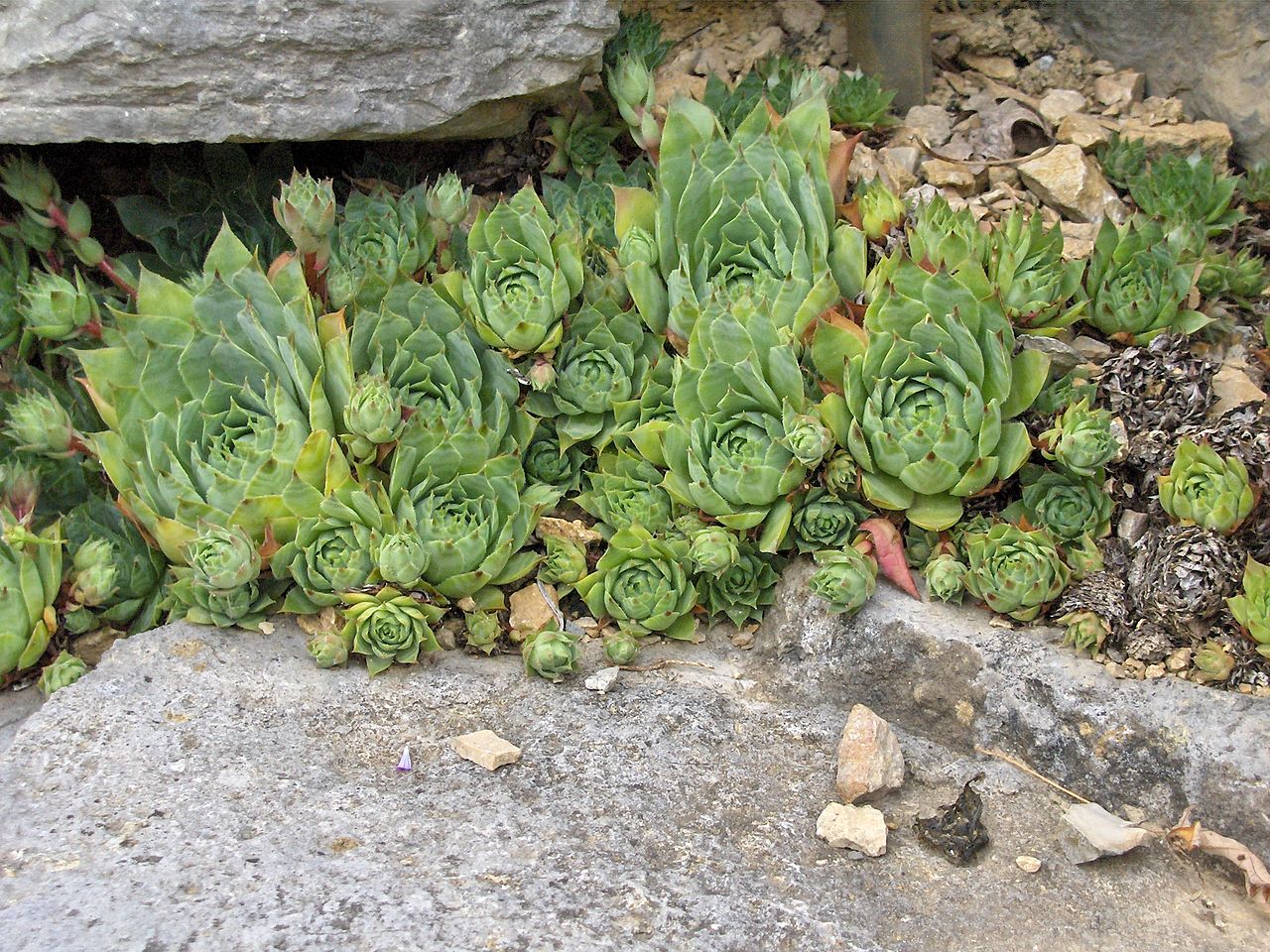
Sempervivium
(houseleek ~ hen & chickens)
To my surprise one house-leek (apparently Sempervivum tectorum of Dewey) has shot up twenty-two inches high and is apparently nearly out, though the petals are erect, not spread. The stem is clothed with the same thick leaves, only smaller and lessening up ward and forming a column about one and a half inches in diameter (with the leaves). The top is a broad raceme (?), about eight inches wide and two thirds as long, of eleven long, spreading, and recurved branches, lined with flowers on the upper side only. These consist of twelve to thirteen lanceolate calyx-segments and as many still longer dull-purple petals and about twenty pistils within and short stamens around them. It is a strange but rather stately cactus-like plant. 

The children call the pretty clusters of radical leaves hen and chickens. In this case the radical leaves are withered, and a fusiform root sustains the flower. This one is not on the bare rock, but lower amid the huckleberry bushes. 

At the Assabet stone bridge, apparently freshly in flower, — though it may have been out nearly as long as the androscemifolium, — apparently the Apocynum cannabinum var. hypericifolium (?). The tallest is four feet high. The flowers very small (hardly more than an eighth of an inch in diameter), the segments of the corolla not revolute but nearly erect. There are twenty to thirty flowers at end of a branch. The divisions of the calyx are longer than in the common, long ovate. Yet it differs from Gray's hypericifolium in having flowers rose-streaked within like the common, the cymes not shorter than the leaves, and the tube of the corolla rather longer than the divisions of the calyx. The leaves are hardly more downy or heart-shaped below than the common. Hypericifolium is a separate species in Pursh and some others. And the branches are less ascending than the common, making an angle of about 62° with the stem (the four lower), while three of the lower of a common one make an angle of 44°.

H. D. Thoreau, Journal, August 5, 1856

Trichostema, maybe several days in some places. See July 31, 1856  ("Trichostema has now for some time been springing up in the fields, giving out its aromatic scent when bruised, and I see one ready to open.");  August 17, 1851 ("The Trichostema dichotomum, — not only its bright blue flower above the sand, but its strong wormwood scent which belongs to the season, –– feed my spirit, endear the earth to me, make me value myself and rejoice.") See also  A Book of the Seasons, by Henry Thoreau, Blue-Curls

Now, at 4 p. m . .  .The Hypericum mutilum is abundantly open . . . sometimes fifteen inches high, while the Canadense and angulatum are shut
.  See August 12, 1856 ("11 a. m. . . .  The Hypericum mutilum is well out at this hour.");  August 17, 1856 ("Hypericum Canadense well out at 2 p. m"); .August 19, 1856 ("I see Hypericum Canadense and mutilum abundantly open at 3 p. m");  August 27, 1856  ("Hypericum Canadense and mutilum now pretty generally open at 4 P.M., thus late in the season, it being more moist and cooler."). See also  A Book of the Seasons,  by Henry Thoreau, St. Johns-wort (Hypericum)

A great water adder . . . full five feet long and nearly as big round as my arm. See July 23, 1856 ("water adder killed on the 15th and left hanging on a twig"); July 15, 1856 ("It was about three feet long, but large round in proportion, with about one hundred and forty abdominal plates and a long, slender tail.)

Aster dumosus, apparently a day or two, with its large conspicuous flower-buds. See August 10, 1856  ("Aster dumosus and pennyroyal out; how long? ");   August 24, 1853 ("The dumosus is the prevailing white one, very abundant.") See also   A Book of the Seasons,  by Henry Thoreau, Asters in August

Choke-cherries. . . scarcely edible, but their beauty atones for it. See August 5, 1858 ("Choke-berries, fair to the eye but scarcely palatable, hang far above your head, weighing down the bushes."); See 
also September 3, 1853 ("Now is the season for those comparatively rare but beautiful wild berries which are not food for man . . . it is strange that we do not devote an hour in the year to gathering those which are beautiful to the eye. It behooves me to go a-berrying in this sense once a year at least.”)

Apparently the Apocynum cannabinum var. hypericifolium (?). The tallest is four feet high. See August 7, 1856 ("Hemp, perhaps a week.");  August 13, 1856 ("I stripped off a shred of Indian hemp bark and could not break it. It is as strong as anything of the kind I know. ") August 16, 1856 (" I find the dog's-bane (Apocynum androsoemifolium) bark not the nearly so strong as that of the A. cannabinum.");  September 2, 1856 ("Some years ago I sought for Indian hemp (Apocynum cannabinum) hereabouts in vain, and concluded that it did not grow here. A month or two ago . . . my eyes fell on it, aye, in three different places, and different varieties of it.") See also A Book of the Seasons, by Henry Thoreau, Dogsbane and Indian hemp

August 5. See A Book of the Seasons, by Henry Thoreau, August 5

Now at 4 p. m.
this dog-day cloudy weather
dwarf johnswort open.

A Book of the Seasons, by Henry Thoreau. Near House-leek Rock

A Book of the Seasons, by Henry Thoreau. 

"A book, each page written in its own season,
out-of-doors, in its own locality."
~edited, assembled and rewritten by zphx © 2009-2026

https://tinyurl.com/hdt-560805

Thursday, August 4, 2016

Two ladies in a boat and a profusion of berries

August 4

P. M. — Carried party a-berrying to Conantum in boat. 

Lespedeza violacea, perhaps the largest-leafed variety, leafets one inch by one third inch, petioled, well out on side of Blackberry Steep. 

Scare up a young apparently summer duck, floating amid the pads, and the same again, coming within gunshot. I think it young because it is not very shy. 

Have heard the alder cricket some days. The turning-point is reached. 

Conantum hillside is now literally black with berries. What a profusion of this kind of food Nature provides, as if to compensate for the scarcity last year!

Fortunate that these cows in their pasture do not love them, but pass them by. The blackberries are already softening, and of all kinds there are many, many more than any or all creatures can gather. They are literally five or six species deep. 
  • First, away down in the shade under all you find, still fresh, the great very light blue (i. e. with a very thick blue bloom) Vaccinium Pennsylvanicum in heavy clusters, that early ambrosial fruit, delicate-flavored, thin-skinned, and cool, — Olympian fruit; 
  • then, next above, the still denser bunches and clusters of V. vacillans, of various varieties, firm and sweet, solid food; 
  • and, rising above these, large blue and also shining black huckleberries (Gaylussacia resinosa) of various flavors and qualities; 
  • and over all runs rampant the low blackberry (Rubus Canadensis), weighing down the thicket with its wreaths of black fruit. 
  • Also here and there the high blackberry, just beginning, towers over all. 
You go daintily wading through this thicket, picking, perchance, only the biggest of the blackberries — as big as your thumb — and clutching here and there a handful of huckleberries or blueberries, but never, perchance, suspecting the delicious cool blue-bloomed ones under all.  This favorable moist weather has expanded some of the huckleberries to the size of bullets. 

Each patch, each bush, seems fuller and blacker than the last. Such a profusion, yet you see neither birds nor beasts eating them, unless ants and the huckleberry-bug! 

I carried my hands full of bushes to the boat, and, returning, the two ladies picked fully three pints from these alone, casting the bare bushes into the stream.

H. D. Thoreau, Journal, August 4, 1856

Carried party a-berrying to Conantum in boat. See August 12, 1853 ("To Conantum by boat, berrying, with three ladies."); September 25, 1858 Go a-graping up Assabet with some young ladies. See also September 16, 1859 ("Ask me for a certain number of dollars if you will, but do not ask me for my afternoons."); September 26, 1859 ("How feeble women, or rather ladies, are! They can not bear to be shined on, but generally carry a parasol to keep off the sun.")

Lespedeza violacea, perhaps the largest-leafed variety, . . . well out. See August 5, 1855 ("The common small violet lespedeza out, elliptic leaved, one inch long.”); August 13, 1856 (“In Bittern Cliff Woods that (apparently) very oblong elliptical leafed Lespedeza violacea, growing very loose and open on a few long petioles, one foot high by four or five inches wide.")

the scarcity last year. .See August 7, 1855 ("To Tarbell Hill again with the Emersons, a-berrying. Very few berries this year.")

Have heard the alder cricket some days. The turning-point is reached. See August 4, 1851 ("I hear the note of a cricket, and am penetrated with the sense of autumn."); August 4, 1852 (“I hear the cricket. He seems to chirp from a new depth toward autumn, new lieferungs of the fall.”); August 15, 1852 ("That clear ring like an alder locust (is it a cricket ?) for some time past is a sound which belongs to the season.") See also A Book of the Seasons, by Henry Thoreau, the Cricket in August

Conantum hillside is now literally black with berries. See August 4, 1852 (“Most huckleberries and blueberries and low blackberries are in their prime now.”); August 4, 1854 ("On this hill (Smith's) the bushes are black with huckleberries. ...Now in their prime. Some glossy black, some dull black, some blue; and patches of Vaccinium vacillans intermixed.") Compare July 26, 1854 ("Almost every bush now offers a wholesome and palatable diet to the wayfarer, — large and dense clusters of Vaccinium vacillans, largest in most moist ground, sprinkled with the red ones not ripe; great high blueberries, some nearly as big as cranberries, of an agreeable acid; huckleberries of various kinds, some shining black, some dull-black, some blue; and low blackberries of two or more varieties. The broods of birds just matured find thus plenty to eat.")

August 4. See A Book of the Seasons, by Henry Thoreau,  August 4 

The low blackberry
weighing down the thicket with  
wreaths of black fruit.

Such a profusion
each patch each bush seems fuller – 
blacker than the last.

A Book of the Seasons, by Henry Thoreau,
"A book, each page written in its own season,
out-of-doors, in its own locality.”
~edited, assembled and rewritten by zphx © 2009-2025

Wednesday, August 3, 2016

Our river is so sluggish and smooth that sometimes I can trace a boat that has passed half an hour before, by the bubbles on its surface.

August 3

Sunday. P. M. — To Lee's Cliff by river. 

Landing at flat shore. The sium and sarothra apparently now in prime. The central umbel of the sium going or gone to seed. The whorled utricularia is open all day. The Hypericum ellipticum is apparently out of bloom, there at least. 

At length from July 30th inclusive the cloud-like wreaths of mist of these dog-days lift somewhat, and the sun shines out more or less, a short time, at 3 p. m. 

The sun coming out when I am off Clamshell, the abundant small dragon-flies of different colors, bright-blue and lighter, looped along the floating vallisneria, make a very lively and gay appearance. I fancy these bright loops adorn or set forth the river like triumphal arches for my procession, stretching from side to side. 

The floating vallisneria is very thick at the shallow bends. I see many of its narrow, erect, spoon-shaped tops. 


Cornus alternifolia 

Cornus alternifolia berries ripe, as I go from Holden Swamp shore to Miles Swamp. They are in open cymes, dull-blue, somewhat depressed globular, tipped with the persistent styles, yet already, as usual, mostly fallen. But handsomer far are the pretty (bare) red peduncles and pedicels, like fairy fingers spread. They make a show at a distance of a dozen rods even. Some thing light and open about this tree, but a sort of witch's tree nevertheless. 

The purple utricularia abundant, but I did not chance to notice it July 25th. 

At Bittern Cliff again lucky enough to find Polygonum tenue, apparently out but a short time, say one week at most. Have marked the spot by a stone from the wall; further north than formerly. 

Selaginella rupestris (?) shows yellow fruit now at Bittern Cliff. 

Gerardia quercifolia, three to four feet high, out there, apparently two or three days. Yet none of the leaves I have are twice pinnatifid. 

Penny royal there, apparently some days.

Diplopappus cornifolius, some time. Desmodium acuminatum a long time out and also gone to seed. Lespedeza hirta, Blackberry Steep, how long? 

High blackberries beginning; a few ripe. 

Parietaria a foot high, some time, under the slippery elm. 

What is that tall (four feet), long-bearded grass, now nearly ripe, under this end of Lee's Cliff? 

I see blackened haycocks on the meadows. Think what the farmer gets with his hay, — what his river-meadow hay consists of, — how much of fern and osier and sweet-gale and Polygonum hydropiperoides and rhexia (I trust the cattle love the scent of it as well as I) and lysimachia, etc., etc., and rue, and sium and cicuta. 

In a meadow now being mown I see that the ferns and small osiers are as thick as the grass. If modern farmers do not collect elm and other leaves for their cattle, they do thus mow and cure the willows, etc., etc., to a considerable extent, so that they come to large bushes or trees only on the edge of the meadow. 

Two small ducks (probably wood ducks) flying south. Already grown, and at least looking south! ! It reminds me of the swift revolution of the seasons.

Our river is so sluggish and smooth that sometimes I can trace a boat that has passed half an hour before, by the bubbles on its surface, which have not burst. I have known thus which stream another party had gone up long before. A swift stream soon blots out such traces. 

Cirsium lanceolatum at Lee's Cliff, apparently some days. Its leaves are long-pointed and a much darker green than those of the pasture thistle. On the under sides of its leaves I noticed very large ants attending peculiar large dark-colored aphides, for their milch cows. 

The prevailing willow off Holden Swamp is sericea- like, but the leaf is narrow, more shining above, and merely glaucous beneath, longer-petioled, the serratures not so much bent toward the point. The twigs not nearly so brittle at the base, but bringing away strings of bark. Stipules probably fallen or inconspicuous. Can it be S. petiolaris? and is it the same with that above Hemlocks, north side? Or is it S. lucida? Vide in press. 

Edge of grain-field next Bittern Cliff Wood, common spurge; and, with it, apparently the same, half ascendant and covered or spotted with a minute fungus.

H. D. Thoreau, Journal, August 3, 1856

Cornus alternifolia berries ripe . . . See August 1, 1852 ("The berries of what I have called the alternate-leaved cornel are now ripe, a very dark blue - blue-black - and round, but dropping off prematurely, leaving handsome red cymes, which adorn the trees from a distance.")

Willows, etc., etc.. . . come to large bushes or trees only on the edge of the meadow. See July 29, 1853 ("[A plant] grows where it escapes the mower, . . . we do not know where they would prefer to grow if unmolested by man, but rather where they best escape his vandalism. How large a proportion of flowers, for instance, are referred to and found by hedges, walls, and fences.")

Our river is so sluggish and smooth that sometimes I can trace a boat that has passed half an hour before. . . See April 16, 1852 ("[Concord River is a] succession of bays . . . a chain of lakes . . . There is just stream enough for a flow of thought; that is all . . . Many a foreigner who has come to this town has worked for years on its banks without discovering which way the river runs.") See also 
A Book of the Seasons, by Henry Thoreau, The pulse of the River (Aaugust 2, 1856)

August 3. See A Book of the Seasons, by Henry Thoreau,  August 3

Bubbles trace a boat
that passed half an hour before –
our sluggish river.

A Book of the Seasons, by Henry Thoreau
"A book, each page written in its own season,
out-of-doors, in its own locality."
~edited, assembled and rewritten by zphx ©  2009-2026

https://tinyurl.com/hdt-560803
 

Tuesday, August 2, 2016

The pulse of the River.

August 2

P. M. — To Hill. 

A green bittern comes, noiselessly flapping, with stealthy and inquisitive looking to this side the stream and then that, thirty feet above the water. This antediluvian bird, creature of the night, is a fit emblem of a dead stream like this Musketicook. 

This especially is the bird of the river. There is a sympathy between its sluggish flight and the sluggish flow of the stream, — its slowly lapsing flight, even like the rills of Musketicook and my own pulse sometimes.  

August 2, 2021
August 2, 2026


Very common now are the few green emerald leafets of the Bidens Beckii, which will ere long yellow the shallow parts. 

Acalypha, apparently not long. 

Dodder, not long (not out 27th of July at railroad bridge), say four or five days. 

A three-ribbed goldenrod by small apple, by wall at foot east side of Hill (S. gigantea ? or one of the two preceding), not nearly out. It differs from my gigantea apparently only in the leaves being perfectly smooth above and the stem smooth and pink (?) glaucous (excepting a little pubescence near the top). Very tall. Vide it by and by. 

The lower leaves of some catnep are now of that delicate lake or claret color. 

Some waxwork leaves have felt the heat and slight drought. Their green is spotted with yellow, distinct yellow and green; others a very delicate clear yellow; others faded quite white.

H. D. Thoreau, Journal, August 2, 1856

A green bittern comes noiselessly flapping. See July 30, 1856 ("A green bittern. . . with heavy flapping flight"); July 31, 1859 ("The small green bitterns are especially numerous."); August 1, 1858 ("So the green bitterns are leaving the nest now"); See also A Book of the Seasons, by Henry Thoreau. The Green Bittern

Very common now are the few green emerald leafets of the Bidens Beckii, which will ere long yellow the shallow parts. See August 1, 1859 ("The B. Beckii (just beginning to bloom) just shows a few green leafets above its dark and muddy masses, now that the river is low."); ); August 9, 1856 ("All the Bidens Beckii is drowned too, and will be delayed, if not exterminated for this year."); August 11, 1853 ("The weeds still covered by the flood, so that we have no Bidens Beckii."); August 12, 1854 ("The Bidens Beckii yellows the side of the river just below the Hubbard Path, but is hardly yet in fullest flower generally."); See also A Book of the Seasons, by Henry Thoreau, The Bidens Beckii

A three-ribbed goldenrod . . . differs from my gigantea. See July 31, 1856  ("The Solidago gigantea (?), three-ribbed, out a long time at Walden shore by railroad, more perfectly out than any solidago I have seen. I will call this S. gigantea, yet it has a yellowish-green stem, slightly pubescent above, and leaves slightly rough to touch above, rays small, about fifteen"); August 16, 1858 ("A three-ribbed goldenrod on railroad causeway, two to three feet high, abundantly out"); August 21, 1856 ("The prevailing solidagos now are . . .2d, the three-ribbed, of apparently several varieties, which I have called arguta or gigantea (apparently truly the last)")

Waxwork leaves have felt the heat. See August 9, 1854 ("
"Walden" published. Elder-berries. 
Waxwork yellowing.")

August 2. See A Book of the Seasons, by Henry Thoreau,  August 2

A green bittern comes
noiselessly flapping – sluggish
pulse of the river.

A Book of the Seasons, by Henry Thoreau
"A book, each page written in its own season,
out-of-doors, in its own locality."
~edited, assembled and rewritten by zphx ©  2009-2026

https://tinyurl.com/hdt-560802

Monday, August 1, 2016

Dense beds of rhexia in full bloom

Rhexia virginia

August 1 

Burdock, several days at least. Erechthites, apparently two or three days, by Peter's Path, end of Cemetery, the middle flowers first.

Crotalaria in fine lechea field, how long? Still out, and some pods fully grown. 

Liatris will apparently open in a day or two. 

Diplopappus umbellatus at Peter's wall. Desmodium Canadense, some time; several great stems five feet high, a little spreading. 


August 01, 2016

Since July 30th, inclusive, we have had perfect dog-days without interruption. The earth has suddenly invested with a thick musty mist. The sky has become a mere fungus. A thick blue musty veil of mist is drawn before the sun. The sun has not been visible, except for a moment or two once or twice a day, all this time, nor the stars by night. Moisture reigns. 

You cannot dry a napkin at the window, nor press flowers without their mildewing. You imbibe so much moisture from the atmosphere that you are not so thirsty, nor is bathing so grateful as a week ago. The burning heat is tempered, but as you lose sight of the sky and imbibe the musty, misty air, you exist as a vegetable, a fungus. 

Unfortunate those who have not got their hay. I see them wading in overflowed meadows and pitching fthe black and mouldy swaths about in vain that they may dry. In the meanwhile, vegetation is becoming rank, vines of all kinds are rampant. Squashes and melons are said to grow a foot in a night. But weeds grow as fast. The corn unrolls. Berries abound and attain their full size. 

Once or twice in the day there is an imperfect gleam of yellow sunlight for a moment through some thinner part of the veil, reminding us that we have not seen the sun so long, but no blue sky is revealed. The earth is completely invested with cloud like wreaths of vapor (yet fear no rain and need no veil), beneath which flies buzz hollowly and torment, and mosquitoes hum and sting as if they were born of such an air. 

The drooping spirits of mosquitoes revive, and they whet their stings anew. Legions of buzzing flies blacken the furniture. (For a week at least have heard that snapping sound under pads.) We have a dense fog every night, which lifts itself but a short distance during the day. At sundown I see it curling up from the river and meadows. 

However, I love this moisture in its season. I believe it is good to breathe, wholesome as a vapor bath.

Toadstools shoot up in the yards and paths. 

The Great Meadows being a little wet, — hardly so much as usual, — I took off my shoes and went barefoot some two miles through the cut-grass, from Peter's to Sphaerocarpa Pools and backward by river. Very little grass cut there yet. The cut-grass is bad for tender feet, and you must be careful not to let it draw through your hands, for it will cut like a fine saw. 

I was surprised to see dense beds of rhexia in full bloom there, apparently on hummocks a rod in diameter left by the ice, or in long ridges mixed with ferns and some Lysimachia lanceolata, arrowhead, etc. They make a splendid show, these brilliant rose-colored patches, especially in the neighborhood of Copan. It is about the richest color to be seen now. Yet few ever see them in this perfection, unless the haymaker who levels them, or the birds that fly over the meadow. 

Far in the broad wet meadows, on the hummocks and ridges, these bright beds of rhexia turn their faces to the heavens, seen only by the bitterns and other meadow birds that fly over. We, dwelling and walking on the dry upland, do not suspect their existence. How obvious and gay to those creatures that fly over the meadow! Seen only by birds and mowers. These gay standards otherwise unfurled in vain. 

Snake-head arethusa still in the meadow there. 

Ludwigia sphaerocarpa apparently a week out, a foot and a half to two feet high.

H. D. Thoreau, Journal, August 1, 1856

Liatris will apparently open in a day or two See );August 26, 1858 ("The liatris is about (or nearly) in prime."); September 6, 1859 ("The liatris is, perhaps, a little past prime. It is a very rich purple in favorable lights and makes a great show where it grows."); September 28, 1858 ("Liatris done, apparently some time.").See also A Book of the Seasons,  by Henry Thoreau, Liatris

Perfect dog-days without interruption. See July 30, 1856 (“This is a perfect dog-day. The atmosphere thick, mildewy, cloudy. It is difficult to dry anything. The sun is obscured, yet we expect no rain”); July 31, 1856 ("This dog-day afternoon . . . the air filled with a decaying musty scent and the z-ing of small locusts, I hear the distant sound of a flail, and thoughts of autumn occupy my mind, and the memory of past years."); See also A Book of the Seasons,  by Henry Thoreau, Locust Days, Dogdayish Days

Snake-head arethusa still in the meadow there. See July 7, 1856 ("The snake-head arethusa is now abundant amid the cranberries”) See also A Book of the Seasons, by Henry Thoreau, The Snakemouth Orchid

Far in the broad wet meadows, on the hummocks and ridges, these bright beds of rhexia turn their faces to the heavens, seen only by the bitterns and other meadow birds that fly over. See July 18, 1852 ("The petals of the rhexia have a beautiful clear purple with a violet tinge."); and note to August 5, 1858 ("I cannot sufficiently admire the rhexia, one of the highest-colored purple flowers, but difficult to bring home in its perfection, with its fugacious petals.") See also  A Book of the Seasons, by Henry Thoreau, Rhexia Virginica (meadow-beauty)

August 1. See A Book of the Seasons, by Henry Thoreau,  August 1. 

Perfect dog-days now 
thick blue musty veil of mist
drawn before the sun.

In dog-day weather
you lose sight of the sky and 
exist like a fungus.

Far in the meadows
 the rhexia seen only 
by birds and mowers.

A Book of the Seasons, by Henry Thoreau
"A book, each page written in its own season,
out-of-doors, in its own locality."
~edited, assembled and rewritten by zphx ©  2009-2026

https://tinyurl.com/hdt-560801

Popular Posts Last 30 Days.

The week ahead in Henry’s journal

The week ahead in Henry’s journal
A journal, a book that shall contain a record of all your joy.
"A stone fruit. Each one yields me a thought." ~ H. D. Thoreau, March 28, 1859


I sit on this rock
wrestling with the melody
that possesses me.