Friday, October 31, 2014

Sat with open window for a week.

October 31.

October 31, 2024
Rain; still warm. 

Ever since October 27th we have had remarkably warm and pleasant Indian summer, with frequent frosts in the morning. Sat with open window for a week.

H. D. Thoreau, JournalOctober 31, 1854


Ever since October 27th we have had remarkably warm and pleasant Indian summer.
See October 31, 1858 ("It is a fine day, Indian-summer-like, and there is considerable gossamer on the causeway and blowing from all trees. ") See also October 21, 1855 ("I sit with an open window, it is so warm."); October 22, 1854 ("This and the last two days Indian-summer weather, following hard on that sprinkling of snow west of Concord. Pretty hard frosts these nights."); October 25, 1854 (" A beautiful, calm Indian-summer afternoon, the withered reeds on the brink reflected in the water. ") ; October 26, 1854 ("As warm as summer. Cannot wear a thick coat. Sit with windows open. ") and A Book of the Seasons, by Henry Thoreau, Indian Summer

Frosts in the mornings –
open window for a week.
Indian summer.

A Book of the Seasons,  by Henry Thoreau
 "A book, each page written in its own season,
out-of-doors, in its own locality."

 ~edited, assembled and rewritten by zphx ©  2009-2024

https://tinyurl.com/hdt-541031


Wednesday, October 29, 2014

Peculiarly fresh scarlet

October 29.
October 29

Detected a large English cherry in Smith’s woods beyond Saw Mill Brook by the peculiar fresh orange-scarlet color of its leaves, now that almost all leaves are quite dull or withered. The same in gardens. The gooseberry leaves in our garden and in fields are equally and peculiarly fresh scarlet.

H. D. Thoreau, Journal, October 29, 1854

Detected a large English cherry by the peculiar fresh orange-scarlet color of its leaves. See October 13, 1857 ("Our cherry trees have now turned to mostly a red orange color."); October 29, 1858 ("the cultivated cherry is quite handsome orange, often yellowish").See also September 30, 1854 (“I detect the sassafras by its peculiar orange scarlet half a mile distant. ”); September 28, 1854 ("The sassafras trees on the hill are now wholly a bright orange scarlet as seen from my window, and the small ones elsewhere are also changed.")

Tuesday, October 28, 2014

The reflected woods begin to look bare

October 28, 2014
October. 28

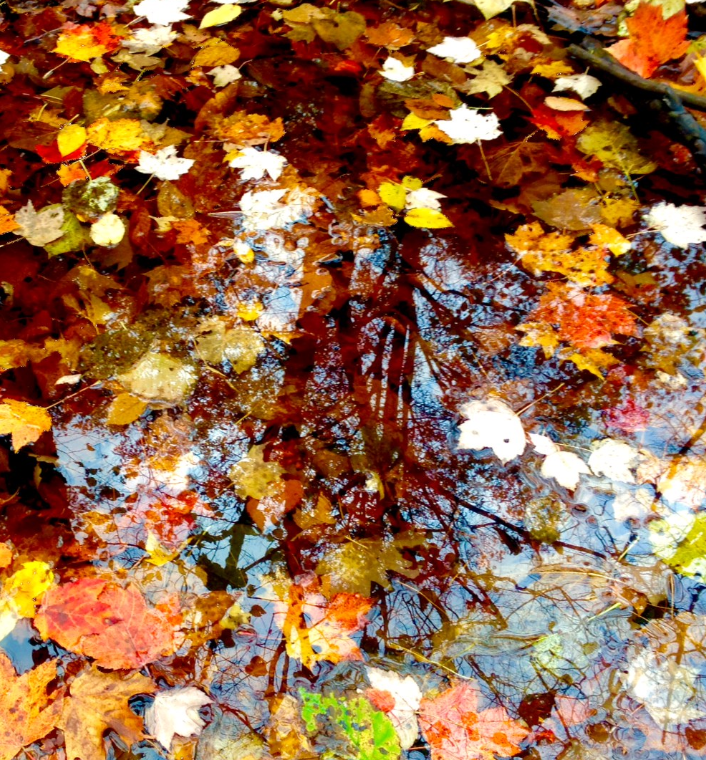
The woods begin to look bare, reflected in the water, and I look far in between the stems of the trees under the bank. 


Birches, which began to change and fall so early, are still in many places yellow.

H. D. Thoreau, Journal, October 28, 1854


I look far in between the stems of the trees under the bank.
 See March 8, 1853 ("Instead of looking into the sky, I look into the placid reflecting water for the signs and promise of the morrow."); March 9, 1855 ("It occurred to me that the reason was that there was reflected to me from the river the view I should have got if I had stood there on the water in a more favorable position."); October 14, 1857 ("This, too, accounts for my seeing portions of the sky through the trees in reflections often when none appear in the substance."); October 17, 1858 (" Now, by the fall of the leaves, so much more light is let in to the water. The river reflects more light, therefore, in this twilight of the year, as it were an afterglow."). See also A Book of the Seasons, by Henry Thoreau, by Henry Thoreau, Reflections

Birches, which began to change and fall so early. See August 11, 1858 ("The birches have lately lost a great many of their lower leaves, which now cover and yellow the ground."); August 13, 1854 ("I am surprised to behold how many birch leaves have turned yellow, — every other one, — while clear, fresh, leather-colored ones strew the ground with a pretty thick bed under each tree. "); October 22, 1858 ("Th birches have been steadily changing and falling for a long, long time. The lowermost leaves turn golden and fall first; so their autumn change is like a fire which has steadily burned up higher and higher, consuming the fuel below, till now it has nearly reached their tops. ")

Birches . . . are still in many places yellow. See October 22, 1855 ("I see at a distance the scattered birch-tops, like yellow flames amid the pines,"); October 26, 1860 ("This is the season of birch spangles, when you see afar a few clear-yellow leaves left on the tops of the birches.") See also A Book of the Seasons, by Henry Thoreau, Birches in Season

The reflected woods
begin to look bare – I look 
far between the trees.


A Book of the Seasons,  by Henry Thoreau
 "A book, each page written in its own season,
out-of-doors, in its own locality."

 ~edited, assembled and rewritten by zphx ©  2009-2024

https://tinyurl.com/hdt28oct54

Sunday, October 26, 2014

As the woods grow more silent

October 26

As warm as summer. Cannot wear a thick coat. Sit with windows open. 

I see considerable gossamer on the causeway and elsewhere. 

Is it the tree sparrows whose jingles I hear? 

October 26, 2022

As the weather grows cooler and the woods more silent, I attend to the cheerful notes of chickadees on their sunny sides. 

Apple trees are generally bare, as well as bass, ash, elm, maple.

H. D. Thoreau, Journal, October 26, 1854

Cannot wear a thick coat. See October 21, 1856 ("A very warm Indian-summer day, too warm for a thick coat."); Compare October 25, 1858 ("This is the coolest day thus far, reminding me that I have only a half-thick coat on. "); October 26, 1858 ("I wear a thicker coat, my single thick fall coat, at last, and begin to feel my fingers cool early and late.")

Sit with windows open
See October 31, 1854 ("[W]e have had remarkably warm and pleasant Indian summer, with frequent frosts in the morning. Sat with open window for a week.") See also October 10, 1856 ("This afternoon it is 80°, . . . I lie with window wide open under a single sheet most of the night").;  October 21, 1855 ("I sit with an open window, it is so warm."); November 8, 1855 ("I can sit with my window open and no fire. Much warmer than this time last year.")

I see considerable gossamer. See October 31, 1858 ("It is a fine day, Indian-summer-like, and there is considerable gossamer on the causeway and blowing from all trees "); November 1, 1851 (" It is a remarkable day for fine gossamer cobwebs. Here in the causeway, as I walk toward the sun, I perceive that the air is full of them streaming from off the willows and spanning the road, all stretching across the road,") See also A Book of the Seasons, by Henry Thoreau, Gossamer Days

As the weather grows cooler and the woods more silent, I attend to the cheerful notes of chickadeesSee October 10, 1851 ("The chickadee, sounding all alone, now that birds are getting scarce, reminds me of the winter,in which it almost alone is heard."); October 23, 1852 ("The chickadees flit along, following me inquisitively a few rods with lisping, tinkling note."); November 4, 1855 ("The birds are almost all gone. The note of the dee de de sounds now more distinct") See also A Book of the Seasons, by Henry Thoreau, the Chickadee in Winter

Apple trees are generally bare, as well as bass, ash, elm, maple.
See October 26, 1858 ("The sugar maples are about bare, except a few small ones."); See also October 16, 1854 ("The ash and most of the elm trees are bare of leaves; the red maples also."); October 18, 1857 ("The bass and the black ash are completely bare; how long?"); October 19, 1856 (“Both the white and black ash are quite bare, and some of the elms there.”);   October 22, 1858 ("Apple orchards throughout the village, or on lower and rich ground, are quite green, but on this drier Fair Haven Hill all the apple trees are yellow, with a sprinkling of green and occasionally a tinge of scarlet, i. e. are russet."); October 23, 1853 ("Apple trees yellow and brown and partly bare; white ash bare (nearly)."); October 24, 1853 ("Red maples and elms alone very conspicuously bare in our landscape."); October 31, 1858 ("the apple trees, which are half of them bare.")

October 26.
 See A Book of the Seasons, by Henry Thoreau, October 26 and A Book of the Seasons, by Henry Thoreau, The seasons and all their changes are in me.

As woods grow silent
we attend to the cheerful
notes of chickadees.

A Book of the Seasons,  by Henry Thoreau,  As the woods grow more silent

A Book of the Seasons,  by Henry Thoreau
"A book, each page written in its own season,
out-of-doors, in its own locality.”
~edited, assembled and rewritten by zphx © 2009-2024

Saturday, October 25, 2014

A beautiful, calm Indian-summer afternoon

October 25

On Assabet. 

The maples being bare, the great hornet nests are exposed. 

A beautiful, calm Indian-summer afternoon, the withered reeds on the brink reflected in the water.

H. D. Thoreau, Journal, October 25, 1854


The great hornet nests are exposed.
See  October 4, 1858 ("Hornets are still at work in their nests."); October 15, 1855 (“The hornets’ nests are exposed, the maples being bare, but the hornets are gone.”); October 24, 1858 ("That large hornets’ nest which I saw on the 4th is now deserted, and I bring it home. But in the evening, warmed by my fire, two or three come forth and craw
l over it, and I make haste to throw it out the window.") See also September 25, 1851 ("The hornets' nest not brown but gray, two shades, whitish and dark, alternating on the outer layers or the covering, giving it a waved appearance.") and A Book of the Seasons, by Henry Thoreau. Wasps and Hornets

A beautiful, calm Indian-summer afternoon. See October 22, 1854 ("This and the last two days Indian-summer weather, following hard on that sprinkling of snow west of Concord. Pretty hard frosts these nights"); October 31, 1854 ("Ever since October 27th we have had remarkably warm and pleasant Indian summer, with frequent frosts in the morning. Sat with open window for a week.") See also A Book of the Seasons, by Henry Thoreau, Indian Summer

A calm afternoon
reflected in the water –
Indian summer.


A Book of the Seasons,  by Henry Thoreau
"A book, each page written in its own season,
out-of-doors, in its own locality.”
~edited, assembled and rewritten by zphx © 2009-2024

https://tinyurl.com/hdt-541025

Wednesday, October 22, 2014

Now they rustle as you walk through them in the woods.

October 22.

October 22, 2023

This and the last two days Indian-summer weather, following hard on that sprinkling of snow west of Concord. Pretty hard frosts these nights. 

Many leaves fell last night, and the Assabet is covered with their fleets. Now they rustle as you walk through them in the woods. 

Bass trees are bare. 

The redness of huckleberry bushes is past its prime. 

I see a snapping turtle, not yet in winter quarters. 

The chickadees are picking the seeds out of pitch pine cones.

H. D. Thoreau, Journal, October 22, 1854

This and the last two days Indian-summer weather. See  October 22, 1853 ("A week or more of fairest Indian summer ended last night . . .It was so warm day before yesterday, I worked in my shirt-sleeves in the woods."); October 25, 1854 ("A beautiful, calm Indian-summer afternoon, the withered reeds on the brink reflected in the water. "); October 31, 1854 ("Ever since October 27th we have had remarkably warm and pleasant Indian summer, with frequent frosts in the morning. Sat with open window for a week.") See also A Book of the Seasons, by Henry Thoreau, Indian Summer

Now they rustle as you walk through them in the woods See October 22, 1857 ("As I go through the woods now, so many oak and other leaves have fallen the rustling noise somewhat disturbs my musing.") See also  October 10, 1851 ("You make a great noise now walking in the woods.”); October 25, 1858 ("The leaves rustle under your feet as much as ever. In some places you walk pushing a mass before you."); October 28, 1852 ("I hear no sound but the rustling of the withered leaves, and, on the wooded hilltops, the roar of the wind."); October 28, 1860 ("We make a great noise going through the fallen leaves in the woods and wood-paths now, so that we cannot hear other sounds.”)

I see a snapping turtle, not yet in winter quarters. See September 26, 1859 ("Heavy Haynes says . . .  that a boy caught a very large snapping turtle on the meadow a day or two. He once dug one up two or three feet deep in the meadow in winter when digging mud. He was rather dormant")

The chickadees are picking the seeds out of pitch pine cones.
See October 23, 1852 ("The chickadees flit along, following me inquisitively a few rods with lisping, tinkling note, — flit within a few feet of me from curiosity, head downward on the pines.") See also A Book of the Seasons, by Henry Thoreau, the Chickadee in Winter

So many leaves fell

now they rustle as you walk 

through them in the woods.

A Book of the Seasons,  by Henry Thoreau
"A book, each page written in its own season,
out-of-doors, in its own locality.”
~edited, assembled and rewritten by zphx © 2009-2024

https://tinyurl.com/hdt-541022

Monday, October 20, 2014

Sunrise from the mountain-top


October 20

October 20, 2018

See the sun rise from the mountain-top. 

This is the time to look westward. All the villages, steeples, and houses on that side were revealed; but on the east all the landscape was a misty and gilded obscurity.

It was worth the while to see westward the countless hills and fields now white with frost. A little white fog marked the site of many a lake and the course of the Nashua, and in the east horizon the great pond had its own fog mark in a long, low bank of cloud. 

Soon after sunrise I saw the pyramidal shadow of the mountain reaching quite across the State, its apex resting on the Green or Hoosac Mountains, appearing as a deep-blue section of a cone there. It rapidly contracted, and its apex approached the mountain itself, and when about three miles distant the whole conical shadow was very distinct. 

The shadow of the mountain makes some minutes’ difference in the time of sunrise to the inhabitants of Hubbardston, within a few miles west.

H. D. Thoreau, Journal, October 20, 1854

It was worth the while to see westward the countless hills and fields now white with frost. See October 20, 1852 ("No doubt, I could have seen further with a glass, and particular objects more distinctly, - could have counted more meeting-houses; but this has nothing to do with the peculiar beauty and grandeur of the view which an elevated position affords.")

Soon after sunrise I saw the pyramidal shadow of the mountain reaching quite across the State. See October 19, 1857 ("Mr. Sanborn tells me that he looked off from Wachusett last night, and that he saw the shadow of the mountain gradually extend itself eastward not only over the earth but finally on to the sky in the horizon"); June 3, 1858 ("It was still hazy, and we did not see the shadow of the mountain until it was comparatively short.")

October 20. See A Book of the Seasons, by Henry Thoreau, October 20

Sunrise looking west –
conical mountain shadow
rapidly contracts.


A Book of the Seasons,  by Henry Thoreau
"A book, each page written in its own season,
out-of-doors, in its own locality.”
~edited, assembled and rewritten by zphx © 2009-2024

https://tinyurl.com/hdt-541020


Popular Posts Last 30 Days.

The week ahead in Henry’s journal

The week ahead in Henry’s journal
A journal, a book that shall contain a record of all your joy.
"A stone fruit. Each one yields me a thought." ~ H. D. Thoreau, March 28, 1859


I sit on this rock
wrestling with the melody
that possesses me.