Friday, June 15, 2018

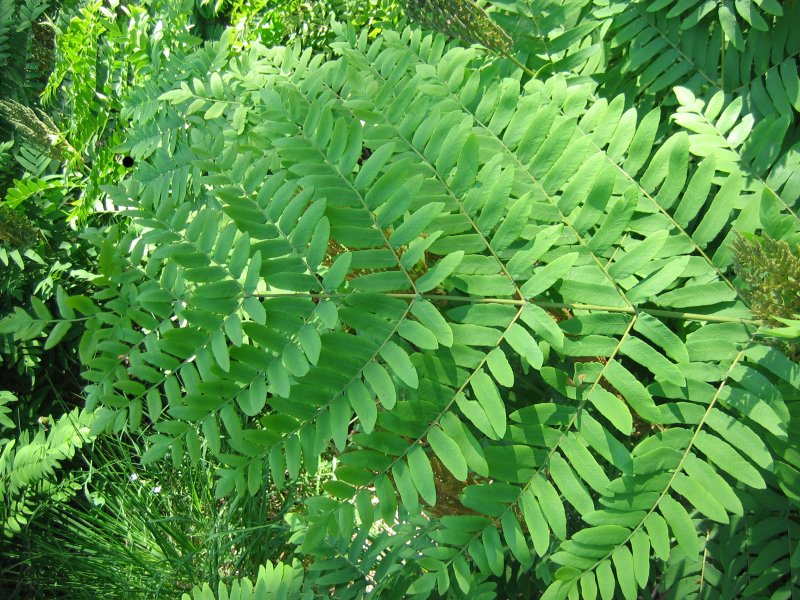
The Osmunda regalis, growing in very handsome hollow circles.

June 15. 
June 15, 2018

Rains steadily again, and we have had no clear weather since the 11th. 

The river is remarkably high, far higher than before, this year, and is rising. I can paddle into and all about the willowy meadow southwest of Island. I had, indeed, anticipated this on account of the remarkable lowness of the river in the spring. 

That coarse grass in the Island meadow which grows in full circles, as on the Great Meadows, is wool-grass, though but little blooms. Some is now fairly in bloom and it has the dark bracts of what I observed on the Great Meadows. The peculiarly circular form of the patches, sometimes their projecting edges being the arcs of circles, is very obvious now that the lower and different grass around is under water. Many plants have a similar habit of growth. 

The Osmunda regalis, growing in very handsome hollow circles, or sometimes only crescents or arcs of circles, is now generally a peculiarly tender green, — its delicate fronds, – but some has begun to go to seed and look brown. Hollow circles, one or two feet to a rod in diameter. 

These two are more obvious when, as now, all the rest of the meadow is covered with water. 

That large grass, five feet high, of the river brink is now just begun. Can it be blue-joint, or Calamagrostis Canadensis? [Probably phalaris.]

H. D. Thoreau, Journal, June 15, 1858

That coarse grass in the Island meadow which grows in full circles, as on the Great Meadows, is wool-grass, sometimes their projecting edges being the arcs of circles.  June 27, 1857 ("southwest of Egg Rock, the coarse sedge [wool-grass] — I think the same with that in the Great Meadows — evidently grows in patches with a rounded outline; i.e., its edge is a succession of blunt, rounded capes, with a very distinct outline amid the other kinds of grass and weeds.")

The Osmunda regalis, growing in very handsome hollow circles, or sometimes only crescents or arcs of circles, is now generally a peculiarly tender green. See July 5, 1860 ("I notice of late the Osmunda regalis fully grown, fresh and handsome.")

Thursday, June 14, 2018

Interrupted ferns now coming up afresh from the root.

June 14

Miss Pratt brings me the fertile barberry from northeast the great yellow birch. The staminate is apparently effete. 

Young partridges, when? 

P. M. — To Gowing's Swamp. 

I notice interrupted ferns, which were killed, fruit and all, by the frosts of the 28th and 29th of May, now coming up afresh from the root. The barren fronds seem to have stood it better. 

See in a meadow a song sparrow's nest with three eggs, and another egg just buried level with the bottom of the nest. Probably it is one of a previous laying, which the bird considered addled. I find it to be not at all developed, nor yet spoiled. 

Common garden columbine, broad and purple, by roadside, fifty rods below James Wright's. 

The river is raised surprisingly by the rain of the 12th. The Mill Brook has been over the Turnpike.

H. D. Thoreau, Journal  June 14, 1858


Young partridges. See June 11, 1856 ("A partridge with young in the Saw Mill Brook path."); June 23, 1854 ("Disturb three different broods of partridges in my walk this afternoon in different places.")

A song sparrow's nest with three eggs. See June 14, 1855 ("A song sparrow’s nest in ditch bank under Clamshell, of coarse grass lined with fine, and five eggs nearly hatched and a peculiar dark end to them."); June 13, 1858 ("A song sparrow's nest here in a little spruce . . . — a very thick, firm, and portable nest, an inverted cone; — four eggs. They build them in a peculiar manner in these sphagnous swamps, elevated apparently on account of water.")

Wednesday, June 13, 2018

A song sparrow's nest in a little spruce

June 13. 

Louring all day. 

P. M. – To Ledum Swamp. 

Lambkill, maybe one day. 

Strawberries. 

In the great apple tree front of the Miles house I hear young pigeon woodpeckers. 

The ledum is apparently past prime. 

The Kalmia glauca and the Andromeda Polifolia are done, the kalmia just done. 

The ledum has grown three or four inches (as well as the andromeda). It has a rather agreeable fragrance, between turpentine and strawberries. It is rather strong and penetrating, and some times reminds me of the peculiar scent of a bee. The young leaves, bruised and touched to the nose, even make it smart.

It is the young and expanding ledum leaves which are so fragrant. There is a yellow fungus common on its leaves, and a black one on the andromeda. 

The Vaccinium Oxycoccus grows here and is abundantly out; some days certainly. 

I hear and see the parti-colored warbler, blue yellow-backed, here on the spruce trees. It probably breeds here. 

Also, within three feet of the edge of the pond-hole, where I can hardly stand in india-rubber shoes without the water flowing over them, a large ant-hill swarming with ants, – though not on the surface because of the mizzling rain. 

One of the prevailing front-rank plants here, standing in the sphagnum and water, is the elodea. 

I see a song sparrow's nest here in a little spruce just by the mouth of the ditch. It rests on the thick branches fifteen inches from the ground, firmly made of coarse sedge without, lined with finer, and then a little hair, small within, — a very thick, firm, and portable nest, an inverted cone; — four eggs. They build them in a peculiar manner in these sphagnous swamps, elevated apparently on account of water and of different materials. Some of the eggs have quite a blue ground. 

Go to Conantum end. 

The Rubus frondosus will not bloom apparently for a day or two, though the villosus is apparently in prime there. 

I hear the peculiar notes of young bluebirds that have flown. 

Arenaria lateriflora, how long? 

The Scheuchzeria palustris, now in flower and going to seed, grows at Ledum Pool, as at Gowing's Swamp. 

See now in meadows, for the most part going to seed, Carex scoparia, with its string of oval beads; and C. lupulina, with its inflated perigynia; also what I take to be C. stipata, with a dense, coarse, somewhat sharp triangular mass of spikelets; also C. stellulata, with a string of little star-like burs. The delicate, pendulous, slender-peduncled C. debilis.

Catbirds hatched.

H. D. Thoreau, Journal, June 13, 1858

Lambkill, maybe one day. See June 9, 1855 ("Lambkill out."); June 10, 1855 ("The Kalmia glauca is done before the lambkill is begun here"); June 13, 1854 ("How beautiful the solid cylinders of the lamb-kill now just before sunset, — small ten-sided, rosy-crimson basins, about two inches above the recurved, drooping dry capsules of last year");


In the great apple tree front of the Miles house I hear young pigeon woodpeckers. See May 17, 1858 ("Measured the large apple tree in front of the Charles Miles house. It is nine feet and ten inches in circumference ");  June 13, 1855 ("C. finds a pigeon woodpecker’s nest in an apple tree, five of those pearly eggs, about six feet from the ground."); June 10, 1856 ("In a hollow apple tree, hole eighteen inches deep, young pigeon woodpeckers, large and well feathered. . . .")

A song sparrow's nest here in a little spruce just by the mouth of the ditch. See  April 30, 1858 ("I find a Fringilla melodia nest with five eggs. Part, at least, must have been laid before the snow of the 27th, but it is perfectly sheltered under the shelving turf and grass on the brink of a ditch."); June 14, 1855 ("A song sparrow’s nest in ditch bank under Clamshell, of coarse grass lined with fine, and five eggs nearly hatched and a peculiar dark end to them."); July 12, 1857 ("A song sparrow's nest in a small clump of alder, two feet from ground! Three or four eggs.")

See Carex now in meadows. See June 11, 1855 ("Carex cephalophora (?) on Heywood’s Peak. That fine, dry, wiry wild grass in hollows in woods and sprout-lands, never mown, is apparently the C. Pennsylvanica, or early sedge. ")

I hear the peculiar notes of young bluebirds that have flown. See. June 13, 1852 (" I hear the feeble plaintive note of young bluebirds, just trying their wings or getting used to them")

June 13. See A Book of the Seasons,  by Henry Thoreau, June 13

A Book of the Seasons,  by Henry Thoreau
"A book, each page written in its own season,
out-of-doors, in its own locality.”
~edited, assembled and rewritten by zphx © 2009-2021

Tuesday, June 12, 2018

Monday, June 11, 2018

A very earnest and pressing business.

June 11

P. M. — To Assabet Bath. 

The fertile Salix alba is conspicuous now at a distance, in fruit, being yellowish and drooping. 

Hear the parti-colored warbler. 


Sylvia Americana
[Sylvia Americana [or "parti-colored warbler,"]:
 J J. Audubon's blue yellow-backed warbler,
 now Northern Parula warbler (Setophaga americana )]

Examine the stone-heaps. One is now a foot above water and quite sharp. They contain, apparently freshly piled up, from a wheelbarrow to a cartload of stones; but I can find no ova in them. 

I see a musquash dive head foremost (as he is swimming) in the usual way, being scared by me, but without making any noise.

Saw a painted turtle on the gravelly bank just south of the bath-place, west side, and suspected that she had just laid (it was mid-afternoon). So, examining the ground, I found the surface covered with loose lichens, etc., about one foot behind her, and digging, found five eggs just laid one and a half or two inches deep, under one side. It is remarkable how firmly they are packed in the soil, rather hard to extract, though but just buried. 

I notice that turtles which have just commenced digging will void considerable water when you take them up. This they appear to have carried up to wet the ground with. 

Saw half a dozen Emys insculpta preparing to dig now at mid-afternoon, and one or two had begun at the most gravelly spot there; but they would not proceed while I watched, though I waited nearly half an hour, but either rested perfectly still with heads drawn partly in, or, when a little further off, stood warily looking about with their necks stretched out, turning their dark and anxious-looking heads about. 

It seems a very earnest and pressing business they are upon. They have but a short season to do it in, and they run many risks. 

Having succeeded in finding the E. picta’s eggs, I thought I would look for the E. insculpta's at Abel Hosmer's rye-field. So, looking carefully to see where the ground had been recently disturbed, I dug with my hand and could directly feel the passage to the eggs, and so discovered two or three nests with their large and long eggs, – five eggs in one of them. It seems, then, that if you look carefully soon after the eggs are laid in such a place, you can find the nests, though rain or even a dewy night might conceal the spot. I saw half a dozen E. insculpta digging at mid-afternoon. 

Near a wall thereabouts, saw a little woodchuck, about a third grown, resting still on the grass within a rod of me, as gray as the oldest are, but it soon ran into the wall. 

Edward Hoar has seen the triosteum out, and Euphorbia Cyparissias (how long?), and a Raphanus Rapha nistrum, the last at Waltham; also Eriophorum polystachyon.

H. D. Thoreau, Journal, June 11, 1858

The fertile Salix alba is conspicuous now at a distance, in fruit, being yellowish and drooping. See  May 10, 1854 ("I perceive the sweetness of the willows on the causeway."); May 10, 1858 ("For some days the Salix alba have shown their yellow wreaths here and there, suggesting the coming of the yellowbird, and now they are alive with them"); May 10, 1860 ("Salix alba flower in prime and resounding with the hum of bees.>".May 12, 1855 ("I perceive the fragrance of the Salix alba, now in bloom, more than an eighth of a mile distant. They now adorn the causeways with their yellow blossoms and resound with the hum of bumblebees,"); May 14, 1852 ("Going over the Corner causeway, the willow blossoms fill the air with a sweet fragrance, and I am ready to sing,")

The parti-colored warbler. See June 13, 1858 ("I hear and see the parti-colored warbler, blue yellow-backed, here on the spruce trees. It probably breeds here. [Ledum Swamp]"); June 22, 1856 ("The woods still resound with the note of my tweezer-bird, or Sylvia Americana.") See also A Book of the Seasons,  by Henry Thoreau, the parti-colored warbler (Sylvia Americana)

Examine the stone-heaps . . . but I can find no ova in them. See May 4, 1858 ("I asked [a fisherman] if he knew what fish made the stone-heaps in the river. He said the lamprey eel.”) May 8, 1858 ("Mr. Wright . . . an old fisherman, remembers the lamprey eels well, which he used to see in the Assabet there, but thinks that there have been none in the river for a dozen years and that the stone-heaps are not made by them . . .I saw one apparently just formed yesterday . . . I cannot detect any ova or young fishes or eels in the heap "); May 12, 1858 ("George, the carpenter, says that he used to see a great many stone-heaps in the Saco in Bartlett, near the White Mountains, like those in the Assabet, and that there were no lampreys there and they called them “snake-heaps.”)

I see a musquash dive head foremost (as he is swimming) in the usual way, being scared by me, but without making any noise. See August 13, 1853 ("Now and then a muskrat made the water boil , which dove or came up near by. They will move so suddenly in the water when alarmed as to make quite a report."); April 23, 1856 ("When near the Dove Rock saw a musquash crossing in front. He dived without noise in the middle of the river, and I saw by a bubble or two where he was crossing my course, a few feet before my boat. ") See also A Book of the Seasons, by Henry Thoreau, the Musquash

Saw a painted turtle on the gravelly bank just south of the bath-place, west side, and suspected that she had just laid. 
See June 10, 1858 ("A painted turtle digging her nest in the road at 5.45 P. M") See also A Book of the Seasons, by Henry Thoreau, The Painted Turtle

I thought I would look for the E. insculpta's at Abel Hosmer's rye-field. See June 10, 1858 ("One E. insculpta is digging there about 7 P. M. Another great place for the last-named turtle to lay her eggs is that rye-field of Abel Hosmer's just north of the stone bridge . . . Apparently the E. insculpta are in the very midst of their laying now. ") See also A Book of the Seasons, by Henry Thoreau The Wood Turtlw (Emys insculpta)

Sunday, June 10, 2018

A Maryland yellow-throat's nest, a painted turtle digging in the road

June 10. 
June 10, 2018

Smilacina racemosa well out, how long? 

Sophia has received the whorled arethusa from Northampton to-day. 

P.M.–To Assabet Bath and return by stone bridge. 

A Maryland yellow-throat's nest near apple tree by the low path beyond the pear tree. Saw a bird flit away low and stealthily through the birches, and was soon invisible. Did not discover the nest till after a long search. Perfectly concealed under the loose withered grass at the base of a clump of birches, with no apparent entrance. The usual small deep nest (but not raised up) of dry leaves, fine grass stubble, and lined with a little hair. Four eggs, white, with brown spots, chiefly at larger end, and some small black specks or scratches. The bird flits out very low and swiftly and does not show herself, so that it is hard to find the nest or to identify the bird. 

See a painted turtle digging her nest in the road at 5.45 P. M. 

At the west bank, by the bathing-place, I see that several turtles’ holes have already been opened and the eggs destroyed by the skunk or other animal. Some of them — I judge by the size of the egg — are Emys insculpta's eggs. (I saw several of them digging here on the 6th.) 

Among the shells at one hole I find one minute egg left unbroken. It is not only very small, but broad in proportion to length. Vide collection. 

One E. insculpta is digging there about 7 P. M. Another great place for the last-named turtle to lay her eggs is that rye-field of Abel Hosmer's just north of the stone bridge, and also the neighboring pitch pine wood. I saw them here on the 6th, and also I do this afternoon, in various parts of the field and in the rye, and two or three crawling up the very steep sand-bank there, some eighteen feet high, steeper than sand will lie, — for this keeps caving. They must often roll to the bottom again. 

Apparently the E. insculpta are in the very midst of their laying now. 

As we entered the north end of this rye field, I saw what I took to be a hawk fly up from the south end, though it may have been a crow. It was soon pursued by small birds. When I got there I found an E. insculpta on its back with its head and feet drawn in and motionless, and what looked like the track of a crow on the sand. Undoubtedly the bird which I saw had been pecking at it, and perhaps they get many of the eggs. [Vide June 11th, 1860.]

Common blue flag, how long?

June 10, 2018

H. D. Thoreau, Journal, June 10, 1858

Smilacina racemosa well out, how long? See June 18, 1857 [Cape Cod] ("The Smilacina racemosa was just out of bloom on the bank. They call it the " wood lily " there. Uncle Sam called it "snake-corn," and said it looked like corn when it first came up"); June 23, 1860 ( Smilacina racemosa, how long?");  September 1, 1856 ("The very dense clusters of the smilacina berries, finely purple-dotted on a pearly ground");  September 18, 1856 ("Smilacina berries of both kinds now commonly ripe"); October 10, 1857 ("I see in the woods some Smilacina racemosa leaves . . . The whole plant gracefully bent almost horizontally with the weight of its dense raceme of bright cherry-red berries at the end.”);See also note to June 19, 1856 ("Looked at a collection of the rarer plants made by Higginson and placed at the Natural History Rooms.) and A Book of the Seasons, by Henry Thoreau, False Solomon's Seal

P.M.–To Assabet Bath and return by stone bridge. See May 14, 1857 (“To Assabet Bath and stone bridge. ”)

The usual small deep nest of dry leaves, fine grass stubble, and lined with a little hair. Four eggs, white, with brown spots, chiefly at larger end, and some small black specks or scratches.  See September 8, 1858 ("Looking for my Maryland yellow-throat’s nest, I find that apparently a snake has made it the portico to his dwelling, there being a hole descending into the earth through it!") See also June 7, 1857 (“A nest well made outside of leaves, then grass, lined with fine grass, very deep and narrow, with thick sides, with four small somewhat cream-colored eggs with small brown and some black spots chiefly toward larger end.”); June 8, 1855 ("What was that little nest on the ridge near by, made of fine grass lined with a few hairs and containing five small eggs ... nearly as broad as long, yet pointed, white with fine dull-brown spots especially on the large end—nearly hatched? The nest in the dry grass under a shrub, remarkably concealed. . . .—It is a Maryland yellow-throat.”); June 12, 1859 ("Maryland yellow-throat four eggs, fresh, in sphagnum in the interior omphalos.")

A painted turtle digging her nest in the road at 5.45 P. M. See June 10, 1856 (“A painted tortoise laying her eggs ten feet from the wheel-track on the Marlborough road. She paused at first, but I sat down within two feet, and she soon resumed her work. ”) See also Book of the Seasons, by Henry Thoreau, The Painted Turtle (Emys Picta)

Common blue flag, how long?
 See June 12, 1852 ("The blue flag (Iris versicolor). Its buds are a dark indigo-blue tip beyond the green calyx. It is rich but hardly delicate and simple enough; a very handsome sword-shaped leaf . . .The blue flag, notwithstanding its rich furniture, its fringed recurved parasols over its anthers, and its variously streaked and colored petals, is loose and coarse in its habit.");  June 14, 1851 ("Saw a blue flag blossom in the meadow while waiting for the stake-driver."); June 14, 1853 ("The blue flag (Iris versicolor) grows in this pure water, rising from the stony bottom all around the shores, and is very beautiful, — not too high-colored, — especially its reflections in the water."); June 15, 1859 ("Blue flag abundant.")June 30,1851 ("The blue flag (Iris versicolor) enlivens the meadow.”); June 30, 1852 ("Is not this period more than any distinguished for flowers, when roses, swamp-pinks, morning-glories, arethusas, pogonias, orchises, blue flags, epilobiums, mountain laurel, and white lilies are all in blossom at once?")

June 10. See A Book of the Seasons, by Henry Thoreau, June 10

a painted turtle
digging her nest in the road
at 5:45

A Book of the Seasons, by Henry Thoreau, a painted turtle digging  in the road
A Book of the Seasons, by Henry Thoreau
"A book, each page written in its own season,
out-of-doors, in its own locality."

  ~edited, assembled and rewritten by zphx ©  2009-2024

Saturday, June 9, 2018

A yellow spotted turtle digging her hole.


P. M. – To Beck Stow's. 


June 9, 2018
High blackberry, not long. 

I notice by the roadside at Moore's Swamp the very common Juncus effusus, not quite out, one to two and a half feet high. 

See a yellow spotted turtle digging her hole at 5 P.M., in a pasture near Beck Stow's, some dozen rods off. It is made under one side like the picta’s.

Potamogetons begin to prevail in the river and to catch my oar. The river is weedy. 

White maple keys are abundantly floating.

H. D. Thoreau, Journal, June 9, 1858

See a yellow spotted turtle digging her hole. See June 6, 1855(“I see a yellow-spotted tortoise twenty rods from river”); June 11, 1854 (“I saw a yellow-spotted tortoise come out, — undoubtedly to lay its eggs, — which had climbed to the top of a hill as much as a hundred and thirty feet above any water.”); June 15, 1857 (“From time to time passed a yellow-spot or a painted turtle in the path, for now is their laying-season.”); June 16, 1858 (“I see a yellow-spotted turtle digging its hole at mid afternoon, but, like the last of this species I saw, it changed its place after I saw it, and I did not get an egg; it is so wary.”) See also A Book of the Seasons, by Henry Thoreau, The Yellow-Spotted Turtle (Emys guttata)

White maple keys are abundantly floating. See May 29, 1854 ("The white maple keys have begun to fall and float down the stream.”); May 30, 1853 ("The white maple keys falling and covering the river."); June 2, 1856 ("White maple keys conspicuous.”)

June 9. See A Book of the Seasons, by Henry Thoreau, June 9


A Book of the Seasons, by Henry Thoreau
"A book, each page written in its own season,
out-of-doors, in its own locality.”
~edited, assembled and rewritten by zphx © 2009-2021


Popular Posts Last 30 Days.

The week ahead in Henry’s journal

The week ahead in Henry’s journal
A journal, a book that shall contain a record of all your joy.
"A stone fruit. Each one yields me a thought." ~ H. D. Thoreau, March 28, 1859


I sit on this rock
wrestling with the melody
that possesses me.