Showing posts sorted by relevance for query Linnæa. Sort by date Show all posts

Sunday, June 1, 2025

A Book of the Seasons: Linnaea borealis (Twinflower)


For the first time I perceive this spring
that the year is a circle.  
I would make a chart of our life,
know why just this circle of creatures completes the world.
Henry Thoreau, April 18, 1852
(Linnaea borealis)


Thoreau knew Linnaea from three sites in Concord: the Loring’s Wood west of Loring’s Pond [Linnaea Borealis Wood, Linnaea Hill(s), Linnaea Wood-lot] Stow’s Wood by Deep Cut in the Walden Woods, and in the Holden wood-lot near Nut Meadow Brook   ~ Ray Angelo, Vascular Flora of Concord 

May 30. I find the linnæa, and budded, in Stow's Wood by Deep Cut. May 30, 1854

June 1. I find the Linnaea borealis growing near the end of the ridge in this lot toward the meadow, near a large white pine stump recently cut.  June 1, 1855

June 3. To Annursnack. By way of the linnæa, which I find is not yet out. That thick pine wood is full of birds. June 3, 1853

June 4. The Linnaea borealis has grown an inch. But are not the flowers winter-killed? I see dead and blackened flower-buds. Perhaps it should have opened before. June 4, 1855

June 6.  4.30 A. M. To Linnæa Woods. Famous place for tanagers . . .The linnæa just out. June 6, 1853

June 6.  I hear of linnaea out in a pitcher and probably (?) in woods. June 6, 1858

June 7.  Linnæa abundantly out some days; say 3d or 4th. June 7, 1854 

June 9. Gathered the Linnæa borealis. June 9, 1851

June 10.  I find some linnæa well out, after all, within a rod of the top of the hill, apparently two or three days. If it flowered more abundantly, probably it would be earlier June 10, 1856  
   
June 19. I cannot find the linnæa in Loring's; perhaps because the woods are cut down; perhaps I am too late. June 19, 1852

June 24. The Linnæa borealis just going out of blossom. I should have found it long ago. Its leaves densely cover the ground.  June 24, 1852

July 15. At about one mile or three quarters below the summit [of Lafayette], just above the limit of trees, we came to a little pond. . . In the dwarf fir thickets above and below this pond, I saw the most beautiful linnæas that I ever saw. They grew quite densely, full of rose-purple flowers, — deeper reddish purple than ours, which are pale, — perhaps nodding over the brink of a spring, altogether the fairest mountain flowers I saw, lining the side of the narrow horse track through the fir scrub. As you walk, you overlook the top of this thicket on each side.  July 15, 1858

See also 
On the Trail of Twinflower (Linnaeus adopted the twinflower as his personal symbol.)
A Book of the Seasons, by Henry Thoreau
"A book, each page written in its own season,
out-of-doors, in its own locality.”
~edited, assembled and rewritten by zphx © 2009-2025

https://tinyurl.com/hdt-linnaea 

Monday, June 3, 2013

Painted-Cup Meadow


June 3

Friday. P. M. - To Annursnack. By way of the linnæa, which I find is not yet out. That thick pine wood is full of birds. 

Castilleja coccinea
(Masebrock, Public domain, via Wikimedia Commons)

The painted-cup is in its prime. It reddens the meadow, – Painted-Cup Meadow. 

It is a splendid show of brilliant scarlet, the color of the cardinal flower, and surpassing it in mass and profusion. They first appear on the side of the hill in drier ground, half a dozen inches high, and their color is most striking then, when it is most rare and precious; but they now cover the meadow, mingled with buttercups, etc., and many are more than eighteen inches high. It reminds me of a flame when it first appears. It might be called flame-flower, or scarlet-tip. Here is a large meadow full of it, and yet very few in the town have ever seen it.

The song of the robin and the chirp (?) of the chip-bird now begin prominently to usher in and to conclude the day. The robin's song seems not so loud as in the early spring, perhaps because there are so many other sounds at present. 

H. D. Thoreau, Journal, June 3, 1853

To Annursnack. By way of the linnæa, which I find is not yet out. See June 6, 1853 ("To Linnæa Woods . . . The linnæa just out."); See also A Book of the Seasons, by Henry Thoreau, Linnaea borealis (Twinflower) [At 365 feet, Annursnack is the highest elevation in Concord; its name derives from an Algonquian word meaning “lookout place.” ~  Ray Angelo, Place Names of Henry David Thoreau in Concord] 

Painted Cup Meadow.  See May 15, 1853 ("The tall buttercup on the west edge of Painted-Cup Meadow for a day or two at least, and the fringed polygala as long.");  May 28, 1856 ("To Painted-Cup Meadow. Potentilla argentea, maybe several days. Trifolium pratense."); May 29, 1856 ("Ride to Painted-Cup Meadow . . . Found a painted-cup with more yellow than usual in it  and at length Edith found one perfectly yellow. What a flowery place, a vale of Enna, is that meadow! Painted-cup, Erigeron bellidifolius, Thalictrum dioicum, Viola Muhlenbergii, fringed polygala, buck-bean, pedicularis, orobanche, etc., etc. Where you find a rare flower, expect to find more rare ones."); June 2, 1854 ("The Painted-Cup Meadow is all lit up with ferns, on its springy slopes."); June 10, 1860 ("There is much handsome interrupted fern in the Painted-Cup Meadow."); July 28, 1860 ("Holcus lanatus long done; very abundant on the west and northwest side of Painted-Cup Meadow."); September 2, 1856 ("In Painted- Cup Meadow the ferns are yellowing, imbrowned, and crisped, as if touched by frost (?), yet it may be owing to the rains."); October 12, 1857 ("The fringed gentian . . . along the north edge of the Painted-Cup Meadows."); September 13, 1858 ("Fringed gentian out well, on easternmost edge of the Painted- Cup Meadows, by wall.") 

The painted-cup is in its prime. It reddens the meadow . . . yet very few in the town have ever seen it. See May 8, 1853 ("At the foot of Annursnack, rising from the Jesse Hosmer meadow, was surprised by the brilliant pale scarlet flowers of the painted-cup (Castilleja coccinea) just coming into bloom. Some may have been out a day or two. Methinks this the most high-colored and brilliant flower yet, not excepting the columbine . . .  In color it matches Sophia's cactus blossoms exactly. It is all the more interesting for being a painted leaf and not petal . . . It is now from three to six inches high, rising from the moist base of the hill. It is wonderful what a variety of flowers may grow within the range of a walk, and how long some very conspicuous ones may escape the most diligent walker. if you do not chance to visit their localities the right week or fortnight, when their signs are out. It is a flaming leaf. The very leaf has flowered; not the ripe tints of autumn, but the rose in the cheek of infancy; a more positive flowering."); May 9, 1855 ("Castilleja show red, one, but will not bloom under a week probably."); May 29, 1856 ("Found a painted-cup with more yellow than usual in it, and at length Edith found one perfectly yellow. What a flowery place, a vale of Enna, is that meadow!”)

[Scarlet painted-cup [Castilleja coccinea] is an annual herb that is hemiparasitic . . . formerly found in several New England states, but is now apparently restricted to Connecticut, where only a small handful of populations remain. GoBotany]

The song of the robin and the chirp of the chip-bird now begin prominently to usher in and to conclude the day. See June 2, 1853 ("3.30 A.M.- When I awake I hear the low universal chirping or twittering of the chip-birds, like the bursting bead on the surface of the uncorked day."); June 16, 1853 ("Before 4 A.M., or sunrise, the sound of chip-birds and robins and bluebirds, etc., fills the air and is incessant.")

June 3. See  A Book of the Seasons,  by Henry Thoreau, June 3

It might be called flame-
flower or scarlet tip – few 
have ever seen it.

 A Book of the Seasons, by Henry Thoreau
"A book, each page written in its own season,
out-of-doors, in its own locality.”
~edited, assembled and rewritten by zphx © 2009-2025

https://tinyurl.com/hdt-530603

Saturday, June 7, 2014

Seeds on my shoes, a step from flowers to fruit.


June 7. 


River reduced to summer width.
Weeds begin to fill the stream.
Muggy evening: fireflies!
(The first I have seen.)

June 7, 2012

A thick fog this morning, through which at last rain falls -- the first after a considerable and first dry spell. As yet nothing has suffered from dryness; the grass is very green and rank, owing to the cold spring, the June-grass converting hillside pastures into mowing-land, and the seeds (or chaff?) of many grasses begin to fall on my shoes.

P. M. - To Dugan Desert via Linnæa Hills.

Curled dock. Linnæa abundantly out some days; say 3d or 4th. 

It has not rained since morning, but continues cloudy and is warm and muggy, the sun almost coming out. The birds sing now more than ever, as in the morning, and mosquitoes are very troublesome in the woods. The locusts so full of pendulous white racemes five inches long, filling the air with their sweetness and resounding with the hum of humble and honey bees. These racemes are strewn along the path by children.  

I am surprised at the size of green berries, -- shad-bush, low blueberries, choke-cherries, etc., etc. It is but a step from flowers to fruit. 

Yesterday I saw the painted and the wood tortoise out. Now I see a snapping turtle, its shell about a foot long, out here on the damp sand, with its head out, disturbed by me. It had just been excavating, and its shell — especially the fore part and sides — and especially its snout, were deeply covered with earth. It appears to use its shell as a kind of spade whose handle is within, tilting it now this way, now that, and perhaps using its head and claws as a pick. It was in a little cloud of mosquitoes, which were continually settling on its head and flippers, but which it did not mind.

Now the river is reduced to summer width. It is in the spring that we observe those dark-blue lakes on our meadows. Now weeds are beginning to fill the stream. 

This muggy evening I see fireflies, the first I have seen or heard of at least.

H. D. Thoreau, Journal, June 7, 1854

Linnæa abundantly out some days; say 3d or 4th. See June 1, 1855 ("I find the Linnaea borealis growing near the end of the ridge in this lot toward the meadow, near a large white pine stump recently cut."); June 4, 1855 ("The Linnaea borealis has grown an inch."); June 10, 1856 ("I find some linnaea well out, after all, within a rod of the top of the hill, apparently two or three days. If it flowered more abundantly, probably it would be earlier.");  and  note to June 9, 1851 ("Gathered the Linnæa borealis.")
 
These racemes are strewn along the path by children. See June 5, 1854 ("Children have been to the Cliffs and woven wreaths or chaplets of oak leaves, which they have left, for they were unconsciously attracted by the beauty of the leaves now.")

A snapping turtle . . .  had just been excavating. See September 16, 1854 ("I find the mud turtle’s eggs at the Desert all hatched.”)

I am surprised at the size of green berries. It is but a step from flowers to fruit. See  May 19, 1854 ("The amelanchiers have bloomed, and already both kinds have shed their blossoms and show minute green fruit. There is not an instant's pause!"); May 30, 1854 ("I see now green high blueberries, and gooseberries in Hubbard's Close, as well as shad-bush berries and strawberries."); June 6, 1852 ("The earliest blueberries are now forming as greenberries.”); June 19, 1859 ("Notice green berries, — blueberries and huckleberries"); see also June 17, 1854 (“The season of hope and promise is past; already the season of small fruits has arrived. We are a little saddened, because we begin to see the interval between our hopes and their fulfillment”);  August 18, 1853 (“The season of flowers or of promise may be said to be over, and now is the season of fruits; but where is our fruit ?”)

The seeds many grasses begin to fall on my shoes. . . The birds sing now more than ever. Compare June 7, 2014 (Carry some boards out to the boardwalk then loop up around by the rope trail and up to the view, just before sunset. The orange spots of light in the woods are later matched by phosphorescent moonlight on way home past the pond in the dark. I thought she had painted rocks until i see the glow all through the woods. Spring flowers are past – now to see one old violet or one columbine left is remarkable. The grasses are in seed and birds subdued, but we still hear thrush sounds and bursts from the ovenbird)

This muggy evening I see fireflies, the first I have seen or heard See also A Book of the Seasons,  by Henry Thoreau, Fireflies, winged sparks of fire!

June 7. See A Book of the Seasons,  by Henry Thoreau, June 7

It is but a step
from flowers to fruit – the size
of these green berries!

A Book of the Seasons, by Henry Thoreau
"A book, each page written in its own season,
out-of-doors, in its own locality.”
~edited, assembled and rewritten by zphx © 2009-2024
tinyurl.com/hdt-540607

Thursday, June 6, 2013

Remembering damp and early spring.

June 6. 

4.30 A. M. 
To Linnæa Woods. 

Famous place for tanagers. 

Considerable fog on river. Few sights more exhilarating than one of these banks of fog lying along a stream. 

The linnæa just out.
 
The aspect of the dry rocky hills already indicates the rapid revolution of the seasons. The spring, that early age of the world, following hard on the reign of water and the barren rocks yet dripping with it, is past. 

There is a growth confined to the damp and early spring.  How many plants have already dried - lichens and algae, which we can still remember, as if belonging to a former epoch, saxifrage, crowfoot, anemone, columbine, etc.

It is Lee's Cliff I am on. How dry and crisp the turf feels there now, not moist with melted snows, remembering, as it were, when it was the bottom of the sea.

H. D. Thoreau, Journal, June 6, 1853

The linnæa just out. See note to June 9, 1851 ("Gathered the Linnæa borealis.")

The spring, that early age of the world, following hard on the reign of water and the barren rocks yet dripping with it, is past. See April 28, 1852 ("This may, perhaps, be nearly the order of the world's creation. Such were the first localities afforded for plants, water-bottoms, bare rocks, and scantily clad lands, and land recently bared of water. Thus we have in the spring of the year the spring of the world represented.")

Monday, June 1, 2015

Twinflower

June 1.

A very windy day, the third, drowning the notes of birds, scattering the remaining apple blossoms. 

Rye, to my surprise, three or four feet high and glaucous. 

Cloudy and rain, threatening withal. 

Surveying at Holden wood-lot, I notice the Equisetum hyemale, its black-scaled flowerets now in many cases separated so as to show the green between, but not yet in open rings or whorls like the limosum.

Twinflower
(Linnaea borealis)
I find the Linnaea borealis growing near the end of the ridge in this lot toward the meadow, near a large white pine stump recently cut. 


C. has found the arethusa out at Hubbard’s Close; say two or three days at a venture, there being considerable.


H. D. Thoreau, Journal, June 1, 1855

I find the Linnaea borealis [twinflower] See June 4, 1855 ("The Linnæa borealis has grown an inch."); June 7, 1854 ("Linnæa abundantly out"); June 10, 1856 ("I find some linnaea well out and  note to June 9, 1851 ("Gathered the Linnæa borealis.")  See also  A Book of the Seasons, by Henry Thoreau, Linnaea borealis (Twinflower) and  Nature and Culture in the Northern Forest, 19; On the Trail of Twinflower

Arethusa at Hubbard's Close. See May 30, 1854 ("I am surprised to find arethusas abundantly out in Hubbard's Close, maybe two or three days ... This high-colored plant shoots up suddenly, all flower, in meadows where it is wet walking. A superb flower.”); May 29, 1856 ("Arethusa bulbosa at Hubbard’s Close apparently a day or two.”).

June 1. See A Book of the Seasons,  by Henry Thoreau, June 1

Third windy day
scattering  apple blossoms
and drowning bird song.

A Book of the Seasons, by Henry Thoreau
"A book, each page written in its own season,
out-of-doors, in its own locality.”
~edited, assembled and rewritten by zphx © 2009-2025

Friday, June 10, 2016

A painted tortoise laying her eggs ten feet from the wheel-track on the Marlborough road.

June 10

8 A. M. — Getting lily pads opposite Badger’s.

Already the pads are much eaten before they are grown, and underneath, on the under side of almost every one, are the eggs of various species of insect, some so minute as to escape detection at first, in close, flat, straight-sided nests. 

The yellow lily and kalmiana are abundantly out. The under sides of the pads, their stems, and the Ranunculus Purshii and other water-plants are thickly covered and defiled with the sloughs, perhaps of those little fuzzy gnats (in their first state) which have so swarmed over the river. It is quite difficult to clean your specimens of them. 

June 10, 2016

P. M. — To Dugan Desert.

Cornus alternifolia a day or two, up railroad; maybe longer elsewhere. 

Spergularia rubra by railroad, it having been dug up last year, and so delayed. 

The cuckoo of June 5th has deserted her nest, and I find the fragments of egg-shells in it; probably because I found it. 

Oxalis freshly out: how long? Apparently but two or three days. 

I find some linnaea well out, after all, within a rod of the top of the hill, apparently two or three days. If it flowered more abundantly, probably it would be earlier. 

Chewink’s nest with four young in the dry sprout-land of Loring’s thick wood that was, under a completely overarching tuft of dry sedge grass. 

I hear the huckleberry-bird now add to its usual strain a-tea tea tea tea tea. 

A painted tortoise laying her eggs ten feet from the wheel-track on the Marlborough road. She paused at first, but I sat down within two feet, and she soon resumed her work. Had excavated a hollow about five inches wide and six long in the moistened sand, and cautiously, with long intervals, she continued her work, resting always on the same spot her fore feet, and never looking round, her eye shut all but a narrow slit. 

Whenever I moved, perhaps to brush off a mosquito, she paused. A wagon approached, rumbling afar off, and then there was a pause, till it had passed and long, long after, a tedious, naturlangsam pause of the slow-blooded creature, a sacrifice of time such as those animals are up to which slumber half a year and live for centuries. 

It was twenty minutes before I discovered that she was not making the hole but filling it up slowly, having laid her eggs. She drew the moistened sand under herself, scraping it along from behind with both feet brought together, the claws turned inward. In the long pauses the ants troubled her (as mosquitoes me) by running over her eyes, which made her snap or dart out her head suddenly, striking the shell. She did not dance on the sand, nor finish covering the hollow quite so carefully as the one observed last year. 

She went off suddenly (and quickly at first), with a slow but sure instinct through the wood toward the swamp.

The clustered blackberry of Dugan Desert not yet out, nor apparently for two or three days. 

Sweet Viburnum apparently two or three days at most, by Warren Miles’s, Nut Meadow Pond. 

In a hollow apple tree, hole eighteen inches deep, young pigeon woodpeckers, large and well feathered. They utter their squeaking hiss whenever I cover the hole with my hand, apparently taking it for the approach of the mother. A strong, rank fetid smell issues from the hole. 

Ripe strawberries, even in a meadow on sand thrown out of a ditch, hard at first to detect amid the red radical leaves. The flower-buds of late there have now that rank smell. 

Lambkill out, at Clamshell. 

The Cratoegus Crus-Galli is out of bloom. 

Arenaria serpyllifolia is out of bloom at Clamshell.

Side-flowering sandwort abundantly out this side of Dugan Spring. 

Solanum well out, by Wood’s Bridge.

H. D. Thoreau, Journal, June 10, 1856

I find some linnaea well out. See June 1, 1855 ("I find the Linnaea borealis."); June 4, 1855 ("The Linnæa borealis has grown an inch"); June 6, 1853 ("The linnæa just out."); and  note to June 9, 1851 ("Gathered the Linnæa borealis.")

The one [laying painted tortoise] observed last year.  See June 18, 1855 ("after a slight pause it proceeds in its work, directly under and within eighteen inches of my face.”). See also June 10, 1858 (“See a painted turtle digging her nest in the road at 5.45 P. M.”) and A Book of the Seasons,  by Henry Thoreau, The Painted Turtle (Emys Picta)

Sweet Viburnum apparently two or three days at most. See June 10, 1854 ("The Viburnum lentago is just out of bloom now that the V. nudum is fairly begun.”); June 10, 1857 (“At R.W.E.'s a viburnum, apparently nudum var. cassinoides (?)”) See also A Book of the Seasons,  by Henry Thoreau, The Viburnums

Warren Miles's, Nut Meadow Pond. See May 7, 1856 ("The brook below is full of fishes,--suckers, pouts, eels, trouts,-- endeavoring to get up, but his dam prevents."); April 28, 1856 ("I began to survey the meadow there early, . . .but a great stream of water was already rushing down the brook, and it almost rose over our boots in the meadow before we had done.”); April 25, 1856 ("Warren Miles had caught three more snapping turtles since yesterday, at his mill, . . . These turtles have been disturbed or revealed by his operations.”); April 24 1856 (Warren Miles at his new mill tells me eels can’t get above his mill now, in the spring.”); February 28, 1856 ("Miles is repairing the damage done at his new mill by the dam giving way.”)

Ripe strawberries . . . hard at first to detect amid the red radical leaves.  See June 14, 1859 ("Early strawberries begin to be common. The lower leaves of the plant are red, concealing the fruit."); June 15, 1853 ("Strawberries in the meadow now ready for the picker. They lie deep at the roots of the grass in the shade. You spread aside the tall grass, and deep down in little cavities by the roots of the grass you find this rich fruit.”) See also 
A Book of the Seasons,  by Henry Thoreau: Strawberries

Lambkill out, at Clamshell. See June 9, 1855 ("Lambkill out."); June 10, 1855 ("The Kalmia glauca is done before the lambkill is begun here"); June 13, 1854 ("How beautiful the solid cylinders of the lamb-kill now just before sunset.”) See also A Book of the Seasons,  by Henry Thoreau, Lambkill (Kalmia augustifolia)

Side-flowering sandwort abundantly out this side of Dugan Spring. See May 26, 1853 ("Side-flowering sandwort is abundant, for some time, by wall of Lee's field near Garfield's."); June 3, 1859 ("Arenaria lateriflora well out, how long? "); June 5, 1855 ("Side-flowering sandwort apparently three days out in Clamshell flat meadow."); June 6, 1852 ("The side-flowering sandwort, an inconspicuous white flower like a chickweed.");  June 13, 1858 ("Arenaria lateriflora, how long?")

June 10. See A Book of the Seasons, by Henry Thoreau, June 10

Ripe strawberries hard
at first to detect amid the
red radical leaves.

A Book of the Seasons,  by Henry Thoreau
"A book, each page written in its own season,
out-of-doors, in its own locality."

~edited, assembled and rewritten by zphx © 2009-2026

https://tinyurl.com/hdt-560610

Sunday, June 24, 2012

What could a man learn by watching the clouds?


P. M. – Το White Pond . The keys of the white ash cover the trees profusely , a sort of mulberry brown , an inch and a half long , handsome . The Vaccinium macrocarpon , probably for some days . The Calopogon pulchellus ( Cymbidium of Bigelow ) , grass pink of some , a pretty purple arethusa - like flower in a shady low copse on Corner road , near the Asclepias quadrifolia , a rather striking flower with two umbels of small pink and white flowers standing above the sur- rounding herbage . Spiræa salicifolia by the roadsides . Archangelica atropurpurea , interesting for its great umbels and vigorous growth of its purplish but rank- smelling stem . It is one of the most forward early leaves in warm springy places . I perceive excrescences on the grape leaves and vines , resembling in their form and disposition the grape clusters that are to be . 


The drifting white downy clouds are objects of a large, diffusive interest. Like all great themes, they are always at hand to be considered, or they float over us unregarded. They are unobtrusive. Far away they float in the serene sky, the most inoffensive of objects. What could a man learn by watching the clouds? The objects which go over our heads unobserved are vast and indefinite. They are among the most glorious objects in nature. They are the flitting sails in that ocean whose bounds no man has visited. A sky without clouds is a meadow without flowers, a sea without sails.

I still perceive that wonderful fragrance from the meadow ( ? ) on the Corner causeway , intense as ever . It is one of those effects whose cause it is best not to know , perchance . Uncommonly cool weather now , after warm days and nights for a week or more . I see many grasshoppers for the first time ( only single ones before ) , in the grass in the White Pond road . They describe a thousand little curves as I walk , with an ominous dry rustling of their wings , about three quarters of an inch long . Come to eat the grass ? It is the biggest game our dog starts . Much of the June - grass is dead ; most of it in dry fields . White Pond very handsome to - day . The shore alive with pollywogs of large size , which ripple the water on our approach . There is a fine sparkle on the water , though not equal to the fall one quite . The water is very high , so that you cannot walk round it , but it is the more pleasant while you are swimming to see how the trees actually rise out of it on all sides . It bathes their feet . The pines now hold somewhat of a subordi- nate rank amid the flourishing evergreens . The dog worried a woodchuck , half grown , which did not turn its back and run into its hole , but backed into it and faced him and us , gritting its teeth and pre- pared to die . But even this little fellow was able to defend himself against the dog with his sharp teeth . That fierce gritting of their teeth is a remarkable habit with these animals . I am disappointed to notice to - day that most of the pine - tops incline to the west , as if the wind had to do with it . The panicled andromeda has froth on it . 

The Linnæa borealis just going out of blossom. I should have found it long ago. Its leaves densely cover the ground. 

H. D. Thoreau, Journal, June 24, 1852

June 24, 2012
June 24, 2012

The drifting white downy clouds . . .
 See June 4, 1855 ("Great white-bosomed clouds, darker beneath, float through the cleared sky and are seen against the deliciously blue sky, such a sky as we have not had before."); June 9, 1856 ("There are some large cumuli with glowing downy cheeks floating about"); June 11, 1856 ("Great cumuli are slowly drifting in the intensely blue sky, with glowing white borders”). Also January 13, 1852 (“Here I am on the Cliffs . . .I look up and they are gone, like the steam from the engine in the winter air. Even a considerable cloud is dissolved and dispersed in a minute or two, and nothing is left but the pure ether. Then another comes by magic, is born out of the pure blue empyrean, and now this too has disappeared, and no one knows whither it is gone.”); August 9, 1860 (". . . all at once a small cloud begins to form half a mile from the summit and rapidly grows in a mysterious manner till it drapes and conceals the summit above us for a few moments, then passes off and disappears northeastward just as it had come..Watching these small clouds forming and dissolving about the summit of our mountain, I cast my eyes toward the dim bluish outline of the Green Mountains in the clear red evening sky, and, to my delight, I detect exactly over the summit of Saddleback Mountain, some sixty miles distant, its own little cloud . . . a sort of fortunate isle in the sunset sky, the local cloud of the mountain.”)


The Linnæa borealis
 just going out of blossom. See 
June 19, 1852 ("I cannot find the linnæa . . . perhaps I am too late"); See also A Book of the Seasons, by Henry Thoreau, Linnaea borealis (Twinflower)


Wednesday, June 9, 2021

A great part of the meadow once belonged to the pond.


June 9..

James Wood, Senior, told me to-day that Asa (?) Melvin's father told him that he had seen ale wives caught (many of them) in the meadow which we were crossing, on the west of Bateman's Pond, where now there is no stream, and though it is wet you can walk everywhere; also one shad. He thinks that a great part of the meadow once belonged to the pond.

Gathered the Linnæa borealis.


H. D. Thoreau, Journal, June 9, 1851

Twinflower
(Linnaea borealis)


Gathered the Linnæa borealis. See June 1, 1855 ("I find the Linnaea borealis growing near the end of the ridge in this lot toward the meadow, near a large white pine stump recently cut."); June 4, 1855 ("The Linnaea borealis has grown an inch."); June 10, 1856 ("I find some linnaea well out, after all, within a rod of the top of the hill, apparently two or three days. If it flowered more abundantly, probably it would be earlier."); and July 15, 1858 ("At about one mile or three quarters below the summit [of Lafayette], just above the limit of trees, we came to a little pond. . . In the dwarf fir thickets above and below this pond, I saw the most beautiful linnaeas that I ever saw. They grew quite densely, full of rose-purple flowers, — deeper reddish purple than ours, which are pale, — perhaps nodding over the brink of a spring, altogether the fairest mountain flowers I saw.")

June 9. See A Book of the Seasons, by Henry Thoreau, June 9

A Book of the Seasons, by Henry Thoreau
"A book, each page written in its own season,
out-of-doors, in its own locality.”
~edited, assembled and rewritten by zphx © 2009-2024

AMERICAN TWINFLOWER There are about 21 references to this in Thoreau’s Journal. 
His first mention of it is on June 9, 1851 where he records gathering it but not specifying where
  • On January 21, 1852 he lists “Linnaea Borealis Wood” among other woodlands being cut down that winter more seriously than ever. 
  • On June 19, 1852 he notes not being able to find the Linnaea in Loring’s [woods?]|, perhaps because the woods are cut down. This suggests that this is the site referred to as Linnaea Borealis Wood in January of that year. 
  • On June 24, 1852 while in the vicinity of or returning from White Pond he remarks on finding this just going out of blossom and how he should have found it long ago, and how its leaves densely cover the ground. 
  • On June 3, 1853 he mentions going to Annursnack Hill by way of the Linnaea which was not yet flowering. The next sentence refers to “that thick pine wood” in connection with the Linnaea. 
  • On June 6, 1853 he visits the Linnaea Woods, a famous place for tanagers, and finds the Linnaea in flower. 
  • On May 30, 1854 he finds this budded in Stow’s Wood by Deep Cut. 
  • On June 7, 1854 he records going to Dugan Desert via the Linnaea Hills and finding it abundantly in flower. 
  • On June 1, 1855 he discovers a station for this at the end of a ridge while surveying the Holden wood-lot (in the vicinity of Nut Meadow Brook). 
  • On June 10, 1856 on his way to Dugan Desert he notes finding some of it in flower within a rod of the top of the hill [Linnaea Hills]. In the same paragraph he mentions sproutland of Loring’s thick wood that was. 
  • On August 28, 1856 going along Marlborough road he refers to going over “linnaea sprout-lands.”
From the above Journal references it appears that Thoreau knew Linnaea from three sites in Concord: the Loring’s Wood west of Loring’s Pond [Linnaea Borealis Wood, Linnaea Hill(s), Linnaea Wood-lot] Stow’s Wood by Deep Cut in the Walden Woods, and in the Holden wood-lot near Nut Meadow Brook   ~ Ray Angelo, Vascular Flora of Concord Massachusetts,  American Twinflower; See also

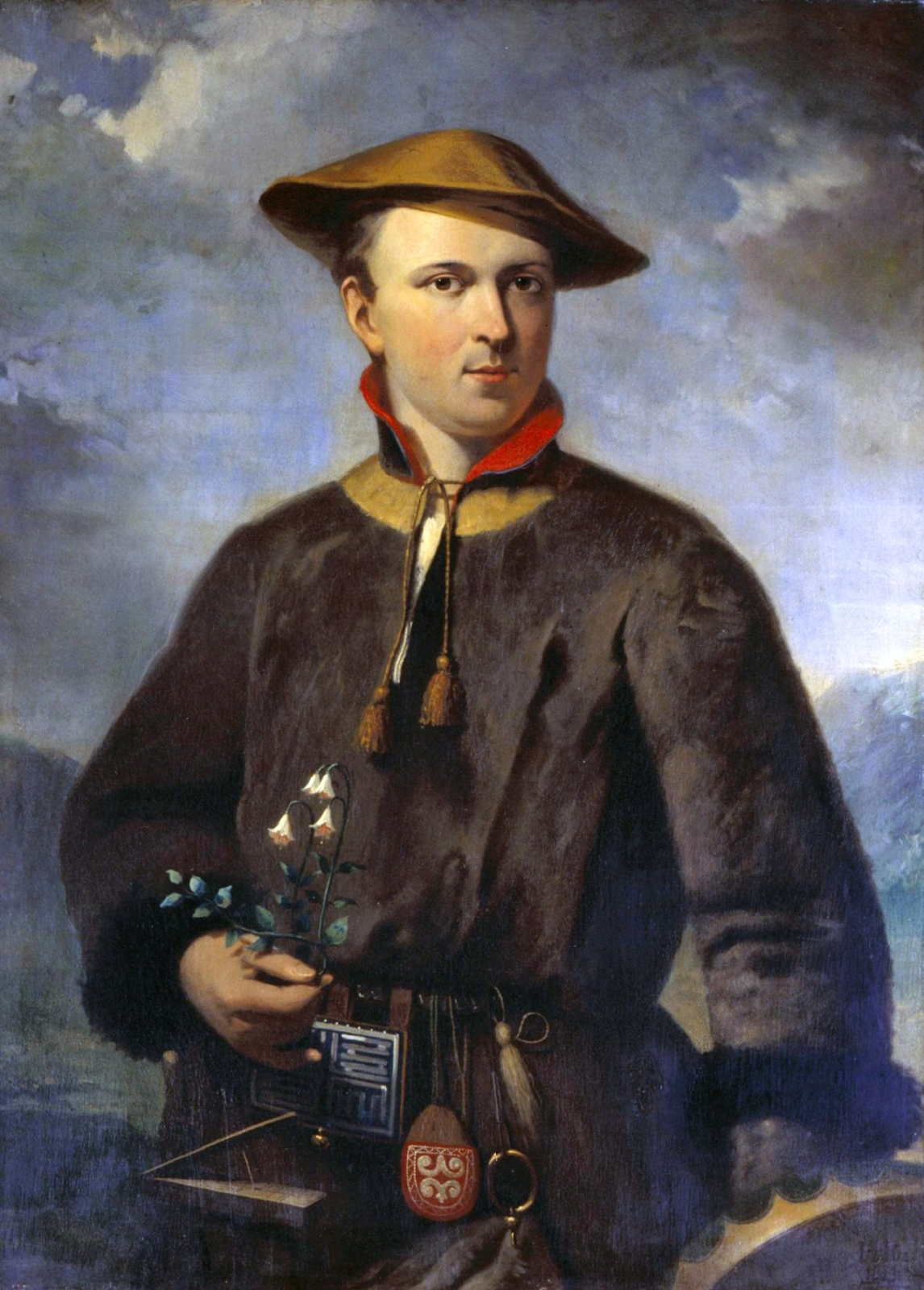
Painting by Hendrik Hollander, 1853. Via Wikimedia Commons.
Linnaeus adopted the twinflower as his personal symbol.


Popular Posts Last 30 Days.

The week ahead in Henry’s journal

The week ahead in Henry’s journal
A journal, a book that shall contain a record of all your joy.
"A stone fruit. Each one yields me a thought." ~ H. D. Thoreau, March 28, 1859


I sit on this rock
wrestling with the melody
that possesses me.