Showing posts sorted by relevance for query glowing cumuli. Sort by date Show all posts

Thursday, June 9, 2016

The black elm-tops and shadows of June.

June 9

P. M. — To Corner Spring. 

Without an umbrella, thinking the weather settled at last. 
There are some large cumuli with glowing downy cheeks floating about. Now I notice where an elm is in the shadow of a cloud,—the black elm-tops and shadows of June.

June 9, 2017

It is a dark eyelash which suggests a flashing eye beneath. It suggests houses that lie under the shade, the repose and siesta of summer noons, the thunder-cloud, bathing, and all that belongs to summer. These veils are now spread here and there over the village. 

It suggests also the creak of crickets, a June sound now fairly begun, inducing contemplation and philosophic thoughts, — the sultry hum of insects. 

A yellowbird’s nest in a poplar on Hubbard’s Bridge causeway; four fresh eggs; ten feet high, three rods beyond fence. 

Veronica scutellata (how long?) at Corner Spring. 

Compelled to squat under a bank and stand under a wood-pile through a shower. 

6.30 P. M. — Up Assabet. 

Again, about seven, the ephemera came out, in numbers as many as last night, now many of them coupled, even tripled; and the fishes leap as before.

A young robin abroad.

H. D. Thoreau, Journal, June 9, 1856

Without an umbrella, thinking the weather settled at last. See June 8, 1860 ("Within a day or two has begun that season of summer when you see afternoon showers, maybe with thunder, or the threat of them, dark in the horizon, and are uncertain whether to venture far away or without an umbrella.")

Large cumuli with glowing downy cheeks floating about. See June 4, 1855 ("Great white-bosomed clouds, darker beneath, float through the cleared sky and are seen against the deliciously blue sky, such a sky as we have not had before."); June 11, 1856 ("Great cumuli are slowly drifting in the intensely blue sky, with glowing white borders”).

It is a dark eyelash which suggests a flashing eye beneath.   See To the Maiden in the East from The Dial (October 1842) and A Week ("The lightning's silent gleam, / Startling my drowsy dream,/ Seemed like the flash / Under thy dark eyelash.")

It suggests houses that lie under the shade, the repose and siesta of summer noons, the thunder-cloud, bathing, and all that belongs to summer. See June 6, 1855 ("You see the dark eye and shade of June."); June 8, 1850 (" When the frogs dream, and the grass waves, and the buttercups toss their heads, and the heat disposes to bathe in the ponds and streams then is summer begun"); June 8, 1859 ("Within a day or two has begun that season of summer when you see afternoon showers, maybe with thunder, or the threat of them, dark in the horizon"); June 11, 1856 ("It is very hot this afternoon, and that peculiar stillness of summer noons now reigns in the woods. "); June 16, 1860 ("It appears to me that these phenomena occur simultaneously, say June 12th :• Heat about. 85° at 2 P.M.• Hylodes cease to peep.• Purring frogs (Rana palustris) cease.• Lightning-bugs first seen.• Bullfrogs trump generally.• Mosquitoes begin to be really troublesome.• Afternoon thunder-showers almost regular.• Sleep with open window.• Turtles fairly and generally begun to lay.")

The creak of crickets, a June sound now fairly begun. See June 7, 1858 ("June shadows are moving over waving grass-fields, the crickets chirp uninterruptedly. . .The trees having leaved out, you notice their rounded tops, suggesting shade."); see also A Book of the Seasons, by Henry Thoreau, The Cricket in Spring

A yellowbird’s nest in a poplar on Hubbard’s Bridge causeway. See June 9, 1855 ("A yellowbird’s nest eight feet from ground in crotch of a very slender maple. “) See also A Book of the Seasons,: the Summer Yellowbird

Again, about seven, the ephemera came out, in numbers as many as last night, ...; and the fishes leap as before. . . . See June 8, 1856 (“my boat being by chance at the same place where it was in ’54, I noticed a great flight of ephemera”).  See also June 9, 1854 (7 p. m. — Up Assabet. . . .[T]here is an incessant sound made by the fishes leaping for their evening meal, dimpling the river like large drops as far as I can see . ..”); June 2, 1854 ("It was a great flight of ephemera"). See also A Book of the Seasons, by Henry Thoreau, Insect Hatches in Spring (millers, perla, shad-flies or ephemera)

June 9. See A Book of the Seasons, by Henry Thoreau, June 9

 I notice an elm 
in the shadow of a cloud –
the shadows of June. 

A Book of the Seasons, by Henry Thoreau
"A book, each page written in its own season,
out-of-doors, in its own locality.”
~edited, assembled and rewritten by zphx © 2009-2026

https://tinyurl.com/hdt-18560609

Thursday, June 4, 2015

A new season has commenced.

June 4.

P. M. ——To Hubbard’s Close. 

Clears up in forenoon. White clover out probably some days, also red as long. 

It has just cleared off after this first rain of consequence for a long time, and now I observe the shadows of massive clouds still floating here and there in the peculiarly blue sky; which dark shadows on field and wood are the more remarkable by contrast with the light yellow-green foliage now, and when they rest on evergreens they are doubly dark, like dark rings about the eyes of June. 

June 4, 2020

Great white-bosomed clouds, darker beneath, float through the cleared sky and are seen against the deliciously blue sky, such a sky as we have not had before. 

Thus it is after the first important rain at this season. The song of birds is more lively and seems to have a new character; a new season has commenced. 

In the woods I hear the tanager and chewink and red-eye. It is fairly summer, and mosquitoes begin to sting in earnest. 


I see the dandelions now generally gone to seed amid the grass —their downy spheres.

There are now many potentillas ascendant, and the Erigeron bellidifolius is sixteen inches high and quite handsome, by the railroad this side of turn-off.

Redstarts still very common in the Trillium Woods (yesterday on Assabet also). Note tche, tche, tche vit, etc. I see some dark on the breast. 

The Lycopodium dendroideum now shows fresh green tips like the hemlock. Greenish puffs on panicled andromedas. 

Lint comes off on to clothes from the tender leaves, but it is clean dirt and all gone when you get home; and now the crimson velvety leafets of the black oak, showing also a crimson edge on the downy under sides, are beautiful as a flower, and the more salmon white oak. 

The Linnaea borealis has grown an inch. But are not the flowers winter-killed? I see dead and blackened flower-buds. Perhaps it should have opened before. 

Wintergreen has grown two inches. 

See a warbler much like the black and white creeper, but perched warbler-like on trees; streaked slate, white, and black, with a large white and black mark on wing, crown divided by a white line and then chestnut (?) or slate or dark, and then white above and below eye, breast and throat streaked downward with dark, rest beneath white. Can it be the common black and white creeper? Its note hardly reminds me of that. It is somewhat like pse pse pse pse, psa psa, weese weese weese, or longer. It did not occur to me that it was the same till I could not find any other like this in the book. 


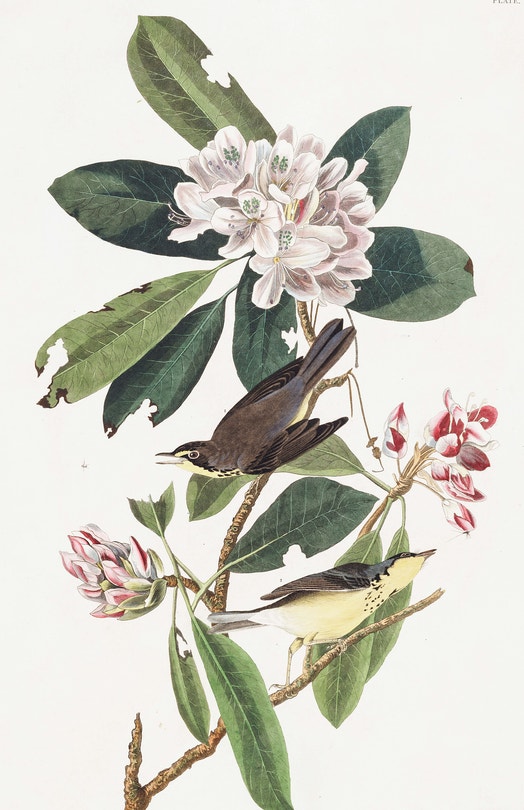
Canada Warbler
(Sylvia pardalina /
Cardellina canadensis)
In the clintonia swamp I hear a smart, brisk, loud and clear whistling warble, quite novel and remarkable, something like te chit a wit, te chit a wit, tchit a wit, tche tche. It is all bright yellow or ochreous orange (?) below except vent, and a dark or black crescent on breast, with a white line about eye. Above it appears a nearly uniform dark blue slate, legs light, bill dark (?), tail long and forked. I think it must be the Canada warbler, seen in ’37, though that seems short for this.
 
It is quite different from the warbler of May 30. 


The recent high winds have turned the edges of young leaves by beating and killing them. 

H. D. Thoreau, Journal, June 4, 1855

The shadows of massive clouds still floating here and there in the peculiarly blue sky. See May 30, 1852 (A day for shadows, even of moving clouds, over fields in which the grass is beginning to wave."); June 3, 1858 ("The shadows of clouds flitting over the landscape are a never-failing source of amusement . . . to see one man’s farm in the shadow of a cloud, — which perhaps he thought covered all the Northern States, — while his neighbor’s farm was in sunshine."); June 9, 1856 ("There are some large cumuli with glowing downy cheeks floating about"); June 11, 1856 ("Great cumuli are slowly drifting in the intensely blue sky, with glowing white borders”). June 24, 1852 ("The drifting white downy clouds are objects of a large, diffusive interest. . . among the most glorious objects in nature. ");  July 1, 1854 ("The clouds are separate glowing masses or blocks floating in the sky, not threatening rain. I see from this hill their great shadows pass slowly here and there over the top of the green forest. ")

In the woods I hear the tanager and chewink and red-eye. See July 10, 1854 ("The singing birds at present are . . . Red-eye, tanager, wood thrush, chewink, veery, oven-bird, — all even at midday.")

I see the dandelions now generally gone to seed amid the grass —their downy spheres.
See June 4, 1852 (“The dandelions are now almost all gone to seed, and children may now see if "your mother wants you."”); 
 May 9, 1858 ("A dandelion perfectly gone to seed, a complete globe, a system in itself.") See also A Book of the Seasons,  by Henry Thoreau, The Dandelion in Spring

Redstarts still very common . . . Note tche, tche, tche vit, etc. See.May 26, 1855 ("Saw a redstart . . . black with a sort of brick red on sides [of] breast, spot on wing  and under root of tail. Note heard once next day, at Kalmia Swamp, somewhat like aveet aveet aveet aveet.");   June 6, 1855  ("On the Island I hear still the redstart—tsip tsip tsip tsip, tsit-i-yet, or sometimes tsip tsip tsip tsip, tse vet . . . It repeats this at regular intervals for a long time") See also  A Book of the Seasons, by Henry Thoreau,  The American Redstart

The Linnaea borealis has grown an inch. See 
   June 1, 1855 ("I find the Linnaea borealis growing near the end of the ridge in this lot toward the meadow, near a large white pine stump recently cut."); See also  A Book of the Seasons, by Henry Thoreau, Linnaea borealis (Twinflower)

Can it be the common black and white creeper? Its note hardly reminds me of that. It is somewhat like pse pse pse pse, psa psa, weese weese weese, or longer.  See April 28, 1856 (" I hear to-day frequently the seezer seezer seezer of the black and white creeper, or what I have referred to that”); May 11, 1856 ("The black and white creeper also is descending the oaks, etc., and uttering from time to time his seeser seeser seeser.”);  May 12, 1855 ("A very neat and active bird, exploring the limbs on all sides and looking three or four ways almost at once for insects. Now and then it raises its head a little, opens its bill, and, without closing it, utters its faint seeser seeser seeser.") See alsoA Book of the Seasons  by Henry Thoreau, The Black and White Creeper

I think it must be the Canada Warbler? See May 23, 1860 ("I get sight for a moment of a large warbler on a young oak, – only the under side, which is a clear bright lemon-yellow, all beneath, with a sort of crescent of black spots on the breast. Is it not the Sylvia pardalina?"); May 28, 1860 ("Sylvia pardalina. It is a bright yellow beneath, with a broad black stripe along each side of the throat, becoming longish black marks crescent-wise on the fore part of the breast, leaving a distinct clear bright-yellow throat, and all the rest beneath bright-yellow; a distinct bright-yellow ring around eye; a dark bluish brown apparently all above; yellowish legs. Not shy; on the birches.")
 See also A Book of the Seasons, by Henry Thoreau, The Canada Warbler

The warbler of May 30. See May 30, 1855 ("A familiar warbler not recognized for some years")

The recent high winds. See May 30, 1855  ("A strong west wind "); June 1, 1855 ("A very windy day, the third, drowning the notes of birds."); June 2, 1855 ("Still windier than before.")

June 4.  See A Book of the Seasons, by Henry Thoreau, June 4

The dandelions
        now gone to seed – downy spheres
seen amid the grass.
A Book of the Seasons, by Henry Thoreau
"A book, each page written in its own season,
out-of-doors, in its own locality.”
~edited, assembled and rewritten by zphx © 2009-2025

Saturday, June 11, 2016

Great cumuli slowly drifting in the intensely blue sky

June 11

P. M. —To Flint’s Pond. 

The locust in graveyard shows but few blossoms yet. 

It is very hot this afternoon, and that peculiar stillness of summer noons now reigns in the woods. I observe and appreciate the shade, as it were the shadow of each particular leaf on the ground.

I think that this peculiar darkness of the shade, or of the foliage as seen between you and the sky, is not accounted for merely by saying that we have not yet got accustomed to clothed trees, but the leaves are rapidly acquiring a darker green, are more and more opaque, and, besides, the sky is lit with the intensest light. It reminds me of the thunder-cloud and the dark eyelash of summer. 

June 11, 2019

Great cumuli are slowly drifting in the intensely blue sky, with glowing white borders. 

The red-eye sings incessant, and the more indolent yellow-throat vireo, and the creeper, and perhaps the redstart? or else it is the parti-colored warbler. 

I perceive that scent from the young sweet-fern shoots and withered blossoms which made the first settlers of Concord to faint on their journey. 

Saw yesterday a great yellow butterfly with black marks. 

See under an apple tree, at entrance of Goose Pond Path from Walden road, a great fungus with hollow white stem, eight or nine inches high, whose black funereal top has melted this morning, leaving a black centre with thin white scales on it. 

All the cistuses are shut now that I see, and also the veiny-leaved hieracium with one leaf on its stem, not long open. 

I notice no white lily pads near the bathing-rock in Flint’s Pond. See a bream’s nest two and a quarter feet diameter, laboriously scooped out, and the surrounding bottom for a diameter of eight feet (! !) comparatively white and clean, while all beyond is mud and leaves, etc., and a very large green and cupreous bream with a centre, while half a dozen shiners are hovering about, apparently watching a chance to steal the spawn. 

A partridge with young in the Saw Mill Brook path. Could hardly tell what kind of creature it was at first, it made such a noise and fluttering amid the weeds and bushes. Finally ran off with its body flat and wings somewhat spread. 

Utricularia vulgaris very abundant in Everett’s Pool. 

A beautiful grass-green snake about fifteen inches long, light beneath, with a yellow space under the eyes along the edge of the upper jaw. 

The Rubus triflorus apparently out of bloom at Saw Mill, before the high blackberry has begun. 

Rice tells me he found a turtle dove’s nest on an apple tree near his farm in Sudbury two years ago, with white eggs; so thin a bottom you could see the eggs through.

H. D. Thoreau, Journal, June 11, 1856

The locust in graveyard shows but few blossoms yet. See June 7, 1854 ("The locusts so full of pendulous white racemes five inches long, filling the air with their sweetness and resounding with the hum of humble and honey bees"); June 9, 1852 ("The locust in bloom"); June 10, 1853 ("The locust bloom is now perfect, filling the street with its sweetness."); June 12, 1852 ("The locusts' blossoms in the graveyard fill the street with their sweet fragrance.")

I observe and appreciate the shade, as it were the shadow of each particular leaf on the ground. See June 2, 1854 ("These virgin shades of the year . . . how full of promise!  I would fain be present at the birth of shadow. It takes place with the first expansion of the leaves.");  June 4, 1860  (" A grateful but thin shade . . .so open that we see the fluttering of each leaf in its shadow.”)

I think that this peculiar darkness of the shade . . . reminds me of the thunder-cloud and the dark eyelash of summer. See June 9. 1856 ("Now I notice where an elm is in the shadow of a cloud,—the black elm-tops and shadows of June. It is a dark eyelash which suggests a flashing eye beneath. It suggests houses that lie under the shade, the repose and siesta of summer noons, the thunder-cloud, bathing, and all that belongs to summer."); May 29, 1857 ("The sunniness contrasts with the shadows of the freshly expanded foliage, like the glances of an eye from under the dark eyelashes of June.") See also May 27, 1859 ("The dark river, now that shades are increased, is like the dark eye of a maiden.") and note to June 6, 1855 ("The dark eye and shade of June.”)

The red-eye sings incessant. See June 11, 1852 ("The red-eye sings now in the woods, perhaps more than any other bird. “);  June 12, 1853 ("The red-eyed vireo is the bird most commonly heard in the woods.”)  See also A Book of the Seasons,  by Henry Thoreau, The Red-eyed Vireo

The more indolent yellow-throat vireo.   See May 19, 1856 ("A yellow-throated vireo . . . singing indolently, ullia — eelya, and sometimes varied to eelyee.”) See also A Book of the Seasons,  by Henry Thoreau, The Yellow-throated Vireo

Saw yesterday a great yellow butterfly with black marks. See June 3, 1859 ("A large yellow butterfly . . . three and a half to four inches in expanse. Pale-yellow, the front wings crossed by three or four black bars; rear, or outer edge, of all wings widely bordered with black, and some yellow behind it; a short black tail to each hind one, with two blue spots in front of two red-brown ones on the tail"); June 14, 1860 ("I see near at hand two of those large yellow (and black) butterflies . . . a small and slender swallow tail with reddish brown and blue at the tail; body black above and yellow along the sides. (C. says it is the Papilio Turnus of Say.)")

All the cistuses are shut now that I see. See May 30, 1853 ("The cistus out, probably yesterday, a simple and delicate flower, its stamens all swept to one side. It upholds a delicate saffron-golden (?) basin about nine inches from the ground."); June 3, 1854 ("The cistus is well out on the Cliffs; maybe several days."); June 7, 1855 ("Cistus, apparently yesterday, open.")

The veiny-leaved hieracium with one leaf on its stem, not long open. See  June 15, 1851 ("The Hieracium venosum, veiny-leaved hawkweed, with its yellow blossoms in the woodland path.");   August 21, 1851 ("I have now found all the hawkweeds. Singular these genera of plants, plants manifestly related yet distinct. They suggest a history to nature, a natural history in a new sense. ") See also A Book of the Seasons,  by Henry Thoreau, The Hawkweeds (hieracium)

A partridge with young in the Saw Mill Brook path. See June 14, 1858 ("Young partridges, when?"); June 27, 1852 ("I meet the partridge with her brood in the woods . . . She spreads her tail into a fan and beats the ground with her wings fearlessly within a few feet of me, to attract my attention while her young disperse.") See also  A Book of the Seasons,  by Henry Thoreau, the Partridge

A beautiful grass-green snake about fifteen inches long, light beneath, with a yellow space under the eyes along the edge of the upper jaw. See May 19, 1860 (“See a green snake, a very vivid yellow green, of the same color with the tender foliage at present, and as if his colors had been heightened by the rain.”); May 9, 1852 ("See a green snake, twenty or more inches long, on a bush, hanging over a twig with its head held forward six inches into the air, without support and motionless.”)  

The Rubus triflorus apparently out of bloom at Saw Mill.  See May 21, 1856  ("Rubus triflorus abundantly out at the Saw Mill Brook; how long?"); June 30, 1854  ("Rubus triflorus berries, some time, — the earliest fruit of a rubus.") See also A Book of the Seasons,  by Henry Thoreau, the Raspberry

June 11. See A Book of the Seasons, by Henry Thoreau, June 11

This hot afternoon
the stillness of summer noons 
in the shady woods.

Cumuli drifting
    in the intensely blue sky –
glowing white borders.

A Book of the Seasons,  by Henry Thoreau
 "A book, each page written in its own season, 
out-of-doors, in its own locality."
~edited, assembled and rewritten by zphx ©  2009-2026

https://tinyurl.com/hdt-560611


Sunday, June 24, 2012

What could a man learn by watching the clouds?


P. M. – Το White Pond . The keys of the white ash cover the trees profusely , a sort of mulberry brown , an inch and a half long , handsome . The Vaccinium macrocarpon , probably for some days . The Calopogon pulchellus ( Cymbidium of Bigelow ) , grass pink of some , a pretty purple arethusa - like flower in a shady low copse on Corner road , near the Asclepias quadrifolia , a rather striking flower with two umbels of small pink and white flowers standing above the sur- rounding herbage . Spiræa salicifolia by the roadsides . Archangelica atropurpurea , interesting for its great umbels and vigorous growth of its purplish but rank- smelling stem . It is one of the most forward early leaves in warm springy places . I perceive excrescences on the grape leaves and vines , resembling in their form and disposition the grape clusters that are to be . 


The drifting white downy clouds are objects of a large, diffusive interest. Like all great themes, they are always at hand to be considered, or they float over us unregarded. They are unobtrusive. Far away they float in the serene sky, the most inoffensive of objects. What could a man learn by watching the clouds? The objects which go over our heads unobserved are vast and indefinite. They are among the most glorious objects in nature. They are the flitting sails in that ocean whose bounds no man has visited. A sky without clouds is a meadow without flowers, a sea without sails.

I still perceive that wonderful fragrance from the meadow ( ? ) on the Corner causeway , intense as ever . It is one of those effects whose cause it is best not to know , perchance . Uncommonly cool weather now , after warm days and nights for a week or more . I see many grasshoppers for the first time ( only single ones before ) , in the grass in the White Pond road . They describe a thousand little curves as I walk , with an ominous dry rustling of their wings , about three quarters of an inch long . Come to eat the grass ? It is the biggest game our dog starts . Much of the June - grass is dead ; most of it in dry fields . White Pond very handsome to - day . The shore alive with pollywogs of large size , which ripple the water on our approach . There is a fine sparkle on the water , though not equal to the fall one quite . The water is very high , so that you cannot walk round it , but it is the more pleasant while you are swimming to see how the trees actually rise out of it on all sides . It bathes their feet . The pines now hold somewhat of a subordi- nate rank amid the flourishing evergreens . The dog worried a woodchuck , half grown , which did not turn its back and run into its hole , but backed into it and faced him and us , gritting its teeth and pre- pared to die . But even this little fellow was able to defend himself against the dog with his sharp teeth . That fierce gritting of their teeth is a remarkable habit with these animals . I am disappointed to notice to - day that most of the pine - tops incline to the west , as if the wind had to do with it . The panicled andromeda has froth on it . 

The Linnæa borealis just going out of blossom. I should have found it long ago. Its leaves densely cover the ground. 

H. D. Thoreau, Journal, June 24, 1852

June 24, 2012
June 24, 2012

The drifting white downy clouds . . .
 See June 4, 1855 ("Great white-bosomed clouds, darker beneath, float through the cleared sky and are seen against the deliciously blue sky, such a sky as we have not had before."); June 9, 1856 ("There are some large cumuli with glowing downy cheeks floating about"); June 11, 1856 ("Great cumuli are slowly drifting in the intensely blue sky, with glowing white borders”). Also January 13, 1852 (“Here I am on the Cliffs . . .I look up and they are gone, like the steam from the engine in the winter air. Even a considerable cloud is dissolved and dispersed in a minute or two, and nothing is left but the pure ether. Then another comes by magic, is born out of the pure blue empyrean, and now this too has disappeared, and no one knows whither it is gone.”); August 9, 1860 (". . . all at once a small cloud begins to form half a mile from the summit and rapidly grows in a mysterious manner till it drapes and conceals the summit above us for a few moments, then passes off and disappears northeastward just as it had come..Watching these small clouds forming and dissolving about the summit of our mountain, I cast my eyes toward the dim bluish outline of the Green Mountains in the clear red evening sky, and, to my delight, I detect exactly over the summit of Saddleback Mountain, some sixty miles distant, its own little cloud . . . a sort of fortunate isle in the sunset sky, the local cloud of the mountain.”)


The Linnæa borealis
 just going out of blossom. See 
June 19, 1852 ("I cannot find the linnæa . . . perhaps I am too late"); See also A Book of the Seasons, by Henry Thoreau, Linnaea borealis (Twinflower)


Saturday, June 11, 2016

A Book of the Seasons: June 11 (the red-eye sings, drifting clouds, shades of June, seasons of the night)


The year is but a succession of days,
and I see that I could assign some office to each day
which, summed up, would be the history of the year.
Henry Thoreau, August 24, 1852


Away from the town 
and deeper into the night –
whip-poor-wills, fire-flies. 

In a moonlight night
I seem to be nearer the
origin of things.
June 11, 1851

I see my shadow 
as a second person who 
sits down on this rock. 

Much like a mirage
a sheet of water revealed 
by its reflections. 

Great cumuli with
glowing white borders slowly 
drifting in the sky.

I observe the shade 
as if the shadow of each 
particular leaf.

June 11, 2018


Saw a sphinx moth night before last. June 11, 1860

Saw yesterday a great yellow butterfly with black marks. June 11, 1856

Another fog this morning. June 11, 1853

Already I see those handsome fungi spots on the red maple leaves, yellow within, with a green centre, then the light-red ring deepening to crimson. June 11, 1860

I now first begin to notice the silvery under sides of the red maple and swamp white oak leaves, turned up by the wind. June 11, 1860

The locust in graveyard shows but few blossoms yet. June 11, 1856

The black willow, having shed its fuzzy seeds and expanded its foliage, now begins to be handsome, so light and graceful. June 11, 1853

The early willows at the bridge are apparently either S. discolor or eriocephala, or both. June 11, 1855

The fertile Salix alba is conspicuous now at a distance, in fruit, being yellowish and drooping. June 11, 1858

The upland fields are already less green where the June-grass is ripening its seeds. They are greenest when only the blade is seen. June 11, 1853

In the sorrel-fields, also, what lately was the ruddy, rosy cheek of health, now that the sorrel is ripening and dying, has become the tanned and imbrowned cheek of manhood. June 11, 1853

Some fields began to be white with whiteweed on the 9th. June 11, 1860

June 11, 2018

The mountains are misty and blue. June 11, 1852

Now observe the dark evergreen of June. June 11, 1855

Hemlocks are about at height of their beauty, with their fresh growth. June 11, 1859

The evergreens are now completely invested by the deciduous trees, and you get the full effect of their dark green contrasting with the yellowish green of the deciduous trees. June 11, 1860

Looking at a hillside of young trees, what various shades of green! The oaks generally are a light and tender and yellowish green; the white birches, dark green now; the maples, dark and silvery. June 11, 1860

I observe and appreciate the shade, as it were the shadow of each particular leaf on the ground. June 11, 1856

Great cumuli are slowly drifting in the intensely blue sky, with glowing white borders. June 11, 1856

June 11, 2019

It reminds me of 
the thunder-cloud and the dark
 eyelash of summer. 
June 11, 1856

How agreeable in a still, cloudy day, when large masses of clouds, equally dispersed, float across the sky, not threatening rain, but preserving a temperate air, to see a sheet of water thus revealed by its reflections, a smooth, glassy mirror, reflecting the light sky and the dark and shady woods. It is very much like a mirage. June 11, 1854

At twelve walk up the Sudbury River above Frank's to Ashland, at first through the meadows, then over the high hills in the vicinity. June 11, 1854

From a high hill on the west of the river, about a mile from Frank's, get a good view of Farm Pond eastward, which empties into the river, with South Framingham on the south east side of it. June 11, 1854

The mosquitoes first troubled me a little last night. June 11, 1853

The air in this pitch pine wood is filled with the hum of gnats, flies, and mosquitoes. June 11, 1852

In one grove pitch pine shoots are from seven to nine tenths as long as last year's growth. June 11, 1859

In order to get the deserted tanager’s nest at the top of a pitch pine which was too weak to climb, we carried a rope in our pockets and took three rails a quarter of a mile into the woods, and there rigged a derrick, by which I climbed to a level with the nest, and I could see if there were eggs in it. June 11, 1855

The cricket sings. June 11, 1852

You must attend to the birds in the spring. June 11, 1852

A robin sings and wood thrush amid the pine. June 11, 1852

The veery reminds me of the wood thrush in its note, as well as form and color. June 11, 1852

Who taught the oven-bird to conceal her nest ? It is on the ground, yet out of sight. What cunning there is in nature ! No man could have arranged it more art fully for the purpose of concealment. Only the escape of the bird betrays it. Early June, 1850

I hear the night warbler breaking out as in his dreams made so from the first for some mysterious reason June 11 1851

Golden crowned thrush (oven-bird) June 11, 1852

The oven-bird and the thrasher sing. The last has a sort of chuckle. June 11, 1852

I hear the bobolink and the lark as I go down the railroad causeway. June 11, 1852
 
There are young bluebirds. June 11, 1855

The red-eye sings now in the woods, perhaps more than any other bird. June 11, 1852

The red-eye sings incessant, and the more indolent yellow-throat vireo, and the creeper, and perhaps the redstart? June 11, 1856

Heard many redstarts on the Island. June 11, 1860

Hear the parti-colored warbler. June 11, 1858

Saw creepers and one wood pewee nest on a swamp white oak, not quite done. June 11, 1860

Probably blackbirds were never less numerous along our river than in these years. June 11, 1853

What a difference between one red-wing blackbird’s egg and another’s! C. finds one long as a robin’s, but narrow, with large black spots on larger end and on side, on or between the bushes by riverside; another much shorter, with a large black spot on the side. Both pale-blue ground. June 11, 1855

Rice tells me he found a turtle dove’s nest on an apple tree near his farm in Sudbury two years ago, with white eggs; so thin a bottom you could see the eggs through. June 11, 1856

Just as we were shoving away from this isle, I heard a sound just like a small dog barking hoarsely, and, looking up, saw it was made by a bittern (Ardea minor), a pair of which were flapping over the meadows and probably had a nest in some tussock thereabouts. June 11, 1860

Examine the stone-heaps . . . but I can find no ova in them. June 11, 1858

See a bream’s nest two and a quarter feet diameter, laboriously scooped out, and the surrounding bottom for a diameter of eight feet (! !) comparatively white and clean . . . while half a dozen shiners are hovering about, apparently watching a chance to steal the spawn. June 11, 1856

I see a musquash dive head foremost (as he is swimming) in the usual way, being scared by me, but without making any noise. June 11, 1858

Near a wall thereabouts, saw a little woodchuck, about a third grown, resting still on the grass within a rod of me, as gray as the oldest are, but it soon ran into the wall. June 11, 1858

A beautiful grass-green snake about fifteen inches long, light beneath, with a yellow space under the eyes along the edge of the upper jaw. June 11, 1856

A painted turtle laying, at 5 p. m. June 11, 1860

Saw a painted turtle on the gravelly bank just south of the bath-place, west side, and suspected that she had just laid (it was mid-afternoon). June 11, 1858

Saw half a dozen Emys insculpta preparing to dig now at mid-afternoon, and one or two had begun at the most gravelly spot there; but they would not proceed while I watched, though I waited nearly half an hour. June 11, 1858

It seems a very earnest and pressing business they are upon. June 11, 1858 They have but a short season to do it in, and they run many risks. June 11, 1858

Landing on Tail's Island, I perceive a sour scent from the wilted leaves and scraps of leaves which were blown off yesterday and strew the ground in all woods. June 11, 1860

Just within the edge of the wood there, I see a small painted turtle on its back, with its head stretched out as if to turn over. June 11, 1860

Surprised by the sight, I stooped to investigate the cause. June 11, 1860

It drew in its head at once, but I noticed that its shell was partially empty. June 11, 1860

I could see through it from side to side as it lay, its entrails having been extracted through large openings just before the hind legs. June 11, 1860

The dead leaves were flattened for a foot over, where it had been operated on, and were a little bloody. June 11, 1860

Its paunch lay on the leaves, and contained much vegetable matter, — old cranberry leaves, etc. June 11, 1860

Judging by the striae, it was not more than five or six years old, — or four or five. June 11, 1860

Its fore parts were quite alive, its hind legs apparently dead, its inwards gone ; apparently its spine perfect. June 11, 1860

The hind legs themselves had not been injured nor the shell scratched. June 11, 1860

The flies had entered it in numbers. June 11, 1860

What creature could have done this which it would be difficult for a man to do? June 11, 1860

I thought it most likely that it was done by some bird of the heron kind which has a long and powerful bill. June 11, 1860

And probably this accounts for the many dead turtles which I have found and thought died from disease. June 11, 1860

A partridge with young in the Saw Mill Brook path. Could hardly tell what kind of creature it was at first, it made such a noise and fluttering amid the weeds and bushes. Finally ran off with its body flat and wings somewhat spread. June 11, 1856

I find, in the dry excrement of a fox left on a rock, the vertebrae and talons of a partridge (?) which he has consumed. June 11, 1853.

Such is Nature, who gave one creature a taste or yearning for another's entrails as its favorite tidbit ! ! June 11, 1860

No wonder the turtle is wary, for, notwithstanding its horny shell, when it comes forth to lay its eggs it runs the risk of having its entrails plucked out. June 11, 1860

That is the reason that the box turtle, which lives on the land, is made to shut itself up entirely within the shell, and I suspect that the mud tortoise only comes forth by night. June 11, 1860

I perceive that scent from the young sweet-fern shoots and withered blossoms which made the first settlers of Concord to faint on their journey. June 11, 1856

See under an apple tree, at entrance of Goose Pond Path from Walden road, a great fungus with hollow white stem, eight or nine inches high, whose black funereal top has melted this morning, leaving a black centre with thin white scales on it. June 11, 1856

All the cistuses are shut now that I see, and also the veiny-leaved hieracium with one leaf on its stem, not long open. June 11, 1856

The Rubus triflorus apparently out of bloom at Saw Mill, before the high blackberry has begun. June 11, 1856

I have noticed the green oak-balls some days. 
June 11, 1855

The target leaf is eaten above. June 11, 1855

Sail to Tail's Island. June 11, 1860

Wind northwest, pretty strong, and not a warm day. June 11, 1860
I notice the patches of bulrushes (Scirpus lacustris) now generally eighteen inches high and very dark green, but recently showing themselves. June 11, 1860

The wind does not blow through our river-valley just as the vanes indicate at home, but conformably to the form of the valley somewhat. June 11, 1860

It depends on whether you have a high and hilly shore to guide it, or a flat one which it may blow across. June 11, 1860

With a north west wind, it is difficult to sail from the willow-row to Hubbard's Bath, yet I can sail more westerly from the island point in Fair Haven Bay to the bath-place above; and though I could not do the first to-day, I did sail all the way from Rice's Bar to half a mile above Sherman's Bridge by all the windings of the river. June 11, 1860

If the bend is due east and the wind northwest I can sail round it. June 11, 1860

Again, as I was approaching Bittern Cliff, I had but little wind, but I said to myself, As soon as I reach the cliff I shall find myself in a current of wind blowing into the opening of the pond valley; and I did. June 11, 1860

Indeed, the wind flows through that part of the river-valley above the water-line somewhat as the water does below it. June 11, 1860

I see from time to time a fish, scared by our sail, leap four to six feet through the air above the waves. June 11, 1860

See many small blue devil's-needles to-day, but no mates with them, and is it not they that the kingbird stoops to snap up, striking the water each time? June 11, 1860

There is at least one foot of water on the meadows generally. June 11, 1860

I cut off the principal bends, pushing amid the thin sedge and pipes, and land on Tail's Island. June 11, 1860

I had carried india-rubber boots to look for wrens' nests, but the water was very much too deep, and I could not have used them except on the very edge in some places. June 11, 1860

Yet the river in Concord this morning was but just one foot above summer level and about eighteen inches above where it was just before the middle of May, when everybody remarked on its extreme lowness. June 11, 1860

I find the Sudbury meadows unexpectedly wet. June 11, 1860

If you should lower it eighteen inches now here, there would still be much water on the Sudbury meadows. June 11, 1860

The sedges, even, are thick and rank only on the more elevated and drier edges of the meadow. June 11, 1860

C. stricta grows thinly (with thin pipes) or occasionally in large tufts. June 11, 1860

Accordingly, on far the greater part of these meadows there is now very little grass, i. e. sedge, but thin pipes and sedge, — the Carex stricta and monile commonly (too wet for scoparia and stellulata). June 11, 1860

On dry parts only, the C. monile, etc. June 11, 1860

Carex cephalophora (?) on Heywood’s Peak. June 11, 1855

The Carex tentaculata at Clamshell in prime, say one week. It abounds at Forget-me-not Shore, — dense- flowered, spreading spikes. June 11, 1860

Is not that carex, Pennsylvanica-like, with a long spike (one inch long by one half-inch wide), C. bullata? June 11, 1855

That fine, dry, wiry wild grass in hollows in woods and sprout-lands, never mown, is apparently the C. Pennsylvanica, or early sedge. June 11, 1855

On our way up, we ate our dinner at Rice's shore, and looked over the meadows, covered there with waving sedge, light-glaucous as it is bent by the wind, reflecting a grayish or light-glaucous light from its underside. June 11, 1860

That meadow opposite Rice's Bath is comparatively well covered with sedge, as the great Sudbury meadow is not. June 11, 1860

Notice pads and pontederias are now pretty thick. June 11, 1860
I notice no white lily pads near the bathing-rock in Flint’s Pond. June 11, 1856

The white lily pads reddish, and showing their crimson undersides from time to time when the wind blows hardest. June 11, 1860

Utricularia vulgaris very abundant in Everett’s Pool. June 11, 1856

The potamogeton (the large common one) is remarkable as a brown leaf, — fit color for the brown water on which it floats, — but the potamogetons are few and scarcely obvious yet on the river. June 11, 1860

I do not see the great Scirpus fluviatilis there yet. June 11, 1860

There are many large spaces of pads, — two at Tail's Island, — showing that they are wet all summer. June 11, 1860

This is more like a lagoon than a meadow, in fact. June 11, 1860

It is too wet even for sedges to flourish, for they are not dense, as on other meadows, except on the higher parts near the hills or shores. June 11, 1860

The veiny-leaved hieracium with one leaf on its stem, not long open. June 11, 1856

Lambkill flower. June 11, 1859

Carrion-flower up a day or two. June 11, 1859

Panicum latifolium (not out) grows by riverside at Dakin's Brook. June 11, 1859

Galium triflorum, how long? June 11, 1859

Ferns generally were killed by the frost of last month, e. g. brakes, cinnamon fern, flowering and sensitive ferns, and no doubt others. I smell the strong sour scent of their decaying. June 11, 1859

The brakes, the sarsaparilla, the osmundas, the Solomon’s-seals, the lady's slippers have long since withered and fallen. The huckleberries and blueberries, too, have lost their leaves. The forest floor is covered with a thick coat of moist brown leaves. June 11, 1859

It is very hot this afternoon, and that peculiar stillness of summer noons now reigns in the woods. June 11, 1856

When I return, about 5 p. m., the shad-flies swarm over the river in considerable numbers, but there are very few at sundown. June 11, 1859

A beautiful summer night, not too warm, moon not quite full, after two or three rainy days. June 11, 1851

When I get away from the town and deeper into the night, I hear whip-poor-wills, and see fireflies in the meadow. June 11, 1851

The whip-poor-will suggests how wide asunder the woods and the town. . . . It is a bird not only of the woods, but of the night side of the woods. June 11, 1851

At 9 p. m. , 54°, and no toads nor peepers heard. June 11, 1860

 I hear the nighthawks uttering their squeaking notes high in the air now at nine o ' clock P. M. , and occasionally  what I do not remember to have heard so late — their booming note. It sounds more as if under a cope than by day. The sound is not so fugacious, going off to be lost amid the spheres, but is echoed hollowly to earth, making the low roof of heaven vibrate. Such a sound is more confused and dissipated by day. June 11, 1851 

No one, to my knowledge, has observed the minute differences in the seasons. June 11, 1851

Hardly two nights are alike. June 11, 1851

Many men walk by day; few walk by night. It is a very different season. Instead of the sun, there are the moon and stars; instead of the wood thrush, there is the whip-poor-will; instead of butterflies, fireflies, winged sparks of fire! June, 1850

The woodland paths are never seen to such advantage as in a moonlight night, opening before me almost against expectation as I walk, as if it were not a path, but an open, winding passage through the bushes, which my feet find. June 11, 1851

I now descend round the corner of the grain-field, through the pitch pine wood into a lower field, inclosed by woods, and find myself in a colder, damp and misty atmosphere, with much dew on the grass. June 11, 1851

There is something creative and primal in the cool mist. June 11, 1851

I seem to be nearer to the origin of things. June 11, 1851

My spiritual side takes a more distinct form. .June 11, 1851

A book of the seasons, each page of which should be written in its own season and out-of-doors, or in its own locality wherever it may be. June 11, 1851

June 11, 2023

See A Book of the Seasons,  by Henry Thoreau:


*****

May 12, 1855 ("The brown thrasher is a powerful singer; he is a quarter of a mile off across the river, when he sounded within fifteen rods. ")
May 13, 1855 ("Now, about two hours before sunset, the brown thrashers are particularly musical. One seems to be contending in song with another.")
May 29, 1855 ("The red-eye, its clear loud song in bars continuously repeated and varied; all tempered white beneath and dark yellow olive above and on edge of wings, with a dark line on side-head or from root of bill; dusky claws, and a very long bill.")
June 2, 1854 ("Are these not kingbird days, when, in clearer first June days full of light, this aerial, twittering bird flutters from willow to willow and swings on the twigs, showing his white-edged tail?")
June 6, 1855 ("On the Island I hear still the redstart—tsip tsip tsip tsip, tsit-i-yet, or sometimes tsip tsip tsip tsip, tse vet. A young male. It repeats this at regular intervals for a long time , sitting pretty still now.")
June 7, 1853 ("The oven-bird runs from her covered nest, so close to the ground under the lowest twigs and leaves, even the loose leaves on the ground, like a mouse, that I can not get a fair view of her. ")
June 7, 1858 ("The nighthawk sparks and booms over arid hillsides and sprout-lands.")
June 8, 1855("A tanager’s nest in the topmost forks of a pitch pine about fifteen feet high, by Thrush Alley; the nest very slight, apparently of pine needles, twigs, etc.; can see through it; bird on")
June 9, 1854 (" The veery rings, and the tree toad.")
June 9, 1855 ("I think I have hardly heard a bobolink for a week or ten days.")
June 9. 1856 ("Now I notice where an elm is in the shadow of a cloud,—the black elm-tops and shadows of June. It is a dark eyelash which suggests a flashing eye beneath. It suggests houses that lie under the shade, the repose and siesta of summer noons, the thunder-cloud, bathing, and all that belongs to summer. ")

June 12, 1853 ("The note of the wood thrush answers to some cool unexhausted morning vigor in the hearer.")
June 13, 1851 ("The nighthawk booms wide awake")
June 13, 1851 (" I hear partridges drumming to-night as late as 9 o'clock .What singularly space penetrating and filling sound! Why am I never nearer to its source? ")
June 13, 1858 (" I hear and see the parti-colored warbler, blue yellow-backed, here on the spruce trees. It probably breeds here. [Ledum Swamp]")
June 14, 1851 ("The blackbird's harsher note resounds over the meadows, and the veery's comes up from the wood.")
June 14, 1858 ("Young partridges, when?")
June 15, 1851 ("I hear, while sitting by the wall, the sound of the stake-driver at a distance. . . . The pumper. I immediately went in search of the bird, but, after going a third of a mile, it did not sound much nearer, and the two parts of the sound did not appear to proceed from the same place. What is the peculiarity of these sounds which penetrate so far on the keynote of nature? ")
June 15, 1852 ("The note of the bobolink begins to sound somewhat rare. ")
June 16, 1854 ("Thrasher and catbird sing still; summer yellowbird and Maryland yellow-throat sing still; and oven-bird and veery.")
June 17, 1852 ("The birds sing well this morning, well as ever. The brown thrasher drowns the rest. Lark first, and, in the woods, the red-eye, veery, chewink, oven-bird, wood thrush.")
June 25, 1860 (" As near as I can make out with my glass, I see and hear the parti-colored warbler at Ledum Swamp on the larches and pines. A bluish back, yellow breast with a reddish crescent above, and white belly, and a continuous screeping note to the end.")
June 26, 1855 ("C. has found a wood pewee’s nest on a horizontal limb of a small swamp white oak, ten feet high, with three fresh eggs, cream-colored with spots of two shades in a ring about large end. Have nest and an egg.")

June 11, 2022

If you make the least correct 
observation of nature this year,
 you will have occasion to repeat it
 with illustrations the next, 
and the season and life itself is prolonged.


A Book of the Seasons, by Henry Thoreau, June 11
A Book of the Seasons,  by Henry Thoreau 
 "A book, each page written in its own season, 
out-of-doors, in its own locality."
~edited, assembled and rewritten by zphx ©  2009-2023


Popular Posts Last 30 Days.

The week ahead in Henry’s journal

The week ahead in Henry’s journal
A journal, a book that shall contain a record of all your joy.
"A stone fruit. Each one yields me a thought." ~ H. D. Thoreau, March 28, 1859


I sit on this rock
wrestling with the melody
that possesses me.