March. The frogs are now heard leaping into the ditches on your approach . . . I see the dimples where the croakers which were on the surface have dived . . . They are very wary, and instantly dive to the bottom . . . Later, in a pool behind Lee's Cliff, I hear them, – the waking up of the leafy pools.
May. Near Jenny Dugan’s, perceive that unaccountable fugacious fragrance, as of all flowers, bursting forth in air . . .It is the general fragrance of the year. I am almost afraid I shall trace it to some particular plant. It surpasses all particular fragrances. I am not sitting near any flower that I can perceive.
Unaccountable
flowery fragrance– yet not
near any flower.
HDT ~ May 6, 1855
From which tree's bloom
it comes, I do not know —
this fragrance.
~ Basho
May. Young blueberries every where in bloom, and Viola pedata along the woodland paths, in high land. Sorrel in bloom, beginning. I am eager to taste a handful.
June. All the phenomena of nature need be seen from the point of view of wonder and awe, like lightning; and, on the other hand, the lightning itself needs to be regarded with serenity, as the most familiar and innocent phenomena are.
July. Before I rise I hear the song of birds from out the fog, like the bursting of its bubbles with music, the bead on liquids just uncorked . . . I am older than last year; the mornings are further between; the days are fewer.
July. This might be called the Haymaker's Moon, for I perceive that when the day has been oppressively warm the haymakers rest at noon and resume their mowing after sunset, sometimes quite into evening.
August. It is the turning-point between afternoon and evening. The few sounds now heard, far or near, are delicious. It is not more dusky and obscure, but clearer than before. Each sound has a broad and deep relief of silence.
October. One crow lingers on a limb of the dead oak till I am within a dozen rods. There is strong and blustering northwest wind, and when it launches off to follow its comrades it is blown up and backward still nearer to me.
October. The moon beginning to wane . . . The forest has lost so many leaves that its floor and paths are much more checkered with light. I hear no sound but the rustling of the withered leaves, and, on the wooded hilltops, the roar of the wind. Each tree resounds all night.
December. For years my appetite was so strong that I fed — I browsed — on the pine forest's edge seen against the winter horizon . . . fed my imagination on them, — far-away, ideal trees . . . the value of the forest for me [was] in that line where it was relieved against the sky.
December. The dear privacy and retirement and solitude which winter makes possible! This evening for the first time the new moon is reflected from the frozen snow-crust.
March 6. A still and mild moonlight night and people walking about the streets. March 6, 1860
March 7.At 9 o'clock P.M to the woods by the full moon. It is rather mild to-night. I can walk without gloves. There is no snow on the trees. The ground is thinly covered with a crusted snow, through which the dead grass and weeds appear, telling the nearness of spring.
Though the snow-crust between me and the moon reflects the moon at a distance, westward it is but a dusky white; only where it is heaped up into a drift, or a steep bank occurs, is the moonlight reflected to me as from a phosphorescent place.
I distinguish thus large tracts an eighth of a mile distant in the west, where a steep bank sloping toward the moon occurs, that glow with a white, phosphorescent light, while all the surrounding snow is comparatively dark, as if shaded by the woods. I look to see if these white tracts in the distant fields correspond to openings in the woods, and find that they are places where the crystal mirrors are so disposed as to reflect the moon's light to me.
Going through the high field beyond the lone graveyard, I see the track of a boy's sled before me, and his footsteps shining like silver between me and the moon. I forget that the sun shone on them as if I had reached the region of perpetual twilight, and their sport appears more significant. For what a man does abroad by night is more spiritual, less animal or vegetable.
As I look down the railroad, standing on the west brink of the Deep Cut, I see a promise or sign of spring in the way the moon is reflected from the snow covered west slope – a sort of misty light as if a fine vapor were rising from it.
The stillness is more impressive than any sound – the moon, the stars, the trees, the snow – a monumental stillness, whose void must be supplied by thought.
The moon appears to have waned a little, yet, with this snow on the ground, I can plainly see the words I write. What a contrast there may be between this moon and the next ! March 7, 1852
March 26. It was like the light reflected from the mountain ridges within the shaded portion of the moon, forerunner and herald of the spring. March 26, 1857
November 18. Tansy still shows its yellow disks, but yarrow is particularly fresh and perfect, cold and chaste, with its pretty little dry-looking rounded white petals and green leaves. Its very color gives it a right to bloom above the snow, —as level as a snow-crust on the top white ruff. November 18, 1855
November 23. Among the flowers which may be put down as lasting thus far, as I remember, in the order of their hardiness: yarrow, tansy (these very fresh and common), cerastium, autumnal dandelion, dandelion, and perhaps tall buttercup, etc., the last four scarce. The following seen within a fortnight: a late three-ribbed goldenrod of some kind, blue-stemmed goldenrod (these two perhaps within a week), Potentilla argentea, Aster undulatus, Ranunculus repens, Bidens connata, shepherd's-purse. November 23, 1852
know why just this circle of creatures completes the world.
Henry Thoreau, April 18, 1852
I go listening
for the croak of the first frog
or peep of hylodes.
March 31, 1855
hdt ~ April 15, 1858
How gradually and imperceptibly the peep of the hylodes mingles with
and swells the volume of sound which makes the voice of awakening nature!
If you do not listen carefully for its first note, you probably will not hear it,
and, not having heard that, your ears become used to the sound,
so that you will hardly notice it at last, however loud and universal.
March 31, 1857
The little peeping frogs make a background of sound in the horizon,
which you do not hear unless you attend.
The little peeper prefers a pool on the edge of a wood,
which mostly dries up at midsummer,
whose shore is covered with leaves
and where twigs lie in the water.
May 3, 1852
March 23. We hear the peep of one hylodes somewhere in this sheltered recess in the woods.March 23, 1859
March 26. A storm gathering, an April-like storm. I hear now in the dusk only the song sparrow along the fences and a few hylas at a distance. And now the rattling drops compel me to return. March 26, 1853
March 26. I lay down on the fine, dry sedge in the sun, in the deep and sheltered hollow a little further on, and when I had lain there ten or fifteen minutes, I heard one fine, faint peep from over the windy ridge between the hollow in which I lay and the swamp, which at first I referred to a bird, and looked round at the bushes which crowned the brim of this hollow to find it, but ere long a regularly but faintly repeated phe-phe-phe-phe revealed the Hylodes Pickeringii. It was like the light reflected from the mountain-ridges within the shaded portions of the moon, forerunner and herald of the spring . . . The first croaking frogs, the hyla, the white maple blossoms, the skunk-cabbage, and the alder’s catkins are observed about the same time . . . The notes of the croaking frog and the hylodes are not only contemporary with, but analogous to, the blossoms of the skunk-cabbage and white maple. March 26, 1857
March 31. I see through the window that it is a very fine day, the first really warm one . . . I go listening for the croak of the first frog, or peep of a hylodes. It is suddenly warm, and this amelioration of the weather is incomparably the most important fact in this vicinity. It is incredible what a revolution in our feelings and in the aspect of nature this warmer air alone has produced.. . .Now you would think that there was a sudden awakening in the very crust of the earth, as if flowers were expanding and leaves putting forth — but not so. I listen in vain to hear a frog or a new bird as yet; only the frozen ground is melting a little deeper, and the water is trickling down the hills in some places. No, the change is mainly in us. We feel as if we had obtained a new lease of life.March 31, 1855
March 31. As I rise the east side of the Hill, I hear the distant faint peep of hylodes and the tut tut of croaking frogs from the west of the Hill. How gradually and imperceptibly the peep of the hylodes mingles with and swells the volume of sound which makes the voice of awakening nature! If you do not listen carefully for its first note, you probably will not hear it, and, not having heard that, your ears become used to the sound, so that you will hardly notice it at last, however loud and universal. I hear it now faintly from through and over the bare gray twigs and the sheeny needles of an oak and pine wood and from over the russet fields beyond, and it is so intimately mingled with the murmur or roar of the wind as to be well-nigh inseparable from it. It leaves such a lasting trace on the ear’s memory that often I think I hear their peeping when I do not. It is a singularly emphatic and ear-piercing proclamation of animal life, when with a very few and slight exceptions vegetation is yet dormant. The dry croaking and tut tut of the frogs (a sound which ducks seem to imitate, a kind of quacking, —and they are both of the water!) is plainly enough down there in some pool in the woods, but the shrill peeping of the hylodes locates itself nowhere in particular, but seems to take its rise at an indefinite distance over wood and hill and pasture, from clefts or hollows in the March wind. It is a wind-born sound . . .To-day both croakers and peepers are pretty numerously heard, and I hear one faint stertorous (bullfrog-like ??) sound on the river meadow. What an important part to us the little peeping hylodes acts, filling all our ears with sound in the spring afternoons and evenings, while the existence of the otter, our largest wild animal, is not betrayed to any of our senses (or at least not to more than one in a thousand)! The voice of the peepers is not so much of the earth earthy as of the air airy. It rises at once on the wind and is at home there, and we are incapable of tracing it further back. March 31, 1857
March 31. C. heard hylas to-day. March 31, 1858
April 1. I hear the first hylodes by chance, but no doubt they have been heard some time. April 1, 1860
April 2. I hear a solitary hyla for the first time. April 2, 1852
April 3. At Hayden's I hear hylas on two keys or notes. Heard one after the other, it might be mistaken for the varied note of one. April 3, 1853
April 5. Hark! while I write down this field note, the shrill peep of the hylodes is borne to me from afar through the woods. April 5, 1854
April 5. I hear the hylodes peeping now at evening, being at home, though I have not chanced to hear any during the day. They prefer the evening. April 5, 1858
April 6. I hear no hylas nor croakers in the morning. Is it too cool for them? . . . I hear hylas in full blast 2.30 P. M. April 6, 1858
April 9. I go off a little to the right of the railroad, and sit on the edge of that sand-crater near the spring by the railroad. Sitting there on the warm bank, above the broad, shallow, crystalline pool, on the sand, amid russet banks of curled early sedge-grass, showing a little green at base, and dry leaves, I hear one hyla peep faintly several times. This is, then, a degree of warmth suflicient for the hyla. He is the first of his race to awaken to the new year and pierce the solitudes with his voice. He shall wear the medal for this year. You hear him, but you will never find him. He is somewhere down amid the withered sedge and alder bushes there quarter his shrill blast sounded, but he is silent, and a kingdom will not buy it again . . . The thermometer at 5 P. M. is 66°+, and it has probably been 70° or more; and the last two days have been nearly as warm. This degree of heat, then, brings the Fringilla rand pine warbler and awakes the hyla. April 9, 1856
April 15. I go to find hylodes spawn. I hear some now peeping at mid-afternoon in Potter's meadow, just north of his swamp. It is hard to tell how far off they are. At a distance they often appear to be nearer than they are; when I get nearer I think them further off than they are; and not till I get their parallax with my eyes by going to one side do I discover their locality. From time to time one utters that peculiar quavering sound, I suspect of alarm, like that which a hen makes when she sees a hawk . They peep but thinly Wading about in the at this hour of a bright day . . . Catch a peeper at Hayden’s Pool. I suspect it may have been a female, for, though I kept it a day at home, it did not peep. It was a pale fawn-color out of water, nine tenths of an inch long, marked with dusky like this,
though not so distinctly.
It could easily climb up the side of a tumbler, and jumped eighteen inches at once. April 15, 1858
April 16. My hylodes in the tumbler will always hop to the side toward the window as fast as I turn it . . .I sat a long time by the little pool behind Lee's, to see the hylodes. Not one was heard there; only the skater insects were slightly rippling the surface, pursuing one another and breeding amid the grass. The bottom is covered with pretty proserpinaca. At length I see one hylodes with heels up, burying itself at the bottom. How wary they are! After nearly half an hour I see one sitting out on a blade of the floating purple grass, but down he goes again. They see or hear you three or four rods off. They are more active toward night. April 16, 1858
April 18.The rush sparrows tinkle now at 3 P. M. far over the bushes, and hylodes are peeping in a distant pool. April 18, 1855
April 18. This evening I hear the snipes generally and peeping of hylas from the door. April 18, 1856
April 21.As I go up the hill beyond the brook, while the hylodes are heard behind, I perceive the faintest possible flower-like scent as from the earth. April 21, 1854
April 22.The hylas peep now in full chorus, but are silent on my side of the pond . . . At 10 P. M. the northern lights are flashing, like some grain sown broadcast in the sky. I hear the hylas peep on the meadow as I stand at the door. April 22, 1852
April 26. The frogs at a distance are now so numerous that, instead of the distinct shrill peeps, it is one dreamy sound. It is not easy to tell where or how far off they are. When you have reached their pool, they seem to recede as you advance. As you squat by the side of the pool, you still see no motion in the water, though your ears ring with the sound, seemingly and probably within three feet. I sat for ten minutes on the watchwaving my hand over the water that they might betray themselves, a tortoise, with his head out, a few feet off, watching me all the while, till at last I caught sight of a frog under a leaf, and caught and pocketed him; but when I looked afterward, he had escaped. The moment the dog stepped into the water they stopped. They are very shy. Hundreds filled the air with their shrill peep. Yet two or three could be distinguished by some peculiarity or variation in their note. Are these different? April 26, 1852
April 26. Birds sing all day when it is warm, still, and overcast as now, much more than in clear weather, and the hyla too is heard, as at evening. The hylodes commonly begins early in the afternoon, and its quire increases till evening. April 26, 1854
April 30. Caught three little peeping frogs. When I approached, and my shadow fell on the water, I heard a peculiarly trilled and more rapidly vibrated note, somewhat, in kind, like that which a hen makes to warn her chickens when a hawk goes over, and most stopped peeping; another trill, and all stopped. It seemed to be a note of alarm. I caught one. It proved to be two coupled. They remained together in my hand. This sound has connection with their loves probably . . . I find them generally sitting on the dead leaves near the water's edge, from which they leap into the water. April 30, 1852
May 1. The little peeping frogs which I got last night resemble the description of the Hylodes Pickeringii and in some respects the peeping hyla, but they are probably the former, though every way considerably smaller (vide pencil mark in report) . Mine are about three quarters of an inch long as they sit, seven eighths if stretched; thigh five sixteenths, leg same; tarsus and toes one half; fou -fingered and five-toed with small tubercles on the ends of them. Some difference in their color; one is like a pale oak leaf at this season, streaked with brown; two others more ashy. Two have crosses like this on back X X of dark brown. On the head thus, with transverse bands on the legs. I keep them in a tumbler. Peep at twilight and at evening, occasionally at other times. One that got out in the evening on to the carpet was found soon after by his peeping on the piano. They easily ascend the glass of the window; jump eighteen inches and more. When they peep, the loose wrinkled skin of the throat is swelled up into a globular bubble, very large and transparent and quite round, except on the throat side, behind which their little heads are lost, mere protuberances on the side of this sphere; and the peeping wholly ab- sorbs them; their mouths shut, or apparently so. Will sit half a day on the side of a smooth tumbler. Made that trilling note in the house. Remain many hours at the bottom of the water in the tumbler, or sit as long on the leaves above. A pulse in the throat always, except in one for an hour or two apparently asleep. They change their color to a darker or lighter shade, chameleon-like. May 1, 1852
May 2.The little frogs peep more or less during the day, but chiefly at evening twilight, rarely in the morning. They peep at intervals. One begins, then all join in over the whole pond, and they suddenly stop all together . . .The little frogs I kept three days in the house peeped at evening twilight, though they had been silent all day; never failed; swelled up their little bagpipes, transparent, and as big as a small cherry or a large pea. May 2, 1852
May 3. The little peeping frogs make a background of sound in the horizon, which you do not hear unless you attend. The little peeper prefers a pool on the edge of a wood, which mostly dries up at midsummer, whose shore is covered with leaves and [where] twigs lie in the water, as where choppers have worked. Theirs is a clear, sharp, earpiercing peep, not shrill, - sometimes a squeak from one whose pipe is out of order, frequently a quavering, curving (?) trill, as if of alarm (?). My little peepers when they slept, the pulsation in their throats stopped. There was a wrinkled bag there. They begin to peep in earnest at or before sundown, and they keep it up now at 10 P. M. But I rarely hear any numbers in the morning, when they probably sleep . . . The little peepers have much the greatest apparatus for peeping of any frogs that I know. Frogs are the birds of the night. May 3, 1852
May 3. At length, too, a hylodes or two were heard close about me, but not one was seen. The nearest seemed to have his residence in my ear alone. It took such possession of my ear that I was unable to appreciate the source whence it came. May 3, 1857
May 4. The little frogs begin to peep in good earnest toward sundown. May 4, 1852
May 5.The only frogs hereabouts whose spawn I do not know are the bullfrogs, R. fontinalis, and hylodes. The first have not begun to trump, and I conclude are not yet breeding; the last, I think, must be nearly done breeding, and probably do not put their spawn in the river proper; possibly, therefore, the oat spawn of yesterday may be that of the R. fontinalis.May 5, 1858
May 5. The peepers and toads are in full blast at night. May 5, 1860
May 6. About 9 P. M. I went to the edge of the river to hear the frogs. It was a warm and moist, rather foggy evening, and the air full of the ring of the toad, the peep of the hylodes, and the low growling croak or stertoration of the Rana palustris. Just there, however, I did not hear much of the toad, but rather from the road, but I heard the steady peeping of innumerable hylodes for a background to the palustris snoring, further over the meadow . . . In the mornings now, I hear no R. palustris and no hylodes, but a few toads still, but now, at night, all ring together, the toads ringing through the day, the hylodes beginning in earnest toward night and the palustris at evening. I think that the different epochs in the revolution of the seasons may perhaps be best marked by the notes of [frogs]. They express, as it were, the very feelings of the earth or nature. They are perfect thermometers, hygrometers, and barometers. May 6, 1858
May 8. The peeper, is he not lord of sound? so tiny, yet heard farther than a man A cool but an agreeable wind. (Going by Bear Garden.) The sounds of peeping frogs (Hylodes) and dreaming toads are mingled into a sort of indistinct universal evening lullaby to creation, while the wind roars in the woods for a background or sea of sound. May 8, 1852
May 9. Saw one of the peeping frogs this afternoon, sitting on a dead leaf on the surface of the water. May 9, 1852
May 16. Nature appears to have passed a crisis . . . The sprayey dream of the toad has a new sound; from the meadow the hylodes are heard more distinctly; and the tree-toad chirrups often from the elms (?). The sultry warmth and moister air has called him into life. May 16, 1853
May 17. Coming home from Spring by Potter's Path to the Corner road in the dusk, saw a dead-leaf-colored hylodes; detected it by its expanding and relapsing bubble, nearly twice as big as its head, as it sat on an alder twig six inches from ground and one rod from a pool. May 17, 1853
May 27. I hear but few toads and peepers now. May 27, 1852
June 1. The hylodes are no longer heard .June 1, 1853
June 2. We heard the hylodes peeping from a rain-water pool a little below the [Monadnock] summit toward night. June 2, 1858
June 2. Cool as it is, the air is full of the ringing of toads, peeping of hylodes, and purring of (probably) Rana palustris. The last is especially like the snoring of the river. In the morning, when the light is similar, you will not hear a peeper, I think, and scarcely a toad. June 2, 1860
June 4. The bullfrog now begins to be heard at night regularly; has taken the place of the hylodes. June 4, 1853
June 5. When I open my window at night I hear the peeping of hylodes distinctly through the rather cool rain (as also some the next morning), but not of toads; more hylodes than in the late very warm evenings when the toads were heard most numerously. The hylodes evidently love the cooler nights of spring; the toads, the warm days and nights of May. Now it requires a cool (and better if wet) night, which will silence the toad, to make the hylodes distinct. June 5, 1860
June 6. How full the air of sound at sunset and just after, especially at the end of a rain-storm! Every bird seems to be singing in the wood across the stream, and there are the hylodes and the sounds of the village. Beside, sounds are more distinctly heard . . . We hear but three or four toads in all, to-night, but as many hylodes as ever. It is too cool, both water and air (especially the first, after the rain, for the toads. At 9 P. M. it is 58. This temperature now, after a rain-storm has cooled the water, will silence the toads generally but make the hylodes more musical than ever. June 6, 1860
June 7. Tonight the toads ring loudly and generally, as do hylodes also, the thermometer being at 62 at 9 P. M. Four degrees more of warmth , the earth being drier and the water warmer, makes this difference . It appears, then, that the evening just after a rain-storm (as the last), thermometer 58, the toads will be nearly silent, but the hylodes wide awake; but the next evening, with thermometer at 62, both will be wide awake .June 7, 1860
June 11. At 9 p. m. , 54°, and no toads nor peepers heard. June 11, 1860
June 12. At 7.30 р. ,m. I hear many toad, it being a warm night, but scarcely any hylodes. June 12, 1860
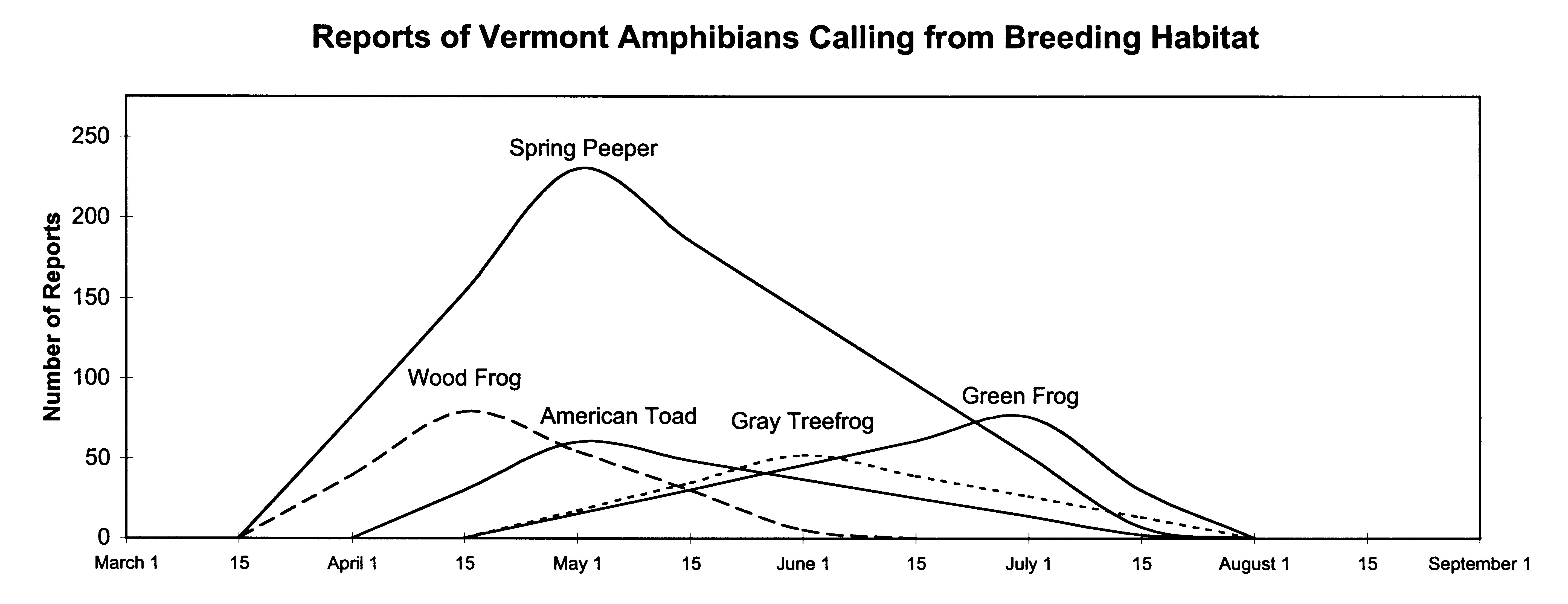
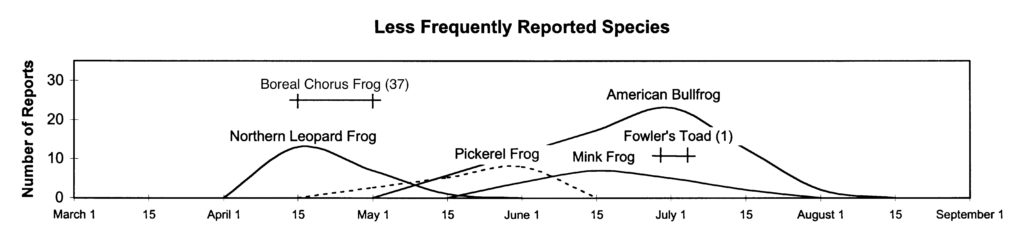
Source: Caitlin Corey and James S. Andrews 2001
June 13. The different frogs mark the seasons pretty well, – the peeping hyla, the dreaming frog, and the bullfrog. June 13, 1851
June 15.For some time I have not heard toads by day . . . The hylodes appear to have done . . . A thunder-shower in the north goes down the Merrimack. We have had warmer weather for several days, say since 12th. A new season begun . . . The bullfrogs now commonly trump at night, and the mosquitoes are now really troublesome. June 15, 1860
June 16. At 2 р . м . 85 ° and about same for several days past . I have heard no hylodes since the 12tth ,. . .It appears to me that these phenomena occur simultaneously, say June 12th :• Heat about. 85° at 2 P.M.• Hylodes cease to peep.• Purring frogs (Rana palustris) cease.• Lightning-bugs first seen.• Bullfrogs trump generally.• Mosquitoes begin to be really troublesome.• Afternoon thunder-showers almost regular.• Sleep with open window.• Turtles fairly and generally begun to lay.June 16, 1860
June 23. I see a young Rana sylvatica in the woods, only five eighths of an inch long. Or is it a hylode? – for I see a faint cross-like mark on the back and yet the black dash on the sides of the face. June 23, 1860
June 29. The frogs and tortoises are striped and spotted for their concealment. The painted tortoise's throat held up above the pads, streaked with yellowish, makes it the less obvious. The mud turtle is the color of the mud, the wood frog and the hylodes of the dead leaves, the bullfrogs of the pads, the toad of the earth. The tree-toad of the bark. June 29, 1852
July 8. To-day I heard a hylodes peep (perhaps a young one, which have so long been silent. July 8, 1853
August 10. I notice several of the hylodes hopping through the woods like wood frogs . . . They are probably common in the woods, but not noticed, on account of their size, or not distinguished from the wood frog. . .
One hylodes which I bring home has a perfect cross on its back, – except one arm of it. August 10, 1858
September 2. Now, after the first rain raising the river, the first assault on the summer's sluggishness, the air is of late cooler and clearer, autumnal, and the meadows and low grounds, which, of course, have been shorn, acquire a fresh yellowish green as in the spring. This is another phase of the second spring, of which the peeping of hylas by and by is another. September 2, 1859
September 9. I believe that I occasionally hear a hylodes within a day or two. September 9, 1852
October 2. Hear a hylodes in the swamp. October 2, 1859
October 3. I hear a hylodes (?) from time to time. October 3, 1852
October 14. Within a couple of rods a single hyla peeps interruptedly, bird-like. October 14, 1857
October 22. I hear a hyla. October 22, 1855
October 23. Many phenomena re- mind me that now is to some extent a second spring, - not only the new - springing and blossoming of flowers , but the peeping of the hylodes for some time, and the faint warbling of their spring notes by many birds . October 23, 1853
November 12. There is no sound of a frog from all these waters and meadows which a few months ago resounded so with them; not even a cricket or the sound of a mosquito.I can fancy that I hear the sound of peeping hylodes ringing in my ear, but it is all fancy. How short their year! How early they sleep! . . . The hylodes, as it is the first frog heard in the spring, so it is the last in the autumn. I heard it last, me thinks, about a month ago. November 12, 1853
November 23. The Indian summer itself, said to be more remarkable in this country than elsewhere, no less than the reblossoming of certain flowers, the peep of the hylodes, and sometimes the faint warble of some birds, is the reminiscence, or rather the return, of spring, the year renewing its youth. November 23, 1853
November 30. This has been a very pleasant month, with quite a number of Indian- summer days, a pleasanter month than October was. It is quite warm today, and as I go home at dusk on the railroad causeway, I hear a hylodes peeping. November 30, 1859
A long, slow dusk on the day before solstice— I did it, I did it, I did it: song of the pond frogs. Shrill piping of the cliff swallows, fluting of a vireo, Raspy song of the Bewick’s wren. So commotion In the trees! These evenings of long light Must be high festival to them. It’s the time When the light seems tender in the needles Of the pine, the shimmer of the aspen leaves Seems kindly on the cliff face, gleams On the patches and gullies of snow summer Hasn’t touched yet. And the creek is flush With life, streams of snow melt cascading down The glacial spills of granite in a turbulence The ouzel, picking off insects in the spray, Seems thrilled by, water on water funneling, Foam on foam, existence pouring out Its one meaning, which is flow. Up here, In the last light, the vireo’s warble declares, Repeats, falls silent. The swallows, soaring, Dipping. They must be feeding their young The insects they are gleaning from the pond. And the frogs: I did it, I did it, I did it Fall silent one by one as dark comes on.