Showing posts sorted by relevance for query glass eagle. Sort by date Show all posts

Thursday, March 13, 2014

Bought a telescope to-day.

March 13. 

Bought a telescope to-day for eight dollars. 

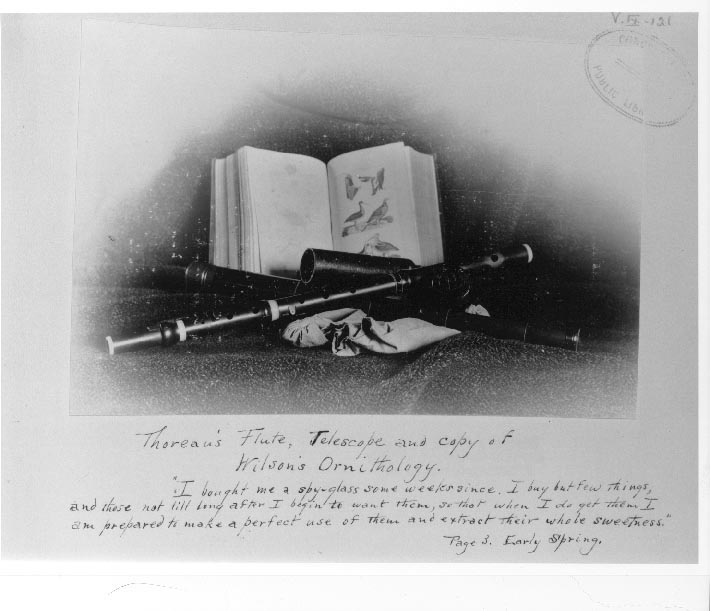
Thoreau's Flute, Telescope, and a Copy of Wilson's Ornithology
Alfred Winslow Hosmer 1851 - 1903, Photographer
(Concord Free Public Library)

Best military spy glass with six slides, which shuts up to about same size, fifteen dollars, and very powerful. Saw the squares of achromatic glass from Paris which Clark uses; fifty-odd dollars apiece, the larger. 

My glass tried by Clark and approved.  

C. was making a glass for Amherst College.

H. D. Thoreau, Journal, March 13, 1854


Bought a telescope to-day for eight dollars.
See April 10, 1854 ("I bought me a spy-glass some weeks since. I buy but few things, and those not till long after I begin to want them, so that when I do get them I am prepared to make a perfect use of them and extract their whole sweet"); April 23, 1854 ("I think I have got the worth of my glass now that it has revealed to me the white-headed eagle"); March 13, 1853 ("All enterprises must be self-supporting, must pay for themselves.")

See also March 14, 1854 (""Counted over forty robins with my glass in the meadow north of Sleepy Hollow , in the grass and on the snow ."); March 16, 1854 ("I see ducks afar , sailing on the meadow , leav- ing a long furrow in the water behind them . Watch them at leisure without scaring them , with my glass ; observe their free and undisturbed motions ."); March 21, 1854 ("River skimmed over at Willow Bay last night . Thought I should find ducks cornered up by the ice ; they get behind this hill for shelter . Saw what looked like clods of plowed meadow rising above the ice . Looked with glass and found it to be more than thirty black ducks asleep with their heads in [ sic ] their backs , motionless , and thin ice formed about them . "); March 22, 1854 ("Saw a small black duck with glass , — a dipper ( ? )"); April 2, 1854 ("Saw black ducks in water and on land . Can see their light throats a great way with my glass . They do not dive , but dip . "); April 3, 1854 ("April 3. Saw from window with glass seven ducks on meadow - water , only one or two conspicuously white , these , black heads , white throats and breasts and along sides , the rest of the ducks , brownish , probably young males and females . Probably the golden - eye . "); April 8, 1854 ("Saw a large bird sail along over the edge of Wheeler's cranberry meadow just below Fair Haven , which I at first thought a gull , but with my glass found it was a hawk and had a perfectly white head and tail and broad or blackish wings . It sailed and circled along over the low cliff , and the crows dived at it in the field of my glass , and I saw it well , both above and beneath , as it turned , and then it passed off to hover over the Cliffs at a greater height . It was undoubtedly a white- headed eagle . It was to the eye but a large hawk . "); April 23 1854 ("Saw my white - headed eagle again , first at the same place , the outlet of Fair Haven Pond . It was a fine sight , he is mainly — i . e . his wings and body black against the sky , and they contrast so strongly with his white head and tail . He was first flying low over the water ; then rose gradually and circled west- ward toward White Pond . Lying on the ground with my glass , I could watch him very easily , and by turns he gave me all possible views of himself . When I ob- served him edgewise I noticed that the tips of his wings curved upward slightly more , like a stereotyped the undulation . He rose very high at last , till I almost lost him in the clouds , circling or rather looping along west- е ward , high over river and wood and farm , effectually concealed in the sky . We who live this plodding life here below never know how many eagles fly over us . . . I Now I see him edgewise like a black ripple in the air , his white head still as ever turned to earth , and now he turns his under side to me , and I behold the full breadth of his broad black wings , some- what ragged at the edges . ") and Bill Uhrich: Thoreau a pioneer in watching rather than shooting birds

Alvan Clark of Cambridge Clark began to sell telescopes around 1850, and eventually became the premier telescope builder in the United States.

My glass tried by Clark and approved.
In this journal entry for March 13 Thoreau roughly describes what is known as the "star test," still used to evaluate telescopes today.~ Thoreau Society Bulletin
Only a part of the object ( ? ) glass available . Bring the edge of the diaphragm against middle of the light , and your nail on object glass in line with these shows what is cut off . Sometimes may enlarge the hole in diaphragm . But , if you do so , you may have to enlarge the hole in diaphragm near small end , which must be exactly as large as the pencil of light there . As the diameter of the pencil is to the diameter of the available portion of the object glass , so is the power , so many times it magnifies . A good glass because the form of the blurred object is the same on each side of the focus , i . e . , shoved in or drawn out . 

Sunday, March 29, 2026

A Book of the Seasons: The White-Headed Eagle


 I would make a chart of our life,
know why just this circle of creatures
completes the world.
Henry Thoreau,
April 18, 1852

White-headed eagle
edgewise like a black ripple
concealed in the sky.

We who live this plodding life here below
never know how many eagles fly over us.

March 29. Crows, by their swift flight and scolding, reveal to me some large bird of prey hovering over the river. I perceive by its markings and size that it cannot be a hen-hawk, and now it settles on the topmost branch of a white maple, bending it down. Its great armed and feathered legs dangle helplessly in the air for a moment, as if feeling for the perch, while its body is tipping this way and that. It sits there facing me some forty or fifty rods off, pluming itself but keeping a good lookout. At this distance and in this light, it appears to have a rusty-brown head and breast and is white beneath, with rusty leg feathers and a tail black beneath. When it flies again it is principally black varied with white, regular light spots on its tail and wings beneath, but chiefly a conspicuous white space on the forward part of the back; also some of the upper side of the tail or tail coverts is white. It has broad, ragged, buzzard-like wings, and from the white of its back, as well as the shape and shortness of its wings and its not having a gull-like body, I think it must be an eagle. It lets itself down with its legs somewhat helplessly dangling, as if feeling for something on the bare meadow, and then gradually flies away, soaring and circling higher and higher until lost in the downy clouds. This lofty soaring is at least a grand recreation, as if it were nourishing sublime ideas. I should like to know why it soars higher and higher so, whether its thoughts are really turned to earth, for it seems to be more nobly as well as highly employed than the laborers ditching in the meadow beneath or any others of my fellow townsmen. March 29, 1858

April 3. Returning, when off the hill am attracted by the noise of crows, which betray to me a very large hawk, large enough for an eagle, sitting on a maple beneath them. Now and then they dive at him, and at last he sails away low round the hill, as if hunting. April 3, 1855

April 6. As I am going along the Corner Road by the meadow mouse brook, hear and see, a quarter of a mile north west, on those conspicuous white oaks near the river in Hubbard’s second grove, the crows buffeting some intruder. The crows had betrayed to me some large bird of the hawk kind which they were buffeting. I suspected it before I looked carefully. I saw several crows on the oaks, and also what looked to my naked eye like a cluster of the palest and most withered oak  leaves with a black base about as big as a crow. Looking with my glass, I saw that it was a great bird. The crows sat about a rod off, higher up, while another crow was occasionally diving at him, and all were cawing. The great bird was just starting. It was chiefly a dirty white with great broad wings with black tips and black on other parts, giving it the appearance of dirty white, barred with black.  I am not sure whether it was a white-headed eagle or a fish hawk.  There appeared much more white than belongs to either, and more black than the fish hawk has. It rose and wheeled, flapping several times, till it got under way; then, with its rear to me, presenting the least surface, it moved off steadily in its orbit over the woods northwest, with the slightest possible undulation of its wings, — a noble planetary motion, like Saturn with its ring seen edgewise.  It is so rare that we see a large body self sustained in the air. While crows sat still and silent and confessed their lord.  Through my glass I saw the outlines of this sphere against the sky, trembling with life and power as it skimmed the topmost twigs of the wood toward some more solitary oak amid the meadows.  To my naked eye it showed only so much black as a crow in its talons might. Was it not the white-headed eagle in the state when it is called the sea eagle? Perhaps its neck-feathers were erected. April 6, 1856

April 8.  Saw a large bird sail along over the edge of Wheeler's cranberry meadow just below Fair Haven, which I at first thought a gull, but with my glass found it was a hawk and had a perfectly white head and tail and broad or blackish wings. It sailed and circled along over the low cliff, and the crows dived at it in the field of my glass, and I saw it well, both above and beneath, as it turned, and then it passed off to hover over the Cliffs at a greater height. It was undoubtedly a white-headed eagle. It was to the eye but a large hawk.   April 8, 1854

April 23. P. M. — To Lee's Cliff on foot. See my white-headed eagle again, first at the same place, the outlet of Fair Haven Pond. It is a fine sight, he is mainly — i.e. his wings and body — so black against the sky, and they contrast so strongly with his white head and tail. He first flies low over the water; then rises gradually and circles westward toward White Pond. Lying on the ground with my glass, I watch him very easily, and by turns he gives me all possible views of himself. Now I see him edgewise like a black ripple in the air, his white head still as ever turned to earth, and now he turns his under side to me, and I behold the full breadth of his broad black wings, some what ragged at the edges. 

When I observe him edgewise I notice that the tips of his wings curve upward slightly. He rises very high at last, till I almost lose him in the clouds, circling or rather looping along westward, high over river and wood and farm, effectually concealed in the sky. We who live this plodding life here below never know how many eagles fly over us. I think I have got the worth of my glass now that it has revealed to me the white-headed eagle.  April 23, 1854. [See March 13, 1854 ("Bought a telescope to-day for eight dollars.")]

July 26. The note of the white-throated sparrow, a very inspiriting but almost wiry sound, was the first heard in the morning, and with this all the woods rang. This was the prevailing bird in the northern part of Maine . . . We soon passed the island where I had camped four years before, and I recognized the very spot . . . As we were pushing away again, a white-headed eagle sailed over our heads.  The Maine Woods July 26, 1857

July 31.  Soon afterward a white-headed eagle sailed down the stream before us. We drove him several miles, while we were looking for a good place to camp, for we expected to be overtaken by a shower, — and still we could distinguish him by his white tail, sailing away from time to time from some tree by the shore still farther down the stream    The Maine Woods July 31, 1857

August 22. At Baker Farm a large bird rose up near us, which at first I took for a hen-hawk, but it appeared larger. It screamed the same, and finally soared higher and higher till it was almost lost amid the clouds, or could scarcely be distinguished except when it was seen against some white and glowing cumulus. I think it was at least half a mile high, or three quarters, and yet I distinctly heard it scream up there each time it came round, and with my glass saw its head steadily bent toward the ground, looking for its prey. Its head, seen in a proper light, was distinctly whitish, and I suspect it may have been a white headed eagle. It did not once flap its wings up there, as it circled and sailed, though I watched it for nearly a mile. How fit that these soaring birds should be haughty and fierce, not like doves to our race!   August 22, 1858

August 25. The approaching storm . . . came on rapidly, with vivid lightning striking the northern earth and heavy thunder following. Just before, and in the shadow of, the cloud, I saw, advancing majestically with wide circles over the meadowy flood, a fish hawk and, apparently, a black eagle (maybe a young white-head). The first, with slender curved wings and silvery breast, four or five hundred feet high, watching the water while he circled slowly southwesterly. What a vision that could detect a fish at that distance! The latter, with broad black wings and broad tail, thus: hovered only about one hundred feet high; evidently a different species, and what else but an eagle? They soon disappeared southwest, cutting off a bend. The thunder-shower passed off to the southeast. August 25, 1856

September 6 Saw, sailing over Mason Village about 10 A. M., a white-headed and white-tailed eagle with black wings, —  a grand sight. September 6, 1852

September 16. Now I see a large one perchance an eagle, I say to myself! – down in the valley, circling and circling, higher and wider. This way he comes. How beautiful does he repose on the air, in the moment when he is directly over you, and you see the form and texture of his wings! How light he must make himself, how much earthy heaviness expel, before he can thus soar and sail! September 16, 1852

October 26. My loftiest thought is somewhat like an eagle that suddenly comes into the field of view, suggesting great things and thrilling the beholder, as if it were bound hitherward with a message for me; but it comes no nearer, but circles and soars away, growing dimmer, disappointing me, till it is lost behind a cliff or a cloud.  October 26, 1857


A Book of the Seasons  by Henry Thoreau
"A book, each page written in its own season,
out-of-doors, in its own locality."
 ~edited, assembled and rewritten by zphx ©  2009-2026

Saturday, March 13, 2021

March 13. I hear the rapid tapping of the woodpecker over the water.

The year is but a succession of days,

and I see that I could assign some office to each day
which, summed up, would be the history of the year.
Henry Thoreau, August 24, 1852

 Journal, March 13, 1853:

But what was that familiar spring sound from the pine wood across the river, like some woodpecker, or possibly nuthatch? See March 5, 1859 ("Going down-town this forenoon, I heard a white-bellied nuthatch on an elm within twenty feet, uttering peculiar notes and more like a song than I remember to have heard from it.. . .It was something like to-what what what what what, rapidly repeated, and not the usual gnah gnah; and this instant it occurs to me that this may be that earliest spring note which I hear, and have referred to a woodpecker! (This is before I have chanced to see a bluebird, blackbird, or robin in Concord this year.) It is the spring note of the nuthatch")

Listening for early birds, I hear a faint tinkling sound in the leafless woods, as if a piece of glass rattled against a stone. See November 17, 1853 ("The notes of one or two small birds, this cold morning, in the now comparatively leafless woods, sound like a nail dropped on an anvil, or a glass pendant tinkling against its neighbor.")

Turn the surplus life of the soul into life for the body.
See May 10, 1853 ("If I am overflowing with life, rich in experience for which I lack expression, then nature will be my language full of poetry...")

The great art of life.
Get your living by loving,
by surplus of soul.


Journal, March 13, 1854:

Thoreau's Flute, Telescope, and a Copy of Wilson's Ornithology
Alfred Winslow Hosmer 1851 - 1903, Photographer
(Concord Free Public Library)


See April 10, 1854 ("I bought me a spy-glass some weeks since. I buy but few things, and those not till long after I begin to want them, so that when I do get them I am prepared to make a perfect use of them and extract their whole sweet"); April 23, 1854 ("I think I have got the worth of my glass now that it has revealed to me the white-headed eagle"). note 
Alvan Clark of Cambridge Clark began to sell telescopes around 1850, and eventually became the premier telescope builder in the United States. Thoreau visited him in March 1854 and took along his newly-purchased spyglass. Clark pronounced the instrument to be of good quality. In his journal entry for March 13 Thoreau  roughly described what is known as the "star test," still used to evaluate telescopes today.~ Thoreau Society Bulletin

Bring the edge of the diaphragm against middle of the light , and your nail on object glass in line with these shows what is cut off . Sometimes may enlarge the hole in diaphragm . But , if you do so , you may have to enlarge the hole in diaphragm near small end , which must be exactly as large as the pencil of light there . As the diameter of the pencil is to the diameter of the available portion of the object glass , so is the power , so many times it magnifies . A good glass because the form of the blurred object is the same on each side of the focus , i . e . , shoved in or drawn out . 

March 14, 1854 (""Counted over forty robins with my glass in the meadow north of Sleepy Hollow , in the grass and on the snow . ")
March 16, 1854 ("I see ducks afar , sailing on the meadow , leav- ing a long furrow in the water behind them . Watch them at leisure without scaring them , with my glass ; observe their free and undisturbed motions . ")

March 21, 1854 (" River skimmed over at Willow Bay last night . Thought I should find ducks cornered up by the ice ; they get behind this hill for shelter . Saw what looked like clods of plowed meadow rising above the ice . Looked with glass and found it to be more than thirty black ducks asleep with their heads in [ sic ] their backs , motionless , and thin ice formed about them . ")

March 22, 1854 ("Saw a small black duck with glass , — a dipper ( ? )")

April 2, 1854 ("Saw black ducks in water and on land . Can see their light throats a great way with my glass . They do not dive , but dip . ")

April 3, 1854 ("April 3. Saw from window with glass seven ducks on meadow - water , only one or two conspicuously white , these , black heads , white throats and breasts and along sides , the rest of the ducks , brownish , probably young males and females . Probably the golden - eye . ")

April 8, 1854  ("Saw a large bird sail along over the edge of Wheeler's cranberry meadow just below Fair Haven , which I at first thought a gull , but with my glass found it was a hawk and had a perfectly white head and tail and broad or blackish wings . It sailed and circled along over the low cliff , and the crows dived at it in the field of my glass , and I saw it well , both above and beneath , as it turned , and then it passed off to hover over the Cliffs at a greater height . It was undoubtedly a white- headed eagle . It was to the eye but a large hawk . ")

April 10. 1854 (" I bought me a spy - glass some weeks since . I buy but few things , and those not till long after I begin to want them , so that when I do get them I am prepared to make a perfect use of them and extract their whole sweet . ")

April 23 1854 ("Saw my white - headed eagle again , first at the same place , the outlet of Fair Haven Pond . It was a fine sight , he is mainly — i . e . his wings and body black against the sky , and they contrast so strongly with his white head and tail . He was first flying low over the water ; then rose gradually and circled west- ward toward White Pond . Lying on the ground with my glass , I could watch him very easily , and by turns he gave me all possible views of himself . When I ob- served him edgewise I noticed that the tips of his wings curved upward slightly more , like a stereotyped the un- dulation . He rose very high at last , till I almost lost him in the clouds , circling or rather looping along west- е ward , high over river and wood and farm , effectually concealed in the sky . We who live this plodding life here below never know how many eagles fly over us . . . I think I have got the worth of my glass now that it has revealed to me the white - headed eagle . Now I see him edgewise like a black ripple in the air , his white head still as ever turned to earth , and now he turns his under side to me , and I behold the full breadth of his broad black wings , some- what ragged at the edges . ")


 Journal, March 13, 1855:

I hear the rapid tapping of the woodpecker from over the water. See March 11, 1859 (“But methinks the sound of the woodpecker tapping is as much a spring note as any these mornings; it echoes peculiarly in the air of a spring morning.); March 15, 1854 ("I hear that peculiar, interesting loud hollow tapping of a woodpecker from over the water.”); March 18, 1853 ("The tapping of the woodpecker about this time.”); March 30, 1854 ("At the Island I see and hear this morning the cackle of a pigeon woodpecker at the hollow poplar; had heard him tapping distinctly from my boat's place."); April 14, 1856 ("Hear the flicker’s . . . tapping sounds afar over the water . It is a hollow sound which rings distinct to a great distance, especially over water.")


Journal, March 13, 1857:

This month has been windy and cold, a succession of snows one or two inches deep, soon going off, the spring birds all driven off. It is in strong contrast with the last month. See February 18, 1857 ("The snow is nearly all gone, and it is so warm and springlike that I walk over to the hill, listening for spring birds."); March 5, 1857 ("This and the last four or five days very gusty. Most of the warmth of the fire is carried off by the draught, which consumes the wood very fast, faster than a much colder but still day in winter.") See also March 15, 1853 ("I have not taken a more blustering walk this past winter than this afternoon."); March 28, 1854 ("Coldest day for a month or more, — severe as almost any in the winter."); March 28, 1855 ("I run about these cold and blustering days, on the whole perhaps the worst to bear in the year, . . . As for the singing of birds, — the few that have come to us, — it is too cold for them to sing and for me to hear. "); March 12, 1856 (" If the present cold should continue uninterrupted a thousand years would not the pond become solid?"); March 8, 1860 ("Nowadays we separate the warmth of the sun from the cold of the wind and observe that the cold does not pervade all places, but being due to strong northwest winds, if we get into some sunny and sheltered nook where they do not penetrate, we quite forget how cold it is elsewhere.")


Journal, March 13, 1859:

The bright catkins of the willow are the springing most generally observed.
 See March 2, 1859 ("Go and measure to what length the silvery willow catkins have crept out beyond their scales, if you would know what time o' the year it is by Nature's clock"); March 10, 1853 (“Methinks the first obvious evidence of spring is the pushing out of the swamp willow catkins"); March 20, 1858 (“How handsome the willow catkins! Those wonderfully bright silvery buttons, so regularly disposed in oval schools in the air, or, if you please, along the seams which their twigs make, in all degrees of forwardness, from the faintest, tiniest speck of silver, just peeping from beneath the black scales, to lusty pussies which have thrown off their scaly coats and show some redness at base on a close inspection.”) March 20, 1858 (“How handsome the willow catkins! Those wonderfully bright silvery buttons, so regularly disposed in oval schools in the air, or, if you please, along the seams which their twigs make, in all degrees of forwardness, from the faintest, tiniest speck of silver, just peeping from beneath the black scales, to lusty pussies which have thrown off their scaly coats and show some redness at base on a close inspection.”)

Garfield to-day said that mink brought three dollars and a quarter,
 See March 15, 1855 ("He [Farmer] sells about a hundred mink skins in a year. . . .He says (I think) a mink’s skin is worth two dollars!”)

The Hunt house, to draw from memory. See February 17, 1857 ("To the old Hunt house. . . .The rear part has a wholly oak frame, while the front is pine."); February 9, 1858 ("The stairs of the old back part are white pine or spruce, each the half of a square log; those of the cellar in front, oak, of the same form."); March 11, 1859 ("To Hunt house. I go to get one more sight of the old house which Hosmer is pulling down, but I am too late to see much of it.")


 Journal, March 13, 1860:

Quite overcast all day. See March 20, 1860 ("The 15th, 16th, 17th, 18th, and 19th were very pleasant and warm days, the thermometer standing at 50° 55° , 56° , 56°, and 51° (average 53 1/2°), - quite a spell of warm weather."); March 21, 1860 ("Colder and overcast. . . . probably not far from 40°") See also January 25, 1860 ("It may be warm or cold. Above 40° is warm for winter. . . .I will call the weather fair, if it does not threaten rain or snow or hail; foul, if it rains or snows or hails, or is so overcast that we expect one or the other from hour to hour.")

 March 13.


I hear the rapid
tapping of the woodpecker
over the water.

A Book of the Seasons, by Henry Thoreau
"A book, each page written in its own season,
out-of-doors, in its own locality.”
~edited, assembled and rewritten by zphx © 2009-2021

Wednesday, April 23, 2014

An eagle concealed, a ripple in the air.

April 23.

A kingfisher with his crack, — cr-r-r-rack. 

Rain yesterday and to-day; yet this morning the robin sings and the blackbirds and, in the yard, the tree sparrow, hyemalis, and song sparrow. A rain is sure to bring the tree sparrow and hyemalis to the gardens.

The first April showers are even fuller of promise and a certain moist serenity than the sunny days. How thickly the green blades are starting up amid the russet! The tinge of green is gradually increasing in the face of the russet earth.

April 23, 2022


P. M. — To Lee's Cliff on foot. See my white-headed eagle again, first at the same place, the outlet of Fair Haven Pond. It is a fine sight, he is mainly — i.e. his wings and body — so black against the sky, and they contrast so strongly with his white head and tail. He first flies low over the water; then rises gradually and circles westward toward White Pond. 

Lying on the ground with my glass, I watch him very easily, and by turns he gives me all possible views of himself. Now I see him edgewise like a black ripple in the air, his white head still as ever turned to earth, and now he turns his under side to me, and I behold the full breadth of his broad black wings, some what ragged at the edges. 


When I observe him edgewise I notice that the tips of his wings curve upward slightly.

He rises very high at last, till I almost lose him in the clouds, circling or rather looping along westward, high over river and wood and farm, effectually concealed in the sky. We who live this plodding life here below never know how many eagles fly over us.

I think I have got the worth of my glass now that it has revealed to me the white-headed eagle.

H. D. Thoreau, Journal, April 23, 1854

A kingfisher with his crack, — cr-r-r-rack.
See April 24, 1854 ("The kingfisher flies with a crack cr-r-r-ack and a limping or flitting flight from tree to tree before us, and finally, after a third of a mile, circles round to our rear. He sits rather low over the water. Now that he has come I suppose that the fishes on which he preys rise within reach.") See also A Book of the Seasons, by Henry Thoreau. The Kingfisher

Rain yesterday and to-day . . . and, in the yard, the tree sparrow, hyemalis, and song sparrow. A rain is sure to bring the tree sparrow and hyemalis to the gardens. See April 23, 1859 (" Rain, rain.. . .The tree sparrows abundant and singing in the yard, but I have not noticed a hyemalis of late. The field sparrow sings in our yard in the rain") See also A Book of the Seasons by Henry Thoreau, Birds in the Rain

The tinge of green is gradually increasing in the face of the russet earth. See April 14, 1854 ("There is a general tinge of green now discernible through the russet on the bared meadows and the hills, the green blades just peeping forth amid the withered ones."); April 28, 1854 ("Perhaps the greenness of the landscape may be said to begin fairly now . . . During the last half of April the earth acquires a distinct tinge of green, which finally prevails over the russet."). See also A Book of the Seasons, by Henry Thoreau, the Colors of March-- Brown Season

The white-headed eagle.  See April 8, 1854  (“A perfectly white head and tail and broad or blackish wings. It sailed and circled along over the low cliff, and the crows dived at it in the field of my glass, and I saw it well.”) See also A Book of the Seasons, by Henry Thoreau, The White-headed Eagle

The worth of my glass. See March 13, 1854 ("Bought a telescope to-day for eight dollars.")

April 23.
See A Book of the Seasons, by Henry Thoreau, April 23

White-headed eagle
edgewise like a black ripple
concealed in the sky.

A Book of the Seasons,  by Henry Thoreau, 
 "A book, each page written in its own season,
out-of-doors, in its own locality."
 ~edited, assembled and rewritten by zphx ©  2009-2024
tinyurl.com/hdt-540423

Tuesday, April 8, 2014

A white-headed eagle

April 8

Methinks I do not see such great and lively flocks of hyemalis and tree sparrows in the morning since the warm days, the 4th, 5th, and 6th. Perchance after the warmer days, which bring out the frogs and butterflies, the alders and maples, the greater part of them leave for the north and give place to newcomers.

Am surprised to find two crowfoot blossoms withered. They undoubtedly opened the 5th or 6th; say the last. They must be earlier here than at the Cliffs, where I have observed them the last two years. 

They are a little earlier than the saxifrage around them here, of which last I find one specimen at last, in a favorable angle of the rock, just opening. I have not allowed enough for the difference of localities.

The columbine shows the most spring growth of any plant.

Saw a large bird sail along over the edge of Wheeler's cranberry meadow just below Fair Haven, which I at first thought a gull, but with my glass found it was a hawk and had a perfectly white head and tail and broad or blackish wings. It sailed and circled along over the low cliff, and the crows dived at it in the field of my glass, and I saw it well, both above and beneath, as it turned, and then it passed off to hover over the Cliffs at a greater height. It was undoubtedly a white-headed eagle. It was to the eye but a large hawk.

H. D. Thoreau, Journal, April 8, 1854

The warmer days, which bring out the frogs and butterflies
. See April 5, 1854 ("These days, when a soft west or southwest wind blows and it is truly warm, and an outside coat is oppressive, — these bring out the butterflies and the frogs, and the marsh hawks which prey on the last. Just so simple is every year. ")

Lively flocks of hyemalis and tree sparrows. See March 23, 1854 ("The birds in yard active now, — hyemalis, tree sparrow, and song sparrow. The hyemalis jingle easily distinguished. "): March 24, 1854 ("Great flocks of hyemalis drifting about with their jingling note"); March 30, 1854 ("Great flocks of tree sparrows and some F. hyemalis on the ground and trees on the Island Neck, making the air and bushes ring with their jingling. March 30, 1854"); April 1, 1854 ("The tree sparrows, hyemalis, and song sparrows are particularly lively and musical in the yard this rainy and truly April day. The air rings with them. ");April 2, 1854 ("The tree sparrows make the alders, etc. ring. They have a metallic chirp and a short canary- like warble . They keep company with the hyemalis.") See also A Book of the Seasons, by Henry Thoreau: Signs of the Spring, the note of the dark-eyed junco going northwardA Book of the Seasons by Henry Thoreau, the Dark-eyed Junco (Fringilla hyemalis); A Book of the Seasons, by Henry Thoreau, the Tree Sparrow

Am surprised to find two crowfoot blossoms withered. . . They must be earlier here than at the Cliffs, . . . They are a little earlier than the saxifrage around them here.  See April 8, 1856 ("On the Fair Haven Cliff, crowfoot and saxifrage are very backward");   April 3, 1853 ("To my great surprise the saxifrage is in bloom. It was, as it were, by mere accident that I found it. I had not observed any particular forwardness in it, when, happening to look under a projecting rock in a little nook on the south side of a stump, I spied one little plant which had opened three or four blossoms high up the Cliff.") April 10, 1853 ("Two crowfoots out on the Cliff. A very warm and dry exposure but no further sheltered were they. Pale yellow offering of spring. The saxifrage is beginning to be abundant, elevating its flowers somewhat, pure, trustful, white amid its pretty notched and reddish cup of leaves . The white saxifrage is a response from earth to the increased light of the year; the yellow crowfoot to the increased heat of the sun");   April 13, 1854 ("The saxifrage is pretty common, ahead of the crowfoot now, and its peduncles have shot up.");   April 23, 1854 (Crowfoot is not yet abundant , though it was earlier than saxifrage, which has now gone ahead"") and  A Book of the Seasons, by Henry Thoreau, the Crowfoot (Ranunculus fascicularis)A Book of the Seasons,  by Henry Thoreau, Saxifrage in Spring (Saxifraga vernalis)

The columbine shows the most spring growth of any plant.  See  April 8, 1855 ("The columbine leaves in the clefts of Cliffs are one of the very earliest obvious growths. I noticed it the first of April.");  April 1, 1855 ("At the first Conantum Cliff I am surprised to see how much the columbine leaves have grown in a sheltered cleft")

A white-headed eagle. See March 13, 1854 ("Bought a telescope to-day for eight dollars"); April 10, 1854 ("I bought me a spy-glass some weeks since. I buy but few things, and those not till long after I begin to want them, so that when I do get them I am prepared to make a perfect use of them and extract their whole sweet"); April 23, 1854 (" Saw my white - headed eagle again , first at the same place. . .We who live this plodding life here below never know how many eagles fly over us"); April 23, 1854 ("I think I have got the worth of my glass now that it has revealed to me the white-headed eagle");  See also April 6, 1856 (" Looking with my glass, I saw that it was a great bird.. . . I am not sure whether it was a white-headed eagle or a fish hawk. . . . then, with its rear to me, presenting the least surface, it moved off steadily in its orbit over the woods northwest, with the slightest possible undulation of its wings, — a noble planetary motion, like Saturn with its ring seen edgewise.") and A Book of the Seasons, by Henry Thoreau, The White-headed Eagle

Thursday, April 10, 2014

The crimson stigmas of the white maple

April 10.

April rain. How sure a rain is to bring the tree sparrows into the yard, to sing sweetly, canary-like! 

I bought me a spy-glass some weeks since. I buy but few things, and those not till long after I begin to want them, so that when I do get them I am prepared to make a perfect use of them and extract their whole sweet. 

P. M. — To Great Meadows by boat, and sail back. There are many snipes now feeding in the meadows, which you come close upon, and then they go off with hoarse cr-r-r-ack cr-r-r-ack. They dive down suddenly from a considerable height sometimes when they alight. 

A great many red-wings along the water's edge in the meadow. Some of these blackbirds quite black, and some apparently larger than the rest. Are they all red-wings? 

The crimson stigmas, like the hazel, of the white maple, generally by themselves, make handsome show.

H. D. Thoreau, Journal, April 10, 1854

How sure a rain is to bring the tree sparrows into the yard, to sing sweetly.
See April 1, 1854 ("The tree sparrows, hyemalis, and song sparrows are particularly lively and musical in the yard this rainy and truly April day. The air rings with them."); April 23, 1854 ("A rain is sure to bring the tree sparrow and hyemalis to the gardens.") See also A Book of the Seasons, by Henry Thoreau, the Tree Sparrow

I bought me a spy-glass some weeks since.
See October 20, 1852 ("Many a man, when I tell him that I have been on to a mountain, asks if I took a glass with me. No doubt, I could have . . . counted more meeting-houses; but this has nothing to do with the peculiar beauty and grandeur of the view which an elevated position affords."); March 29, 1853 ("Would it not be well to carry a spy-glass in order to watch these shy birds such as ducks and hawks? In some respects, methinks it would be better than a gun. The latter brings them nearer dead, but the former alive. You can identify the species better by killing the bird, because it was a dead specimen that was so minutely described, but you can study the habits and appearance best in the living specimen"); March 13, 1854 ("Bought a telescope to-day for eight dollars. Best military spy glass with six slides, which shuts up to about same size, fifteen dollars, and very powerful."); March 16, 1854 ("I see ducks afar, sailing on the meadow, leaving a long furrow in the water behind them. Watch them at leisure without scaring them, with my glass; observe their free and undisturbed motions. "); April 8, 1854 (“ It sailed and circled along over the low cliff, and the crows dived at it in the field of my glass, and I saw it well . . . undoubtedly a white-headed eagle”); April 23, 1854 ("I think I have got the worth of my glass now that it has revealed to me the white-headed eagle").

There are many snipes now feeding in the meadows.
See April 18, 1854 ("Scared up snipes on the meadow's edge, which go off with their strange zigzag, crazy flight and a distressed sound, — craik craik or cr-r-ack cr-r-rack. One booms now at 3 p. m. They circle round and round, and zig zag high over the meadow, and finally alight again, descending abruptly from that height.") See also A Book of the Seasons, by Henry Thoreau: the Snipe

The crimson stigmas of the white maple make handsome show.
See March 29, 1853 ("The female flowers of the white maple, crimson stigmas from the same rounded masses of buds with the male, are now quite abundant. . . . The two sorts of flowers are not only on the same tree and the same twig and sometimes in the same bud, but also sometimes in the same little cup."); April 6, 1854 ("I am surprised to find so much of the white maples already out. "); April 8, 1855 ("The crimson female stigmas also peeping forth"); April 10, 1855 ("Early on the morning of the 8th I paddled up the' Assabet looking for the first flowers of the white maple and alder. I held on to the low curving twigs of the maple where the stream ran swiftly, the round clusters of its bursting flower-buds spotting the sky above me, and on a close inspection found a few which (as I have said) must have blossomed the day before. ") See also A Book of the Seasons, by Henry Thoreau, White Maple Buds and Flowers

The crimson stigmas
of the white maple, themselves,
make a handsome show.

A Book of the Seasons, by Henry Thoreau
"A book, each page written in its own season,
out-of-doors, in its own locality."
~edited, assembled and rewritten by zphx © 2009-2024
https://tinyurl.com/hdt-540410

Wednesday, April 6, 2016

Reflecting water alternating with unreflecting ice.

April 6

7 A. M. — To Willow [Lily] Bay. 

The meadow has frozen over, skimmed over in the night. The ducks must have had a cold night of it. 

I thought I heard white-bellied swallows over the house before I arose. 

The hedges resound with the song of the song sparrow. He sits high on a spray singing, While I stand near, but suddenly, becoming alarmed, drops down and skulks behind the bushes close to the ground, gradually removing far to one side. 

 What a sly, skulking fellow! I have a glimpse of him skulking behind a stone or a bush next to the ground, or perhaps he drops into a ditch just before me, and when I run forward he is not to be seen in it, having flitted down it four or five rods to where it intersected with another, and then up that, all beneath the level of the surface, till he is in the rear of me. 

Just beyond Wood’s Bridge, I hear the pewee. With What confidence after the lapse of many months, I come out to this waterside, some warm and pleasant spring morning, and, listening, hear, from farther or nearer, through the still concave of the air, the note of the first pewee! If there is one within half a mile, it will be here, and I shall be sure to hear its simple notes from those trees, borne over the water. 

It is remarkable how large a mansion of the air you can explore with your ears in the still morning by the waterside. 

I can dig in the garden now, where the snow is gone, and even under six inches of snow and ice I make out to get through the frost with a spade. The frost will all be out about as soon as last year, for the melting of the snow has been taking it out. It is remarkable how rapidly the ground dries, for where the frost is out the water does not stand, but is soaked up.

There has been no skating the last winter, the snow having covered the ice immediately after it formed and not melting, and the river not rising till April, when it was too warm to freeze thick enough. 

As we sat yesterday under the warm, dry hillside, amid the F. hyemalis by Tarbell’s, I noticed the first bluish haze—a small patch of it—over the true Nut Meadow, seen against the further blue pine forest over the near low yellow one. This was of course the subtle vapor which the warmth of the day raised from Nut Meadow. This, while a large part of the landscape was covered with snow, an affecting announcement of the approach of summer. 

The one wood seemed but an underwood on the edge of the other, yet all Nut Meadow’s varied surface intervened, with its brook and its cranberries, its sweet gale, alder, and willow, and this was its blue feather! 

P. M. — To Hubbard’s second grove, by river. 

At Ivy Tree, hear the fine tseep of a sparrow, and detect the fox-colored sparrow on the lower twigs of the willows and from time to time scratching the ground beneath. It is quite tame,—a single one with its ashy head and mottled breast. 

It is a still and warm, overcast afternoon, and I am come to look for ducks on the smooth reflecting water which has suddenly surrounded the village, — water half covered with ice or icy snow. 

April 6, 2019

On the 2d it was a winter landscape, —a narrow river covered thick with ice for the most part, and only snow on the meadows. In three or four days the scene is changed to these vernal lakes, and the ground more than half bare. The reflecting water alternating with unreflecting ice. 

Apparently song sparrows may have the dark splash on each side of the throat but be more or less brown on the breast and head. Some are quite light, some quite dark. Here is one of the light—breasted on the top of an apple tree, sings unweariedly at regular intervals something like ichulp I chili chili, chili chili, (faster and faster) chili chili, chili chili I iuller ichay ier splay-ee. The last, or third, bar I am not sure about. It flew too soon for me. I only remember that the last part was sprinkled on the air like drops from a rill, as if its strain were moulded by the spray it sat upon.

Now see considerable flocks of robins hopping and running in the meadows; crows next the water-edge, on small isles in the meadow. 

As I am going along the Corner Road by the meadow mouse brook, hear and see, a quarter of a mile north west, on those conspicuous white oaks near the river in Hubbard’s second grove, the crows buffeting some intruder. The crows had betrayed to me some large bird of the hawk kind which they were buffeting. I suspected it before I looked carefully. I saw several crows on the oaks, and also what looked to my naked eye like a cluster of the palest and most withered oak  leaves with a black base about as big as a crow.

 Looking with my glass, I saw that it was a great bird.

The crows sat about a rod off, higher up, while another crow was occasionally diving at him, and all were cawing. The great bird was just starting. 

It was chiefly a dirty white with great broad wings with black tips and black on other parts, giving it the appearance of dirty white, barred with black.

I am not sure whether it was a white-headed eagle or a fish hawk.  There appeared much more white than belongs to either, and more blackthan the fish hawk has. 

It rose and wheeled, flapping several times, till it got under way; then, with its rear to me, presenting the least surface, it moved off steadily in its orbit over the woods northwest, with the slightest possible undulation of its wings, — a noble planetary motion, like Saturn with its ring seen edgewise. 

It is so rare that we see a large body self sustained in the air. While crows sat still and silent and confessed their lord. 

Through my glass I saw the outlines of this sphere against the sky, trembling with life and power as it skimmed the topmost twigs of the wood toward some more solitary oak amid the meadows. 

To my naked eye it showed only so much black as a crow in its talons might. Was it not the white-headed eagle in the state when it is called the sea eagle? Perhaps its neck-feathers were erected. 

I went to the oaks. Heard there a nuthatch’s faint vibrating tut-tut, somewhat even like croaking of frogs, as it made its way up the oak bark and turned head down to peck. Anon it answered its mate with a gnah gnah

Smelt a skunk on my return, at Hubbard’s blueberry swamp, which some dogs that had been barking there for half an hour had probably worried, for I did not smell it when I went along first. I smelt this all the way thence home, the wind being southwest, and it was quite as perceptible in our yard as at the swamp. The family had already noticed it, and you might have supposed that there was a skunk in the yard, yet it was three quarters of a mile off, at least.

H. D. Thoreau, Journal, April 6, 1856

The hedges resound with the song of the song sparrow. See April 3, 1856 ("Hear the sprayey tinkle of the song sparrow along the hedges."); April 6, 1855 ("The banks of the river are alive with song sparrows . . . they have come to enliven the bare twigs before the buds show any signs of starting. ") See also A Book of Seasons, by Henry Thoreau,  the Song Sparrow (Fringilla melodia)

 Just beyond Wood’s Bridge, I hear the pewee. If there is one within half a mile, it will be here, and I shall be sure to hear its simple notes from those trees, borne over the water.  See April 1, 1859 ("At the Pokelogan up the Assabet, I see my first phoebe, the mild bird. It flirts its tail and sings pre vit, pre vit, pre vit, pre vit incessantly, as it sits over the water, and then at last, rising on the last syllable, says pre-VEE, as if insisting on that with peculiar emphasis"); April 7, 1856 ("At the Hubbard Bridge, we hear the incessant note of the phoebe,— pevet, pe-e-vet, pevee’, —its innocent, somewhat impatient call."). See also A Book of Seasons, by Henry Thoreau, the Eastern Phoebe and A Book of the Seasons,  by Henry Thoreau, the Arrival of the Phoebe in Early Spring

There has been no skating the last winter, the snow having covered the ice immediately after it formed. See March 27, 1856 ("People do not remember when there was so much old snow on the ground at this date."); also Donald Sutherland, The Long, Hard Winter of 1855-56 ("The Winter of 1855-56 was the coldest winter of the 1850s."); Compare January 31, 1855 (“An unprecedented expanse of ice. At 10 A. M., skated up the river to explore further than I had been.”) and A Book of the Seasons,  by Henry Thoreau, The Winter of Skating

I noticed the first bluish haze . . . an affecting announcement of the approach of summer . . . its blue feather! See March 5, 1855 ("This blue haze, and the russet earth seen through it, remind me that a new season has come.");  April 16, 1855 ("At sunset, the mountains, after this our warmest day as yet, had got a peculiar soft mantle of blue haze, pale blue as a blue heron, ushering in the long series of summer sunsets."); June 2, 1854 ("The air has now begun to be filled with a bluish haze.")

Hear the fine tseep of a sparrow, and detect the fox-colored sparrow . . .  with its ashy head and mottled breast. See  April 4, 1855  ("Their clear, fox colored backs are very handsome. I get quite near to them."); April 6, 1859 ("The sparrows love to flit along any thick hedge . . . Tree sparrows, F. hyemalis, and fox-colored sparrows in company.") See also  A Book of the Seasons,  by Henry Thoreau, the Fox-colored Sparrow.

Now see considerable flocks of robins hopping and running in the meadows. See March 28, 1853 ("I do not now think of a bird that hops so distinctly, rapidly, and commonly as the robin, with its head up. "); April 3, 1856 ("I see small flocks of robins running on the bared portions of the meadow.")

Looking with my glass, I saw that it was a great bird. See April 23, 1854 ("We who live this plodding life here below never know how many eagles fly over us”); April 3, 1855 ("Returning, when off the hill am attracted by the noise of crows, which betray to me a very large hawk, large enough for an eagle, sitting on a maple beneath them. Now and then they dive at him, and at last he sails away low round the hill, as if hunting. "); April 8, 1854 (“A perfectly white head and tail and broad or blackish wings. It sailed and circled along over the low cliff, and the crows dived at it in the field of my glass, and I saw it well, both above and beneath, as it turned, and then it passed off to hover over the Cliffs at a greater height. It was undoubtedly a white-headed eagle.”) See also A Book of the Seasons, by Henry Thoreau, The White-headed Eagle

Smelt a skunk on my return. See April 18, 1852 ("Why should just these sights and sounds accompany our life? Why should I hear the chattering of black-birds, why smell the skunk each year?") See also A Book of the Seasons,  by Henry Thoreau, The Skunk

April 6. See A Book of the Seasons, by Henry Thoreau, April 6

The first bluish haze,
subtle vapor, blue feather
of approaching summer.

A Book of the Seasons  by Henry Thoreau, 

A Book of the Seasons,   by Henry Thoreau
"A book, each page written in its own season,
out-of-doors, in its own locality."
 ~edited, assembled and rewritten by zphx ©  2009-2026

https://tinyurl.com/hdt-560406
Popular Posts Last 30 Days.

The week ahead in Henry’s journal

The week ahead in Henry’s journal
A journal, a book that shall contain a record of all your joy.
"A stone fruit. Each one yields me a thought." ~ H. D. Thoreau, March 28, 1859


I sit on this rock
wrestling with the melody
that possesses me.